

| Number of abdominal quadrants | 4 (Right Upper, Left Upper, Right Lower, Left Lower) |
| Most common cause of acute abdominal pain in adults | Nonspecific abdominal pain (no clear diagnosis after initial workup) (BMJ Clinical Evidence) |
| Appendix location | Right lower quadrant |
| When to call 911 | Sudden severe pain, rigid abdomen, signs of shock, or pain with bloody stool |
| Organs in right upper quadrant | Liver, gallbladder, part of the pancreas, right kidney |
| Organs in left lower quadrant | Descending and sigmoid colon, left ovary and fallopian tube |
How Clinicians Map Abdominal Pain
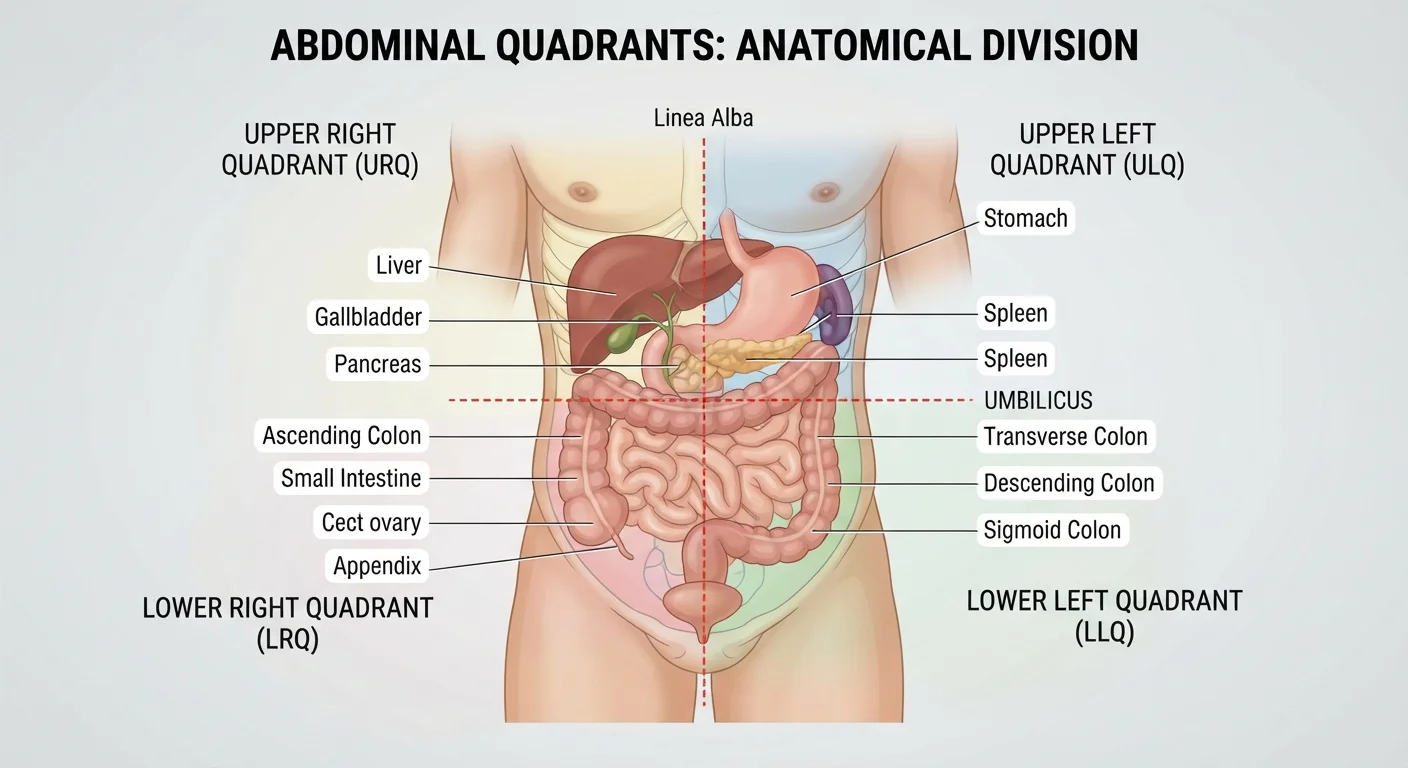
Clinicians divide the abdomen into four quadrants — right upper (RUQ), left upper (LUQ), right lower (RLQ), and left lower (LLQ) — or into nine regions for more precise localization. Knowing which quadrant your pain falls in narrows the list of possible organs involved and helps guide the clinical conversation.
| Number of abdominal quadrants | 4 (Right Upper, Left Upper, Right Lower, Left Lower) |
| Most common cause of acute abdominal pain in adults | Nonspecific abdominal pain (no clear diagnosis after initial workup) (BMJ Clinical Evidence) |
| Appendix location | Right lower quadrant |
| When to call 911 | Sudden severe pain, rigid abdomen, signs of shock, or pain with bloody stool |
| Organs in right upper quadrant | Liver, gallbladder, part of the pancreas, right kidney |
| Organs in left lower quadrant | Descending and sigmoid colon, left ovary and fallopian tube |
It is important to remember that pain can be visceral (arising from an organ itself) or referred — felt somewhere other than its true source. A classic example is gallbladder pain that radiates to the right shoulder. These concepts, defined below, explain why abdominal diagnosis requires more than location alone.
Peritoneum
The thin tissue layer lining the inner wall of the abdomen and covering most abdominal organs. Inflammation of this lining, called peritonitis, is a medical emergency.
Referred pain
Pain felt at a location other than where it originates. For example, a problem in the diaphragm may be felt as shoulder pain.
Visceral pain
Dull, crampy, or colicky pain arising from internal organs. It is often difficult to localize precisely, unlike sharp surface-level pain.
Rebound tenderness
Pain that worsens when pressure on the abdomen is suddenly released. It can signal peritoneal irritation and warrants prompt medical evaluation.
Hernia
A condition where an organ or fatty tissue pushes through a weak spot in the surrounding muscle or connective tissue, sometimes causing localized pain or a visible bulge.
Diverticulitis
Inflammation or infection of small pouches (diverticula) that can form in the lining of the digestive tract, most commonly in the lower left colon.
Right Upper Quadrant: Liver, Gallbladder, and More
Pain in the right upper quadrant frequently involves the liver or gallbladder. Common causes include:
- Gallstones or cholecystitis: Steady, intense pain — often after a fatty meal — that may radiate to the right shoulder or back.
- Hepatitis: A dull ache or pressure under the right rib cage, sometimes with jaundice or fatigue.
- Peptic ulcer disease: Burning pain that may localize here, particularly if the duodenum is affected.
- Right-sided kidney stones or infection: Flank pain that can wrap around to the front of the RUQ.
Less commonly, pneumonia affecting the lower right lung can cause RUQ discomfort — a reminder that not all abdominal pain originates inside the abdomen. For pain that also travels upward toward the chest, see our guide to non-cardiac chest pain.
Left Upper Quadrant: Stomach, Spleen, and Pancreas
The left upper quadrant houses the stomach, spleen, tail of the pancreas, and left kidney. Pain here may suggest:
- Gastritis or peptic ulcer: Burning or gnawing pain, often worse on an empty stomach or relieved temporarily by eating.
- Pancreatitis: A deep, boring pain that typically radiates straight through to the back; often associated with nausea and vomiting.
- Splenomegaly (enlarged spleen): A dull fullness or ache under the left ribs, sometimes following a viral infection such as mononucleosis.
- Left kidney pathology: Similar to the right side — stones or infection produce flank pain that can radiate forward.
This Guide Is Informational, Not Diagnostic
Mapping pain to a location can help you communicate with your healthcare provider, but it cannot replace clinical evaluation. Many conditions share overlapping symptoms, and organs can refer pain to unexpected areas. Always consult a qualified healthcare professional for any abdominal pain that is severe, persistent, or accompanied by other concerning symptoms.
Lower Quadrants: Intestines, Appendix, and Pelvic Organs
The lower abdomen contains much of the large intestine, the appendix (on the right), and — depending on sex — pelvic reproductive organs.
Right Lower Quadrant
- Appendicitis: Classically begins as central or periumbilical pain that migrates to the RLQ; often accompanied by fever, nausea, and rebound tenderness.
- Inguinal hernia: A localized ache or bulge in the lower right groin area.
- Ovarian cyst or ectopic pregnancy (right side): Sharp or cramping pain in people with ovaries; ectopic pregnancy is a medical emergency.
Left Lower Quadrant
- Diverticulitis: Crampy pain in the LLQ is the hallmark presentation; may include fever and changes in bowel habits.
- Irritable bowel syndrome (IBS): Diffuse cramping that often concentrates in the lower left; relieved by a bowel movement.
- Left ovarian pathology: Mirrors the causes listed for the right side.
~10%
Emergency visits attributed to abdominal pain
Abdominal pain accounts for approximately 10% of all emergency department visits in the United States, making it one of the most common presenting complaints.
1 in 15
Lifetime risk of appendicitis
According to estimates in surgical literature, approximately 1 in 15 people will develop appendicitis at some point in their lives.
Central or periumbilical pain can indicate early appendicitis, small bowel obstruction, or mesenteric ischemia — a serious reduction in blood supply to the intestines. Sudden, severe central pain warrants urgent evaluation.
When Abdominal Pain Requires Immediate Attention
Certain features of abdominal pain are red flags that require prompt or emergency care — do not wait for symptoms to resolve on their own if any of the following are present:
- Sudden, severe, or "worst pain of your life" onset
- Rigid or board-like abdomen
- Pain accompanied by signs of shock: rapid heartbeat, low blood pressure, fainting, or pale clammy skin
- Bloody stool, vomiting blood, or black tarry stools
- High fever with abdominal tenderness
- Abdominal pain during pregnancy at any stage
For those with chronic abdominal concerns — including conditions linked to excess visceral fat — understanding the broader context of abdominal health matters. Abdominal obesity carries distinct health risks that extend beyond discomfort and are worth discussing with a physician.
This article is for informational purposes only and does not constitute medical advice, diagnosis, or treatment. Always consult a qualified healthcare professional regarding any abdominal symptoms or health concerns.