
Waist-to-Height Ratio and WHR: What These Calculators Tell You About Metabolic Risk

Key Takeaways
- Waist-to-height ratio and waist-to-hip ratio measure fat distribution, not total body fat.
- A WHtR above 0.5 is broadly associated with elevated metabolic risk in adults.
- WHR thresholds differ by sex: above 0.90 for men and 0.85 for women signals higher risk, per WHO guidelines.
- These calculators complement — but do not replace — BMI or clinical assessment.
- Measurement technique matters: small errors in waist measurement can shift your ratio meaningfully.
- Always discuss results with a healthcare provider before making decisions about diet, exercise, or treatment.
Waist-to-Height Ratio & WHR
Waist-to-height ratio (WHtR) compares your waist circumference to your total height, while waist-to-hip ratio (WHR) compares your waist to your hip circumference. Both are screening tools used to estimate how much fat is stored around the abdomen — a zone linked to metabolic and cardiovascular health risks. Unlike body weight or BMI, these ratios account for where fat is distributed, not just how much exists.
Abdominal adiposity, particularly visceral fat surrounding internal organs, is an independent risk factor for type 2 diabetes, hypertension, and cardiovascular disease — risks that waist-based ratios are specifically designed to flag.
Why Waist Measurements Matter Beyond the Scale
Body weight and BMI measure total mass but say nothing about where that mass is located. Fat stored in the abdomen — particularly visceral fat that surrounds internal organs — carries different health implications than fat stored in the hips, thighs, or arms. Waist-based measurements were developed specifically to capture this distinction.
Research has consistently shown that central adiposity is independently associated with elevated risk of type 2 diabetes, cardiovascular disease, hypertension, and metabolic syndrome — even in individuals whose BMI falls within a normal range. This is why clinicians and health researchers have turned to waist circumference ratios as practical screening additions. For a broader look at how these tools fit alongside other measurements, see health calculators every adult should know about.
0.5
WHtR threshold linked to elevated metabolic risk
Multiple large-scale studies identify a waist-to-height ratio of 0.5 or above as a consistent marker for increased cardiometabolic risk across adult populations.
0.90 / 0.85
WHR high-risk cut-offs (men / women)
The World Health Organization defines high-risk waist-to-hip ratio as above 0.90 for men and above 0.85 for women based on population health data.
~3x
Greater diabetes risk with high central adiposity
Research published in peer-reviewed endocrinology literature has found that individuals with high visceral fat accumulation may face substantially higher odds of developing type 2 diabetes compared to those with low abdominal fat.
How Each Calculator Works
Waist-to-Height Ratio (WHtR)
This calculation is straightforward: divide your waist circumference by your height, both in the same unit (inches or centimeters). A person who is 68 inches tall with a 36-inch waist has a WHtR of approximately 0.53. The appeal of WHtR is that height acts as a built-in normalizer — it adjusts expectations proportionally across taller and shorter individuals without requiring separate population tables.
The widely cited "keep your waist to less than half your height" rule of thumb translates directly from this formula: a WHtR below 0.5 is the general low-risk target for most adults.
Waist-to-Hip Ratio (WHR)
WHR divides waist circumference by hip circumference. Because hip measurement is included, this ratio captures body shape more than size — distinguishing android (apple-shaped, abdominal) fat distribution from gynoid (pear-shaped, peripheral) distribution. The WHO identifies high-risk thresholds as WHR above 0.90 for men and above 0.85 for women.
Both metrics use simple inputs, but they answer slightly different questions. WHtR is particularly useful as a size-adjusted single screening number; WHR is valuable for assessing body shape pattern. Using both together provides a more complete picture than either alone — and more still when combined with a BMI reading, as explored in reading your BMI result without jumping to conclusions.
Measuring Correctly: Getting Reliable Inputs
Because these ratios involve division of small numbers, even a 1–2 inch error in measurement can shift your result enough to change its risk category. Consistent, careful technique is essential.
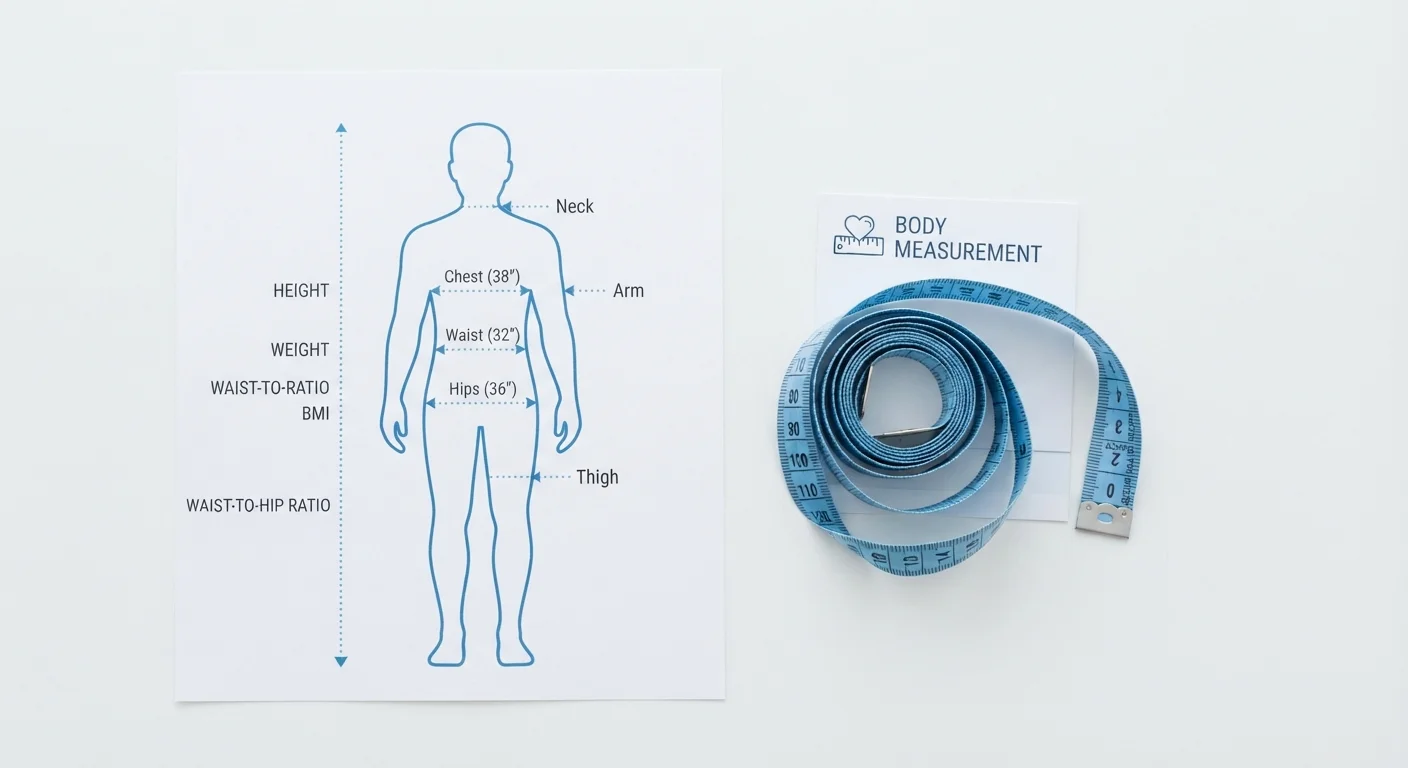
- Waist: Stand upright and relaxed. Locate the midpoint between the bottom of your lowest rib and the top of your iliac crest (hip bone) — typically around navel height. Exhale gently and measure snugly without compressing skin.
- Hip (for WHR): Measure at the widest point of your hips and buttocks, keeping the tape horizontal all the way around.
- Height (for WHtR): Use a wall-mounted stadiometer or stand flat against a wall with a book resting level on your head to mark the measurement.
Avoid measuring immediately after a large meal, while wearing thick clothing, or while tensing your core. Taking two readings and averaging them reduces variability.
Measure Consistently for Useful Comparisons
If you plan to track your WHtR or WHR over time, always measure at the same time of day, under similar conditions (e.g., before eating, wearing similar clothing). Consistency in technique matters far more than achieving a single perfect measurement. Log your readings alongside the date so trends become visible over weeks and months.
Interpreting Your Results and Their Limits
A ratio outside the low-risk range is a signal worth discussing with a clinician — not a diagnosis. These are population-level screening thresholds, derived from studies of large groups, and they carry meaningful uncertainty when applied to any single individual.
Several factors can affect how your results should be interpreted:
- Ethnicity: Some research suggests that optimal WHtR and WHR cut-offs may differ across ethnic groups, with South Asian and East Asian populations, for example, showing higher metabolic risk at lower waist values than cut-offs derived from predominantly European cohorts.
- Age: Waist circumference tends to increase with age even when weight stays stable. Some researchers advocate for age-adjusted thresholds, though these are not yet universally standardized.
- Sex: Men and women typically store fat differently; the sex-specific WHR thresholds reflect this biology.
- Pregnancy and certain health conditions make standard interpretation unreliable.
For a thorough understanding of what online calculators can and cannot conclude about your health, understand what health calculators can and cannot tell you is a useful companion. Men specifically concerned about abdominal fat can find additional context in abdominal obesity in men and its health risks.
This article is for informational purposes only and does not constitute medical advice. Always consult a qualified healthcare professional for personal health concerns, symptoms, or before making changes to your health regimen.