

Key Takeaways
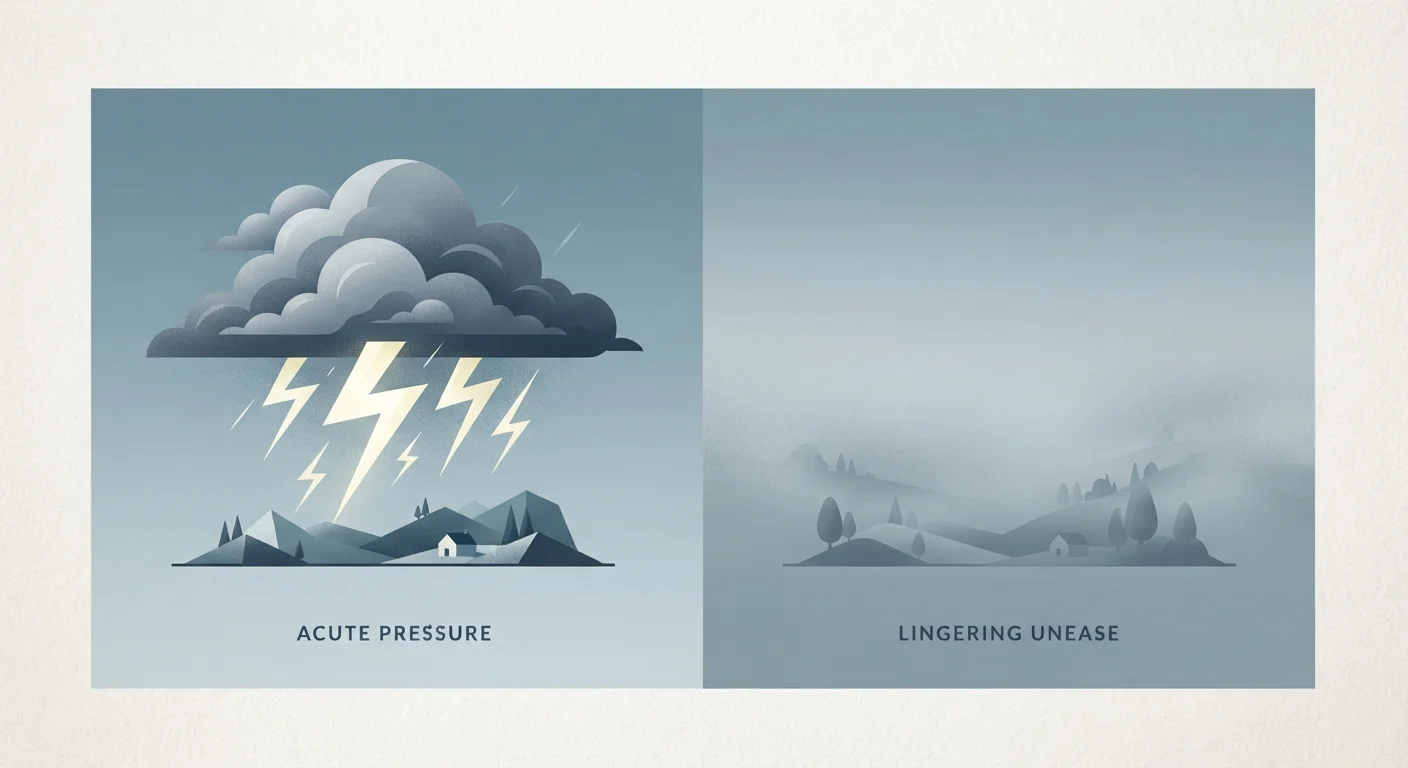
- Stress is usually tied to a specific external trigger; anxiety can persist without one.
- Both activate the body's fight-or-flight system, but anxiety tends to last longer and feel less controllable.
- Knowing which you're experiencing helps you choose the most effective coping response.
- Chronic stress can develop into an anxiety disorder if left unaddressed over time.
- Professional support is available and effective for both stress and clinical anxiety.
Option A
Stress
The body's direct response to an identifiable external demand.
Best for: Understanding as a short-term, situation-linked reaction that typically resolves when the stressor is removed.
Option B
Anxiety
A persistent internal state that persists even without an obvious trigger.
Best for: Recognising as an ongoing emotional pattern that may require structured coping strategies or professional support.
If your tension is clearly tied to a deadline, conflict, or life event
Stress
Situation-linked distress is typically stress. Addressing the source or using short-term coping strategies — like structured problem-solving or rest — is usually effective.
If worry persists after the situation has resolved or feels uncontrollable
Anxiety
Persistent, free-floating worry that doesn't track a clear cause is more characteristic of anxiety and may benefit from professional evaluation.
If physical symptoms like a racing heart or tight chest appear regularly without a clear stressor
Anxiety
Recurring physical symptoms disconnected from obvious triggers are a hallmark of anxiety disorders and warrant a conversation with a healthcare provider.
If you want to understand long-term health risks of ongoing pressure
Stress
Chronic, unmanaged stress carries distinct cardiovascular, immune, and sleep-related health risks that are important to address proactively.
What's Actually Happening in Your Body
When you feel overwhelmed before a big presentation or tense during a difficult conversation, your nervous system activates the same core response for both stress and anxiety: the hypothalamic-pituitary-adrenal (HPA) axis releases cortisol and adrenaline, accelerating your heart rate, tensing your muscles, and sharpening your focus. From the inside, the two states can feel nearly identical — which is precisely why they're so often conflated.
The key biological distinction is what triggers the response and how long it lasts. Stress is typically proportionate and time-limited: it arises in response to a real, identifiable demand and tends to subside once that demand is resolved. Anxiety, by contrast, involves a threat-detection system that stays activated even in the absence of a clear external cause. The brain's amygdala — the region responsible for processing threat — continues signalling danger even when the environment is objectively safe.
For a deeper look at how anxiety manifests physically, see how anxiety shows up as physical symptoms.
| Criterion | Stress | Anxiety |
|---|---|---|
| Primary trigger | Identifiable external stressor | Internal; often no clear cause |
| Duration | Resolves with the stressor | Persists beyond the situation |
| Sense of control | Often feels manageable | Often feels uncontrollable |
| Core emotion | Frustration, pressure, urgency | Dread, worry, apprehension |
| Physical symptoms | Tension, fatigue, headaches | Racing heart, chest tightness, restlessness |
| Effect on thinking | Focus on the specific problem | Diffuse worry, difficulty redirecting thoughts |
| Self-management response | Problem-solving, rest, lifestyle habits | Coping skills plus possible professional support |
The Timeline and Trigger Difference
One of the most practical ways to distinguish stress from anxiety is to ask: Can I point to what's causing this? Stress has an identifiable source — a work deadline, a relationship conflict, financial pressure, a health scare. It arrives with the stressor and, for most people, eases when the situation changes.
Anxiety is more diffuse. It may begin with a stressor but continue long after it's resolved. It can also arise without any obvious trigger at all — a phenomenon clinicians sometimes describe as free-floating worry. People experiencing anxiety often report a sense of dread or apprehension they can't fully explain, along with difficulty controlling or redirecting their thoughts.
It's also worth noting that stress and anxiety exist on a continuum. Prolonged or intense stress can reshape the nervous system over time, lowering the threshold at which anxiety responses are triggered. This is one reason why chronic stress is worth taking seriously — it isn't just uncomfortable in the moment; it can make the system more reactive over time.
31%
Adults affected by an anxiety disorder at some point in their lives
According to the National Institute of Mental Health, anxiety disorders are among the most prevalent mental health conditions in the United States.
~60%
Adults who report stress affecting their physical health
The American Psychological Association's Stress in America surveys consistently show a majority of U.S. adults experience stress-related physical effects.
When Stress Becomes Anxiety — and What to Do
The boundary between stress and anxiety isn't always sharp. A useful rule of thumb: if distress is proportionate to a current situation and resolves naturally, it's likely stress. If it persists beyond the situation, feels disproportionate, or significantly disrupts daily functioning — sleep, work, relationships — it may have crossed into anxiety territory.
For stress, evidence-based self-management strategies include structured problem-solving, regular physical activity, adequate sleep, and mindfulness-based techniques. These work because they address the underlying stressor or help regulate the physiological arousal it creates.
For anxiety, the same strategies can help, but they may not be sufficient on their own — particularly for anxiety disorders, which are among the most common and most treatable mental health conditions. Cognitive behavioral therapy (CBT) has a strong evidence base for anxiety, and a qualified mental health professional can help determine whether additional support is appropriate.
Not sure if what you're experiencing fits a recognized pattern? Our plain-language guide to anxiety symptoms walks through the key signs without jargon. And if stress or anxiety is consistently interfering with your daily life, knowing when to seek professional help is an important next step.
This article is for general informational and educational purposes only and is not a substitute for professional medical or mental health advice. If you are concerned about your mental health, please consult a qualified healthcare provider.