

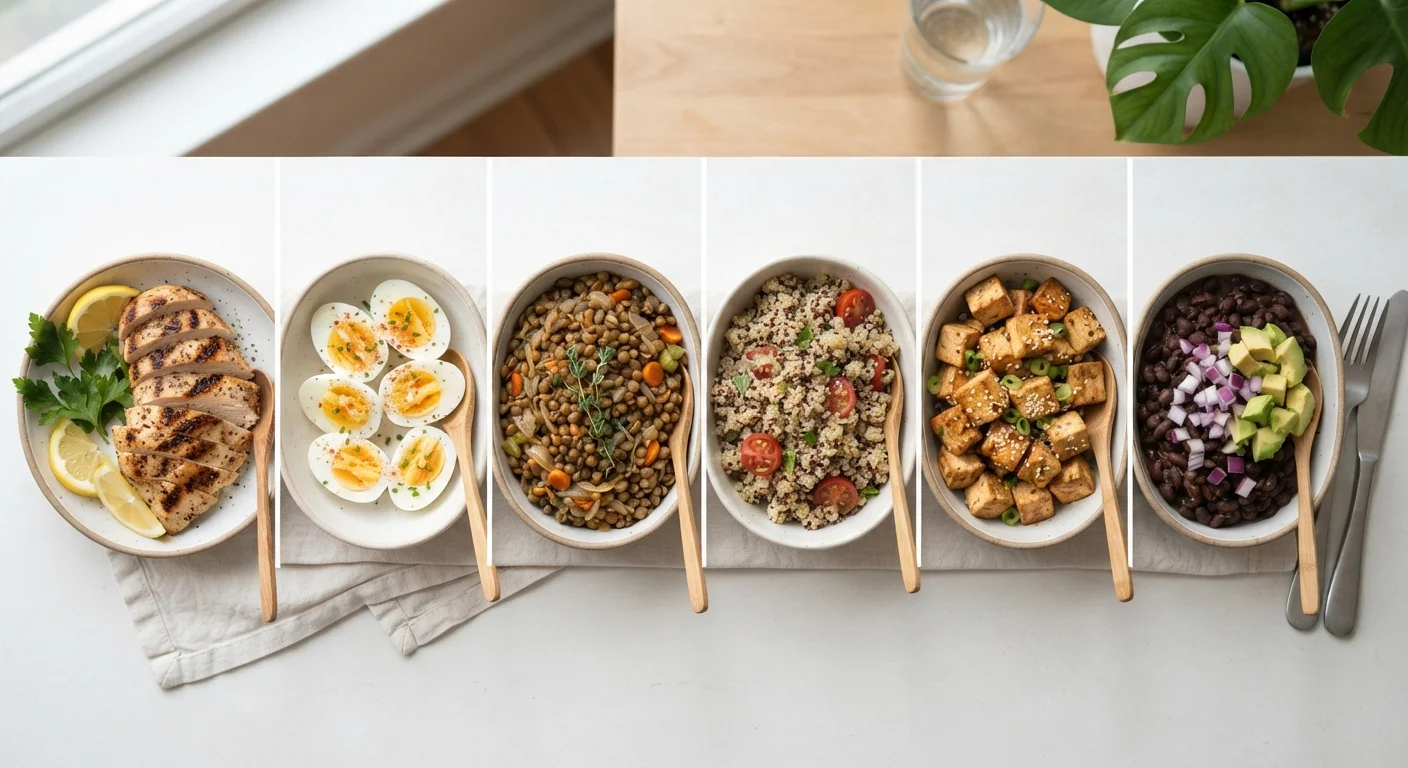
Key Takeaways
- Complete proteins supply all nine essential amino acids; incomplete proteins are low in one or more.
- Most animal foods — meat, fish, eggs, and dairy — are complete protein sources.
- Several plant foods, including quinoa, soy, and buckwheat, are also complete proteins.
- Plant-based eaters can meet all amino acid needs by eating a variety of protein sources throughout the day.
- You do not need to combine complementary proteins within a single meal — daily variety is sufficient.
- Protein quality matters, but total daily intake and food variety are the most practical targets to focus on.
Complete vs. Incomplete Proteins
A complete protein is any food that provides all nine essential amino acids — the ones your body cannot produce on its own — in sufficient quantities. An incomplete protein lacks or contains very low levels of one or more of these essential amino acids. Most animal-based foods are complete proteins, while most (though not all) plant foods are incomplete.
The nine essential amino acids are histidine, isoleucine, leucine, lysine, methionine, phenylalanine, threonine, tryptophan, and valine. The concept of a 'limiting amino acid' describes whichever essential amino acid is present in the lowest proportion relative to physiological need in a given food.
Why Amino Acids Are the Real Story
When nutrition experts talk about protein quality, they are really talking about amino acids. Protein is not a single molecule — it is a broad category of nutrients made up of chains of amino acids. Of the roughly 20 amino acids involved in human physiology, nine are classified as essential, meaning the body cannot manufacture them and must obtain them from food.
A food earns the label complete protein when it delivers all nine essential amino acids at levels that meet or exceed human physiological requirements. A food labeled incomplete is simply one that falls short on at least one of these nine — typically called a limiting amino acid. This distinction matters because different amino acids drive different biological processes, from muscle synthesis and immune function to hormone production and neurotransmitter activity.
A Note on Protein Quality Scoring
Nutrition scientists use standardized tools to compare protein quality across foods. The most current method is the Digestible Indispensable Amino Acid Score (DIAAS), which accounts for both the amino acid content of a food and how well those amino acids are absorbed in the small intestine. Animal proteins typically score higher on DIAAS than plant proteins, largely due to digestibility differences — though this gap narrows significantly in the context of a varied, whole-food diet.
Understanding amino acid completeness is one piece of the protein puzzle. For context on how much total protein different people actually need, our explainer on realistic daily protein intake covers practical targets across activity levels.
Which Foods Are Complete Proteins?
Animal-derived foods dominate the complete protein category. Eggs, meat, poultry, fish, seafood, dairy milk, and yogurt all supply the full spectrum of essential amino acids. This is one reason animal proteins are frequently used as reference standards in nutritional science — their amino acid profiles closely match human requirements.
However, several plant foods also qualify:
- Soy — in all its forms (edamame, tofu, tempeh, soy milk) — is one of the most nutritionally complete plant proteins available.
- Quinoa — technically a seed, not a grain — contains all nine essential amino acids and is also a source of fiber and minerals.
- Buckwheat, despite its name, is unrelated to wheat and provides a well-rounded amino acid profile.
- Hemp seeds offer meaningful amounts of all essential amino acids alongside beneficial fats.
- Nutritional yeast and amaranth are considered near-complete or complete depending on the serving size and preparation.
9
Essential amino acids humans must obtain from food
The nine essential amino acids — including leucine, lysine, and tryptophan — cannot be synthesized by the body and must be supplied through dietary protein sources.
~20%
Of dietary protein recommendation met by a cup of cooked lentils
Based on a general baseline of 50g daily protein for a reference adult diet; lentils provide around 18g per cooked cup but are lower in methionine, classifying them as incomplete.
~36g
Protein per 100g serving of firm tofu (dry-weight equivalent)
Soy-based foods like tofu are among the highest-protein complete plant sources per calorie, according to USDA FoodData Central nutritional composition data.
Most other plant foods — beans, lentils, peas, most grains, nuts, and seeds — are incomplete proteins. This does not make them nutritionally poor; it simply means they are best understood as part of a broader dietary pattern rather than standalone protein sources.
How Plant-Based Eaters Can Meet Their Amino Acid Needs
The practical takeaway for people eating little or no animal protein is straightforward: variety over the course of a day reliably covers all essential amino acids. The scientific basis for this is the body's amino acid pool — a dynamic reserve from which individual acids are drawn and replenished continuously. A single meal does not need to be amino-acid-complete if the day's overall intake is.
This insight effectively retired the older rule of combining complementary proteins at every meal — for example, rice and beans or bread and peanut butter — though these combinations remain nutritionally excellent in their own right. The key complementary pairings worth understanding are:
- Legumes + grains: Legumes (beans, lentils, chickpeas) are rich in lysine but lower in methionine; grains have the opposite profile. Together, they provide a complete amino acid picture.
- Legumes + nuts or seeds: A similar complementary dynamic applies, making combinations like hummus with sesame tahini particularly well-rounded.
Plant-based diets can also support adequate protein intake when overall calorie needs are met and protein sources are varied. Research suggests that omnivores and well-planned plant-based eaters can achieve comparable muscle protein synthesis outcomes, though this remains an active area of study. For a broader examination of what the evidence actually shows, our article on protein myths addresses common misconceptions directly.
This article is for general informational purposes only and does not constitute medical or dietary advice. Consult a registered dietitian or qualified healthcare professional for personalized nutrition guidance, particularly if you have specific health conditions or dietary requirements.