

Key Takeaways
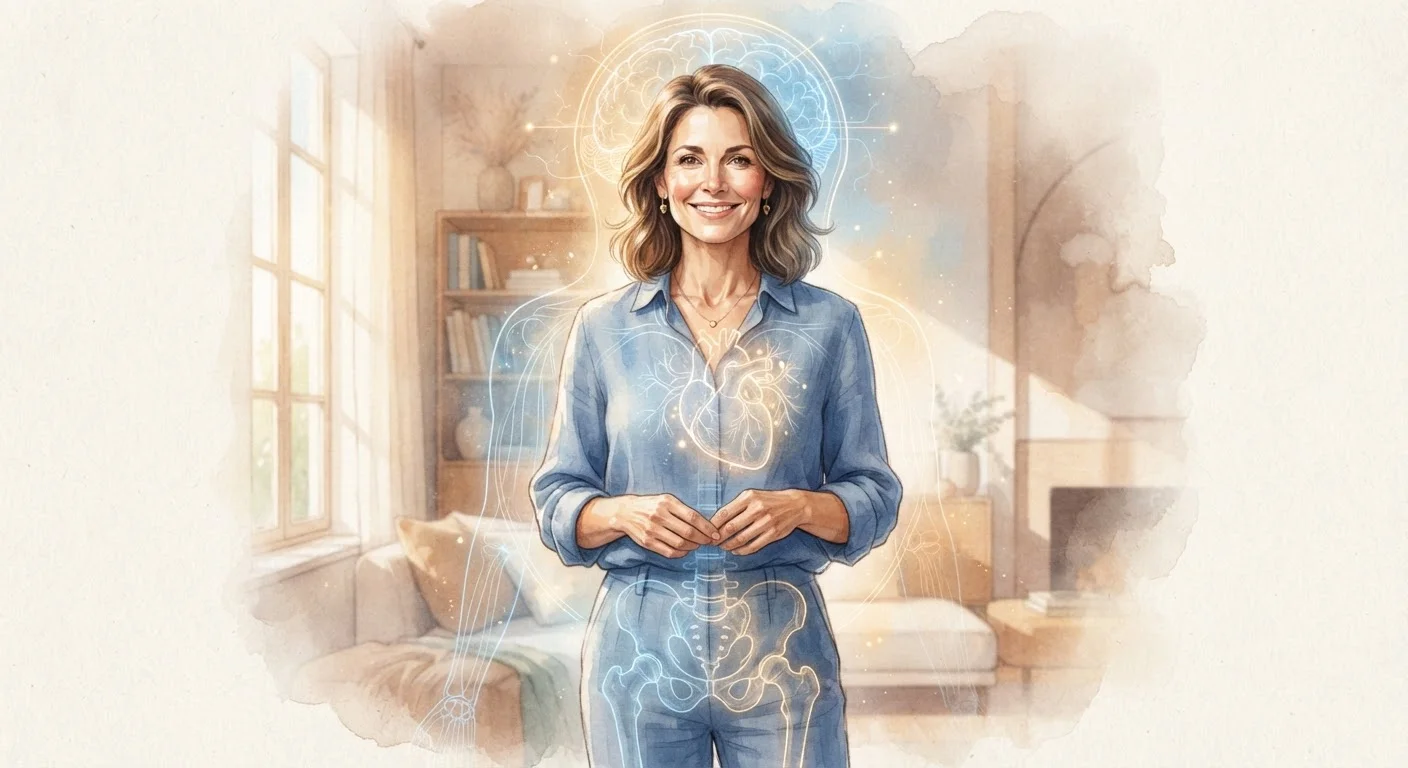
- Oestrogen receptors exist in the brain, heart, bones, and immune system — not only reproductive tissue.
- Declining oestrogen at menopause accelerates bone loss, raising fracture risk significantly.
- Oestrogen plays a measurable role in mood regulation, memory, and cognitive function.
- Before menopause, oestrogen contributes to a lower cardiovascular risk profile compared to age-matched men.
- Understanding oestrogen's systemic role helps women interpret symptoms across every life stage.
Oestrogen
Oestrogen is a group of hormones — primarily estradiol, estriol, and estrone — produced mainly in the ovaries, with smaller amounts made in fat tissue and the adrenal glands. While it plays a central role in reproductive development and the menstrual cycle, oestrogen also acts as a signalling molecule throughout the body, influencing the brain, heart, bones, skin, and immune system. Its receptors are found in virtually every major organ, which is why shifting oestrogen levels affect so many aspects of health simultaneously.
Oestrogen binds to two primary receptor types — oestrogen receptor alpha (ERα) and beta (ERβ) — which are distributed differently across tissues, explaining the hormone's diverse, sometimes opposing effects in different organ systems.
A Hormone With a Whole-Body Reach
Most of us learn early that oestrogen drives puberty, regulates the menstrual cycle, and supports pregnancy. What rarely gets the same airtime is how deeply this hormone is woven into the everyday functioning of nearly every major organ system in the body.
Oestrogen receptors have been identified in the brain, heart, blood vessels, bones, liver, skin, and immune cells. This distribution is not accidental — it reflects the hormone's role as a systemic regulator, calibrating everything from inflammation to vascular tone to the rate at which bone tissue is renewed. Understanding this broader picture is genuinely useful: it helps explain why perimenopause feels like so much more than a change in periods, and why oestrogen-related changes can ripple across health in ways that aren't immediately obvious.
For a full picture of how oestrogen and its hormonal companions shift across a woman's life, our complete hormonal health reference is a useful companion to this article.
~50%
Bone density women may lose post-menopause without intervention
Research indicates women can lose up to half of their trabecular bone mass after menopause, with the steepest losses in the first decade following the final period.
1 in 2
Women over 50 expected to experience an osteoporosis-related fracture
According to the National Osteoporosis Foundation, approximately half of women over 50 will sustain a fracture related to low bone density in their lifetime.
~10 years
Cardiovascular risk lag women have over men pre-menopause
Epidemiological data consistently shows pre-menopausal women develop coronary artery disease roughly a decade later than men, with oestrogen cited as a contributing protective factor.
Oestrogen and Bone: A Critical Partnership
Bone is living tissue, continuously broken down and rebuilt through a process called remodelling. Oestrogen plays a direct role in this cycle by slowing the activity of osteoclasts — the cells responsible for breaking down bone — while supporting the bone-building work of osteoblasts.
When oestrogen levels fall sharply at menopause, this balance tips. Bone is resorbed faster than it is replaced, and women can lose a significant proportion of their bone density in the years immediately following their final period. This is why osteoporosis disproportionately affects post-menopausal women and why fracture risk rises with age in ways that often go unrecognised until a break occurs.
Weight-bearing exercise, adequate calcium and vitamin D intake, and regular bone density screening — especially for those with additional risk factors — are all evidence-supported strategies for preserving skeletal health. Specific guidance on what applies to your individual situation should always come from a healthcare professional.
Talk to Your Doctor About Bone Density Screening
Post-menopausal women, and those with additional risk factors such as family history, low body weight, or long-term corticosteroid use, are candidates for DEXA scanning to assess bone density. Early identification of bone loss opens up more options for slowing its progression. Ask your healthcare provider whether a scan is appropriate for you.
Mood, Memory, and the Brain Connection
Oestrogen influences the production, release, and receptor sensitivity of several neurotransmitters — including serotonin, dopamine, and norepinephrine — that are central to mood regulation, motivation, and cognitive function. Its effects on the hippocampus, a brain region involved in memory formation, are particularly well-studied.
This helps explain why hormonal transitions — puberty, the postpartum period, perimenopause — are often accompanied by shifts in emotional wellbeing and mental clarity. The steep drop in oestrogen after childbirth, for example, is one contributing factor to postpartum mood changes, as explored in detail in our article on the postpartum hormonal shift.
It is important to note that oestrogen is one variable among many in mental health — not a simple on-off switch. Genetics, life circumstances, sleep, and social support all matter enormously. For a deeper look at the evidence, our piece on the hormonal roots of depression in women covers the research in accessible depth.
Cardiovascular Health: The Oestrogen Advantage — and Its Limits
Before menopause, women tend to have lower rates of heart disease than men of comparable age. Oestrogen contributes to this difference by supporting endothelial function (the health of the cells lining blood vessels), maintaining a more favourable balance of LDL and HDL cholesterol, and modulating inflammatory pathways involved in arterial disease.
After menopause, as oestrogen levels fall, this relative cardiovascular advantage narrows. Rates of hypertension, unfavourable lipid profiles, and coronary artery disease climb in post-menopausal women, eventually reaching or exceeding those seen in men of the same age group. Heart disease remains the leading cause of death in women in the United States — a fact that underscores why the oestrogen-cardiovascular connection deserves more public attention than it typically receives.
It is also worth being clear about what the research does not yet confirm: the relationship between hormone therapy and cardiovascular outcomes is complex, varies by timing, formulation, and individual health profile, and should only be explored in conversation with a qualified clinician — not assumed to be protective based on oestrogen's physiological effects alone.
This article is for informational purposes only and does not constitute medical advice. Always consult a qualified healthcare professional for guidance specific to your health needs.