

| Standard beginner set range | 2–3 sets per exercise (American College of Sports Medicine (ACSM) guidelines for novice exercisers) |
| Typical rep range for muscular strength | 1–6 reps per set (NSCA Essentials of Strength Training and Conditioning) |
| Typical rep range for hypertrophy (muscle size) | 6–12 reps per set (NSCA Essentials of Strength Training and Conditioning) |
| Typical rep range for muscular endurance | 15+ reps per set (ACSM resistance training guidelines) |
| Rest between heavy strength sets | 2–5 minutes (NSCA programming recommendations) |
| Rest between endurance-focused sets | 30–90 seconds (NSCA programming recommendations) |
Why Fitness Vocabulary Matters
Walking into a gym — or opening a fitness app — can feel like entering a conversation in a foreign language. Instructions like "3 sets of 12 reps at 60% 1RM with 90-second rest intervals" make perfect sense to experienced exercisers, but are genuinely confusing to someone just getting started. That confusion is a real barrier.
This reference breaks down the most common training terms in plain language, so you can read any workout program, understand what you're being asked to do, and focus on doing it well. For a broader look at how different exercise types fit together, see The Main Types of Exercise and What Each One Does for Your Body.
Rep (Repetition)
One complete execution of a single exercise movement — for example, lowering and raising a dumbbell once during a curl. Reps are the smallest unit of training volume.
Set
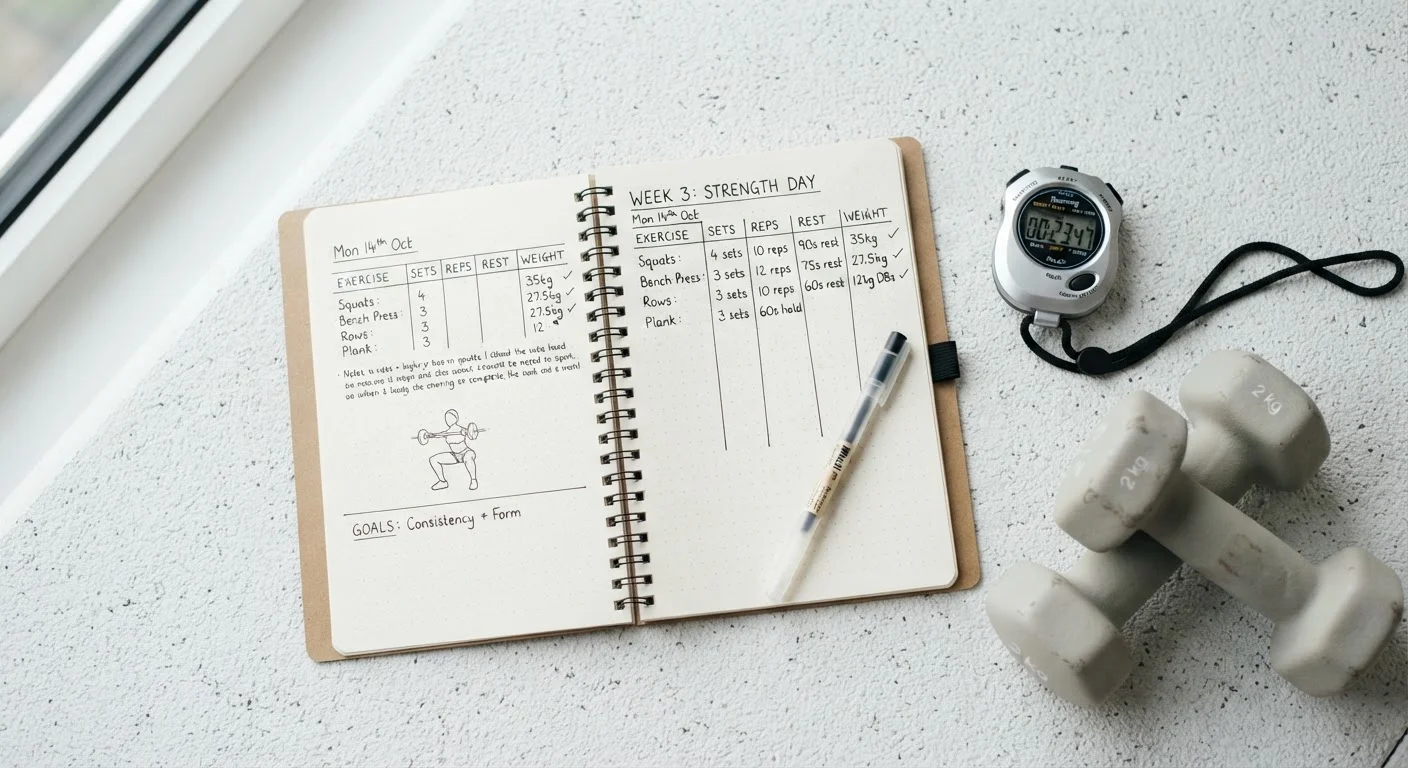
A group of consecutive reps performed without stopping. For example, 10 reps performed back-to-back equals one set. Most programs list sets before reps (e.g., 3×10 means 3 sets of 10 reps).
Rest Interval
The recovery period between sets or exercises. Rest length is deliberately programmed: shorter rests (30–60 seconds) challenge endurance; longer rests (2–3+ minutes) allow more complete recovery for heavy strength work.
1RM (One-Rep Max)
The maximum weight you can lift for exactly one full rep with proper form. It is used as a benchmark to set training loads — for example, working at 70% of your 1RM for a given set.
Progressive Overload
The principle of gradually increasing training demand over time — through more weight, more reps, less rest, or added sessions — to continue prompting adaptation. It is considered the central driver of long-term fitness progress.
Volume
The total amount of work done in a workout or training week, typically calculated as sets × reps × weight. Managing volume — not increasing it too quickly — is key to avoiding overtraining.
Compound Exercise
A movement that works multiple muscle groups and joints simultaneously, such as a squat, deadlift, or push-up. Compound exercises are generally efficient and form the backbone of most strength programs.
Isolation Exercise
A movement targeting a single muscle group using one primary joint, such as a bicep curl or leg extension. Often used to address specific weaknesses or after compound work.
DOMS
Delayed Onset Muscle Soreness — muscle tenderness and stiffness that develops 24–48 hours after unfamiliar or intense exercise. It reflects normal tissue stress response and typically resolves within a few days.
Tempo
The speed at which you perform each phase of a rep — typically expressed as a four-digit code (e.g., 3-1-2-0) representing seconds for lowering, pause at bottom, lifting, and pause at top.
Superset
Two exercises performed back-to-back with little or no rest between them. Supersets can save time and increase training density; they pair either opposing muscle groups or the same muscle group.
RPE (Rate of Perceived Exertion)
A self-reported scale (typically 1–10) describing how hard an effort feels. An RPE of 7 means you feel you could do 3 more reps; RPE 10 means maximum effort. It helps calibrate intensity without requiring specific loads.
Core Programming Terms at a Glance
The terms below appear in virtually every structured workout program. Understanding them lets you decode instructions quickly and apply them accurately.
| Standard beginner set range | 2–3 sets per exercise (American College of Sports Medicine (ACSM) guidelines for novice exercisers) |
| Typical rep range for muscular strength | 1–6 reps per set (NSCA Essentials of Strength Training and Conditioning) |
| Typical rep range for hypertrophy (muscle size) | 6–12 reps per set (NSCA Essentials of Strength Training and Conditioning) |
| Typical rep range for muscular endurance | 15+ reps per set (ACSM resistance training guidelines) |
| Rest between heavy strength sets | 2–5 minutes (NSCA programming recommendations) |
| Rest between endurance-focused sets | 30–90 seconds (NSCA programming recommendations) |
One term worth expanding on: progressive overload. This is the foundational principle behind all effective training. Your body adapts to a given stress and stops changing. To keep improving, you gradually increase that stress — by adding a little more weight, performing one more rep, resting slightly less, or adding a training day. Small, consistent increases over weeks and months produce durable results. No single session transforms your fitness; the accumulation does.
Similarly, understanding volume — the total amount of work performed — helps you compare training weeks and avoid doing too much too soon. A common beginner mistake is dramatically increasing volume from one week to the next, which raises injury risk. A more sustainable approach is adding roughly 10% more total work per week.
Recovery Terms You'll Encounter
Training creates the stimulus for adaptation, but the actual adaptation — stronger muscles, better endurance, improved coordination — happens during recovery. Understanding recovery terminology helps you plan training weeks that include genuine rest, not just lighter workouts.
Rest Is Training, Not the Absence of It
Many new exercisers skip or shorten rest days, assuming more training always means faster results. In reality, muscles rebuild and grow stronger during rest — not during the workout itself. Consistently under-recovering can stall progress and increase injury risk. Plan rest as deliberately as you plan your sessions.
Active recovery means low-intensity movement — a walk, gentle cycling, or light stretching — on days between harder sessions. It keeps blood circulating without adding meaningful training stress. Passive rest means no structured exercise at all, and it's essential at least once or twice per week for most people.
Delayed onset muscle soreness (DOMS) is the aching stiffness that typically peaks 24–48 hours after an unfamiliar or especially hard workout. It is a normal physiological response to muscle stress, not a sign of injury or a requirement for progress. For a deeper look at how rest and recovery fit into a sustainable fitness routine, see Rest, Recovery, and Adaptation and Recovery and Mobility: A Complete Guide to Sustainable Fitness.
This article is for general informational purposes only and does not constitute medical advice. If you have a health condition, injury, or are new to exercise, consult a qualified healthcare or fitness professional before starting a new training program.