

Key Takeaways
- No single recovery method outperforms all others; the best approach depends on your goals and training context.
- Cold water immersion can reduce acute soreness but may blunt some long-term strength adaptations.
- Massage and compression offer meaningful benefits for perceived soreness and short-term performance readiness.
- Active recovery and sleep remain the most consistently supported, lowest-risk strategies across populations.
- Always consult a healthcare professional if you have underlying conditions before beginning any new recovery protocol.
Our Verdict
Each recovery modality has a distinct physiological target and an evidence base of varying strength. Cold water immersion and massage show the clearest short-term effects on soreness and perceived readiness, while compression and active recovery offer practical, low-risk options for most exercisers. Sleep and nutrition remain the non-negotiable foundation that all other strategies build upon.
| Best for | Recommended |
|---|---|
| Athletes prioritising next-day soreness reduction after intense training | Cold Water Immersion |
| Those seeking muscle tension relief and parasympathetic relaxation | Massage (manual or self-myofascial release) |
| Exercisers wanting a practical, portable tool during travel or multi-day events | Compression Garments |
| Anyone building a sustainable, everyday recovery routine with no special equipment | Active Recovery and Quality Sleep |
Why Recovery Deserves the Same Attention as Training
Exercise provides the stimulus for adaptation — but the adaptation itself occurs during recovery. As we explore in more depth in Rest, Recovery, and Adaptation, skipping deliberate recovery doesn't just leave gains on the table; it increases the risk of overtraining and injury. The question for most exercisers isn't whether to recover, but how.
Popular recovery tools — cold water immersion, compression garments, massage, active recovery, and others — each claim to speed the process. But their mechanisms differ, and so does the quality of evidence supporting them. This comparison breaks down what each method actually targets and what current research suggests about its usefulness.
The Main Contenders: What Each Method Does
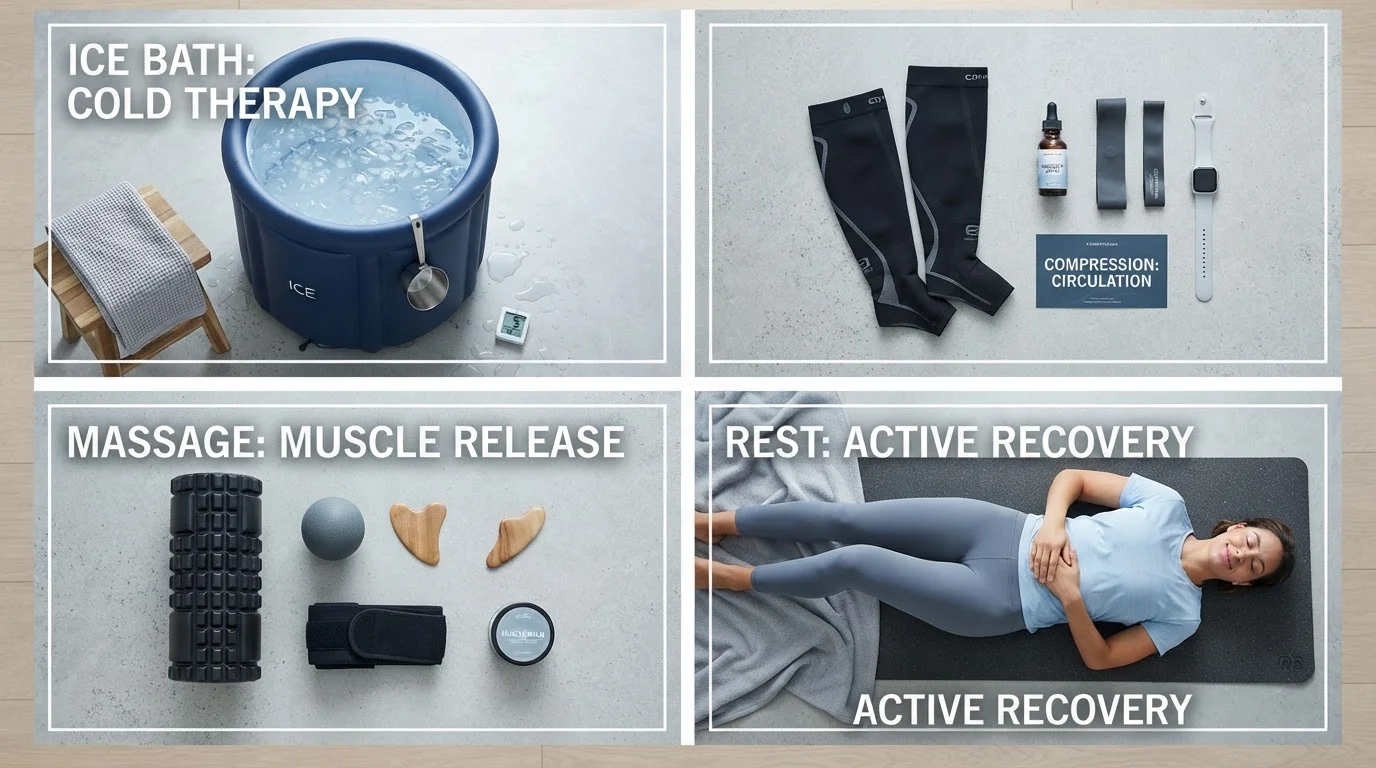
Cold Water Immersion (CWI) — also called ice baths — works primarily by causing vasoconstriction, reducing blood flow and metabolic activity in stressed tissue, which may dampen inflammation and the perception of muscle soreness (DOMS — delayed onset muscle soreness). Evidence from multiple meta-analyses supports a moderate effect on DOMS and perceived fatigue in the 24–72 hours after high-intensity training. However, research published in journals including the Journal of Physiology suggests that regular CWI may attenuate some signalling pathways involved in muscle hypertrophy, making it a less ideal routine choice for those focused primarily on building strength.
Compression garments (sleeves, tights, socks) apply graduated external pressure to limbs, theorised to reduce swelling, support venous return, and decrease oscillation of soft tissue during movement. Systematic reviews show modest but consistent benefits for reducing DOMS and markers of muscle damage when worn for several hours post-exercise. They're low-risk, portable, and practical during multi-day training blocks.
Massage — whether from a therapist or via self-myofascial release tools like foam rollers — is thought to improve tissue perfusion, reduce mechanical tension, and activate the parasympathetic nervous system. The evidence for reducing DOMS is reasonably consistent, though effect sizes are small to moderate. Importantly, foam rolling studies suggest it may also improve short-term range of motion, making it a useful complement to mobility work. See how warming up and cooling down fit in for context on when this matters most.
Active recovery — low-intensity movement such as walking, easy cycling, or yoga on rest days — promotes circulation without adding meaningful physiological stress. It's among the most consistently supported strategies for clearing metabolic byproducts and maintaining psychological readiness to train. Active Recovery vs. Complete Rest examines the evidence in detail.
| Cold Water Immersion | Compression Garments | Massage / Foam Rolling | Active Recovery | |
|---|---|---|---|---|
| Primary mechanism | Vasoconstriction, reduced inflammation | Graduated external pressure, venous return | Tissue perfusion, mechanical tension relief | Circulation, metabolic clearance |
| Evidence for reducing DOMS | Moderate–strong | Moderate | Moderate | Moderate |
| Potential drawbacks | May blunt hypertrophy signals | Mild discomfort; sizing important | Cost or time for professional massage | Requires discipline on rest days |
| Ease of access | Requires tub and cold water | Portable, purchase once | Foam roller low-cost; therapist costly | No equipment needed |
| Best use case | Post-intense competition bouts | Multi-day training blocks, travel | Soreness relief, mobility support | Everyday rest-day movement |
| Risk level | Low–moderate (cold shock risk) | Very low | Very low | Very low |
Practical Considerations Before Choosing a Method
Combine Methods Strategically, Not Randomly
Stacking every recovery tool doesn't guarantee better results. Research suggests diminishing returns when multiple modalities are combined without a clear rationale. Identify your primary recovery goal — reducing acute soreness, maintaining range of motion, or building readiness to train again — and select one or two methods that target it directly. Reassess periodically based on how your body responds.
Context matters significantly when selecting recovery tools. A competitive athlete peaking for an event may prioritise rapid soreness clearance (favouring CWI or compression), while someone training for general health and longevity might gain more from consistent active recovery and sleep optimisation. For a practical day-to-day framework, the Post-Workout Recovery Checklist provides structured guidance on sequencing nutrition, hydration, movement, and sleep.
Cost, accessibility, and individual tolerance also shape decisions. Cold immersion requires equipment and is uncomfortable for many people; massage sessions involve scheduling and expense. Compression garments are a one-time purchase with minimal barrier to use. Active recovery costs nothing.
One consistent finding across the literature: no adjunct recovery strategy compensates for inadequate sleep. The American College of Sports Medicine (ACSM) and other bodies consistently highlight sleep as the single highest-leverage recovery intervention available. Understanding what happens at the cellular level during muscle recovery can help contextualise why no gadget or technique replaces the basics.
This article is for general informational and educational purposes only and does not constitute medical advice. Consult a qualified healthcare professional before starting any new recovery protocol, particularly if you have cardiovascular, circulatory, or musculoskeletal conditions.