

Key Takeaways
- Exercise creates microscopic damage to muscle fibres; the repair of that damage drives adaptation.
- Inflammation immediately after exercise is a necessary and productive part of healing, not a problem to eliminate.
- Satellite cells — muscle stem cells — are central to rebuilding and strengthening muscle tissue.
- Protein synthesis peaks within 24–48 hours post-exercise, making nutrition and sleep especially critical in that window.
- Inadequate recovery prevents full repair, limiting progress and raising injury risk over time.
- Recovery is not passive — it is where the fitness gains from training are actually realised.
Muscle Repair (Post-Exercise)
Muscle repair is the biological process your body initiates after strenuous exercise damages muscle fibres. It involves inflammation, cellular cleanup, protein synthesis, and structural rebuilding — ultimately leaving the muscle slightly stronger and more resilient than before. This process happens almost entirely during rest, not during the workout itself.
The primary mechanism is skeletal muscle hypertrophy driven by satellite cell activation and myofibrillar protein synthesis, regulated in part by signalling pathways including mTOR (mechanistic target of rapamycin).
Why Workouts Break Muscles Down
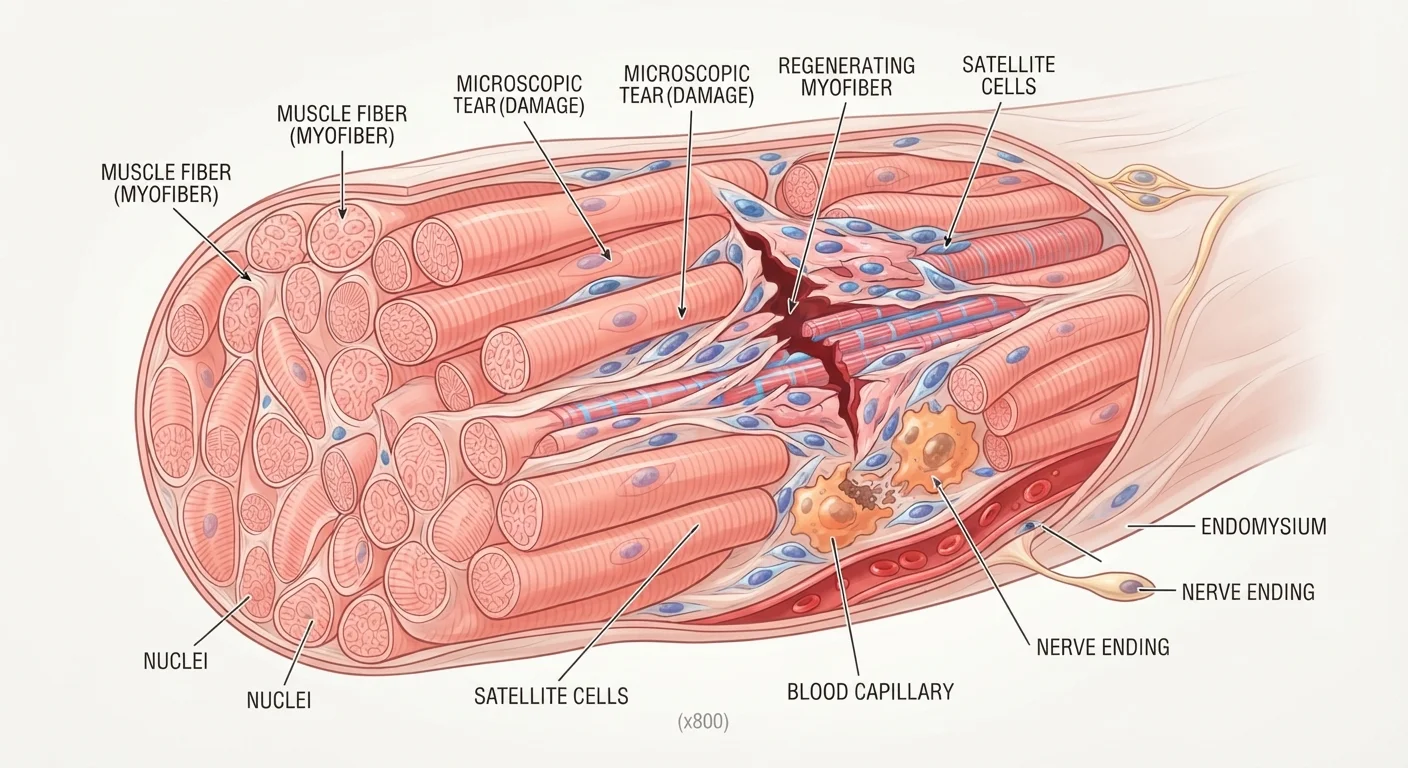
It may seem counterintuitive, but exercise — particularly resistance and high-intensity training — works by causing controlled damage to muscle tissue. When you lift weights or sprint, you place mechanical stress on muscle fibres, generating microscopic tears in the contractile proteins (actin and myosin) that make up those fibres. This is not an injury in the clinical sense; it is the intended stimulus for adaptation.
The degree of damage depends on the type of muscle action involved. Eccentric contractions — where a muscle lengthens under load, such as lowering a weight — consistently produce greater fibre disruption than concentric (shortening) actions. This is why a heavy set of Romanian deadlifts tends to produce more soreness the next day than a similarly intense leg press. The body's response to this damage is what drives long-term strength and endurance gains.
Understanding this mechanism reframes recovery: it is not downtime between workouts but the essential second half of the training process. As explained in our overview of why recovery is the other half of any training plan, exercise creates the stimulus and rest is where adaptation happens.
The Inflammation Phase: Necessary, Not Optional
Within minutes of completing a hard session, your immune system mounts a controlled inflammatory response at the site of muscle damage. Specialised white blood cells called neutrophils arrive first, followed by macrophages — cells that clear cellular debris, damaged proteins, and fragmented fibre material. This phase peaks roughly 24–48 hours post-exercise, which aligns with the familiar window of peak soreness.
This inflammation is not something to aggressively suppress. Research published through the American College of Sports Medicine (ACSM) and others has highlighted that the inflammatory cascade activates key signalling molecules — including cytokines and growth factors — that recruit the repair machinery needed for rebuilding. Routinely blunting inflammation with high doses of anti-inflammatory medications may interfere with adaptation, though this remains an area of active research. Consult a healthcare professional before changing any medication routine.
Inflammation After Exercise Is Different From Chronic Inflammation
The acute inflammation that follows exercise differs importantly from chronic, systemic inflammation associated with disease. Post-exercise inflammation is localised, time-limited, and purposeful — part of a tightly regulated repair sequence rather than a pathological process. Treating them as equivalent can lead to misguided attempts to suppress a beneficial biological response.
The acute inflammation that follows exercise differs importantly from chronic, systemic inflammation associated with disease. Post-exercise inflammation is localised, time-limited, and purposeful — part of a tightly regulated repair sequence rather than a pathological process.
Satellite Cells and the Rebuilding Process
Once debris is cleared, the rebuilding phase begins — and the key players are satellite cells, a type of muscle stem cell that lies dormant along the periphery of muscle fibres. Mechanical damage and the signalling molecules released during inflammation activate these cells. They proliferate, differentiate, and fuse with existing muscle fibres to deposit new contractile proteins, effectively patching and reinforcing the damaged areas.
This protein synthesis process is energetically costly and nutritionally dependent. Amino acids — sourced from dietary protein — serve as the raw material. The rate of muscle protein synthesis (MPS) is significantly elevated for up to 48 hours after resistance exercise, which is why what you eat and when you sleep in the days following training has a meaningful effect on the quality of repair.
24–48 hrs
Peak window for muscle protein synthesis post-exercise
Exercise science research consistently identifies the 24–48 hour post-workout period as when muscle protein synthesis rates are most elevated, underscoring the importance of nutrition and sleep in that window.
~72 hrs
Typical full repair timeline for moderately stressed muscle
According to exercise physiology literature, most muscle fibre repair following moderate-to-high intensity resistance exercise completes within approximately 48–72 hours, though this varies with training volume and individual factors.
Up to 2×
Increase in muscle protein synthesis after resistance training
Research cited by the American College of Sports Medicine indicates that muscle protein synthesis can approximately double in the hours following a resistance training session compared to resting baseline rates.
Over repeated training cycles, this repair-and-rebuild sequence produces the structural changes we recognise as muscle growth (hypertrophy) and improved force production. The muscle is not simply restored to its prior state — it is remodelled to better handle the stress it encountered. This adaptation process is well-documented in exercise science literature and forms the basis of progressive overload as a training principle.
For a practical look at supporting this process day-to-day, the post-workout recovery checklist covers nutrition timing, hydration, and sleep strategies grounded in current evidence.
What Happens When Recovery Is Shortchanged
When training volume or frequency outpaces the body's capacity to repair, the cumulative effect is overreaching — and, in more severe cases, overtraining syndrome. Rather than continuing to adapt, muscles remain in a partial state of damage. Performance plateaus or declines, injury risk rises, and motivation can suffer.
Signs that recovery may be insufficient include persistent soreness beyond 72 hours, declining performance over consecutive sessions, disrupted sleep, and elevated resting heart rate. These are signals worth taking seriously, not pushing through. Rest, recovery, and adaptation are not optional extras — they are structural requirements of any sustainable training programme.
Individual recovery capacity varies significantly. Age, training experience, sleep quality, nutrition status, and stress load all influence how quickly muscle repair completes. There is no universal timeline that applies to everyone, which is why prescriptive recovery advice should come from a qualified fitness or healthcare professional familiar with your circumstances.
This article is for general informational and educational purposes only and does not constitute medical or personalised fitness advice. Always consult a qualified healthcare or exercise professional before making changes to your training or recovery practices, particularly if you have an existing health condition or injury.