

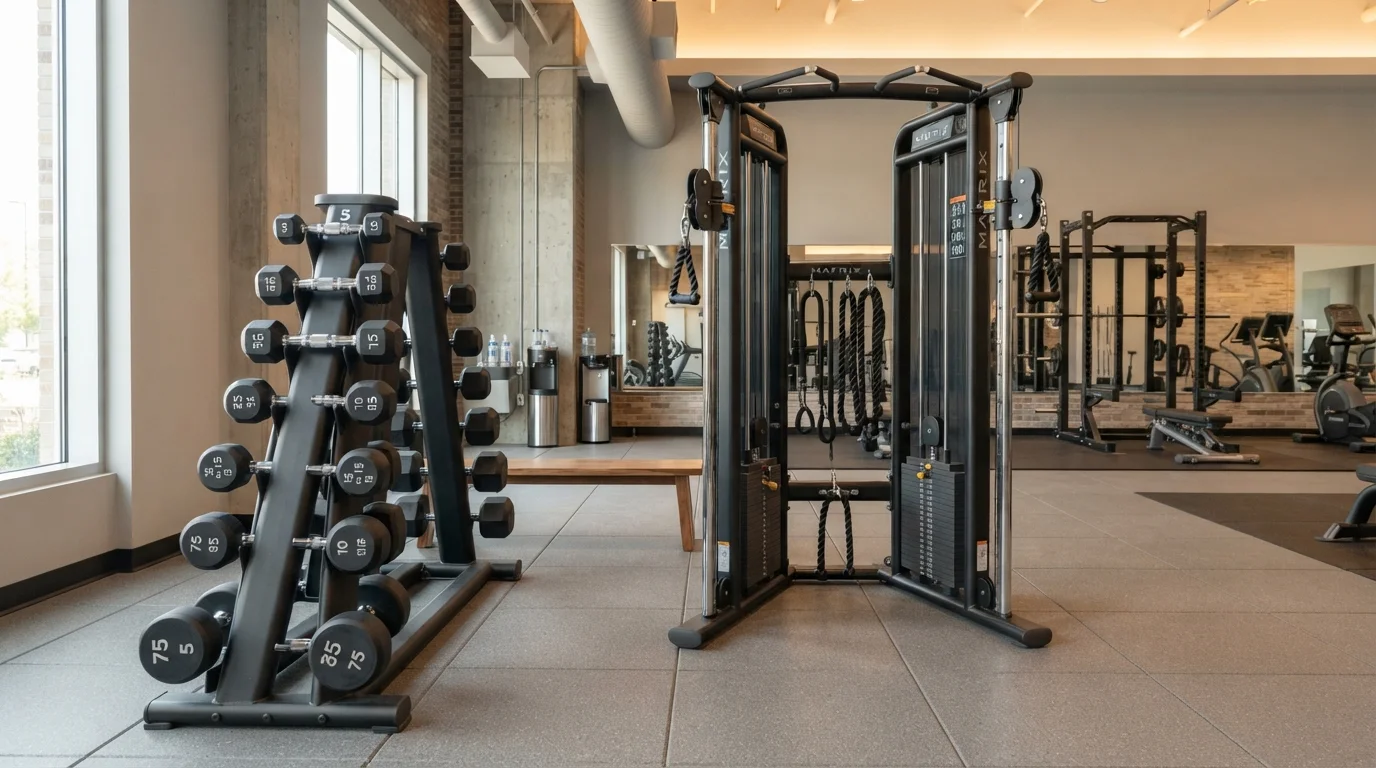
Key Takeaways
- Free weights recruit stabiliser muscles more broadly, making them effective for functional, multi-joint strength.
- Resistance machines constrain movement to a fixed path, reducing coordination demands and injury risk for beginners.
- Neither approach is universally superior — the best choice depends on experience, goals, and physical condition.
- Combining both tools within a programme can offer complementary benefits across a training week.
- Consult a fitness professional before starting any new resistance training programme, especially with prior injuries.
Option A
Free Weights
The versatile, skill-demanding classic.
Best for: Adults who want to develop functional strength, balance, and coordination across multiple muscle groups simultaneously.
Option B
Resistance Machines
The guided, accessible strength-building tool.
Best for: Beginners, those returning from injury, or anyone who wants to isolate specific muscles with built-in movement guidance.
If you are new to resistance training
Resistance Machines
Machines guide you through a controlled range of motion, reducing the technical demands and risk of improper form while you build foundational strength.
If you want to build functional, real-world strength
Free Weights
Free weights require your stabilising muscles to work continuously, translating more directly to everyday physical tasks and athletic movement patterns.
If you are returning to training after an injury
Resistance Machines
The fixed movement path reduces stress on surrounding joints and connective tissue, allowing controlled loading under medical or physiotherapy guidance.
If you want to maximise training variety and efficiency
Free Weights
A single set of dumbbells or a barbell can replicate dozens of exercises, making free weights highly adaptable across different training goals and settings.
If you want to safely target a specific muscle group
Resistance Machines
Machines isolate muscles effectively without requiring the coordination needed for free-weight alternatives, which can be useful for targeted rehabilitation or bodybuilding goals.
What Sets These Two Approaches Apart
Free weights — dumbbells, barbells, kettlebells, and similar implements — require the user to control both the load and the movement path entirely. That demands engagement from stabilising muscles throughout each repetition. Resistance machines, by contrast, constrain movement along a predetermined track, so the mechanical work is more focused on the target muscle group with less demand on balance and coordination.
This distinction matters practically. A barbell back squat requires your core, hips, and dozens of smaller stabilisers to work in concert. A leg press machine channels the same general movement into a guided path that reduces that coordination requirement significantly. Neither is inherently better — they are asking your body to do meaningfully different things.
For a broader look at how resistance training fits alongside cardiovascular exercise, see our comparison of cardio and strength training.
| Criterion | Free Weights | Resistance Machines |
|---|---|---|
| Stabiliser muscle involvement | High — full-body coordination required | Low — path is mechanically guided |
| Technique demands | Steep learning curve | Accessible for beginners |
| Injury risk (untrained users) | Higher without coaching | Lower due to fixed movement |
| Exercise variety | Very high from minimal equipment | Limited to machine design |
| Muscle isolation | Moderate — requires skill | High — built into the design |
| Functional strength transfer | Strong evidence of carryover | More limited transfer |
| Suitability for rehabilitation | Variable — case dependent | Often preferred under guidance |
The Case for Free Weights
Research consistently supports the role of free-weight training in developing functional strength — the kind that transfers to real-life activities. Because multi-joint free-weight movements recruit a broader network of muscles simultaneously, they tend to produce strength gains that carry over beyond the gym. The American College of Sports Medicine (ACSM) recognises multi-joint exercises as a cornerstone of effective resistance training programming.
Free weights also offer high exercise variety from minimal equipment. A pair of dumbbells can facilitate dozens of movements targeting virtually every major muscle group. This versatility is a meaningful advantage for home trainers or those with limited gym access.
That said, the technique demands are real. Poor form with free weights — particularly barbell lifts — increases injury risk, especially for the lower back, shoulders, and knees. Working with a qualified fitness professional when learning foundational movements is strongly recommended. See our companion piece on compound versus isolation exercises for guidance on which movement patterns suit different goals.
2×/week
Minimum resistance training frequency recommended
The ACSM recommends adults engage in muscle-strengthening activities involving all major muscle groups at least two days per week.
~1–3%
Annual muscle mass loss after age 30 (untreated)
Research estimates adults can lose roughly 1–3% of muscle mass per year from around age 30 without resistance training, a process known as sarcopenia.
The Case for Resistance Machines
Machines shine in specific contexts: introducing newcomers to resistance training, supporting rehabilitation after injury, and enabling targeted muscle isolation. Because the movement path is fixed, users can focus on effort and muscle engagement rather than technique management. This lowers the barrier to entry considerably.
For older adults or those managing joint conditions, machines can allow progressive overload — gradually increasing the training stimulus over time — with a reduced risk of technique breakdown under fatigue. As our article on strength training across the lifespan explains, exercise selection may need to adapt as the body changes with age, and machines often provide a safer starting point for those re-entering training.
One common misconception is that machines produce inferior muscle development. Evidence does not support this claim broadly. For hypertrophy (muscle growth) goals, machine-based training can be highly effective, particularly for isolating muscles that are difficult to target with free weights alone — the leg curl or pec deck, for instance.
A Note on Special Populations
Older adults, pregnant individuals, and those managing chronic conditions or recovering from injury should not treat general fitness guidance as personal medical advice. Resistance training can be highly beneficial across these groups, but exercise selection, load, and progression should be guided by a qualified healthcare provider or certified exercise professional familiar with the individual's health history.
Building a Balanced Programme
The most effective resistance training programmes for most adults are not dogmatically free-weight-only or machine-only. They draw on both tools strategically. A common approach: use multi-joint free-weight movements (squats, deadlifts, rows, presses) as the structural core of a session, then complement them with machine-based isolation exercises to address specific muscle groups with less systemic fatigue.
Programme design should account for your current fitness level, training history, and any health considerations. Adults new to resistance training are generally advised to begin with two sessions per week, gradually building volume and intensity as competence improves — consistent with ACSM guidelines. If you have any pre-existing health conditions or injuries, consult a qualified healthcare professional or certified exercise specialist before beginning a new programme.
For a more detailed breakdown of how these tools fit within a broader men's health context, see our article on making sense of the gym floor debate.
This article is for general informational purposes only and does not constitute medical or exercise advice. Always consult a qualified healthcare or fitness professional before beginning a new training programme.