

Key Takeaways
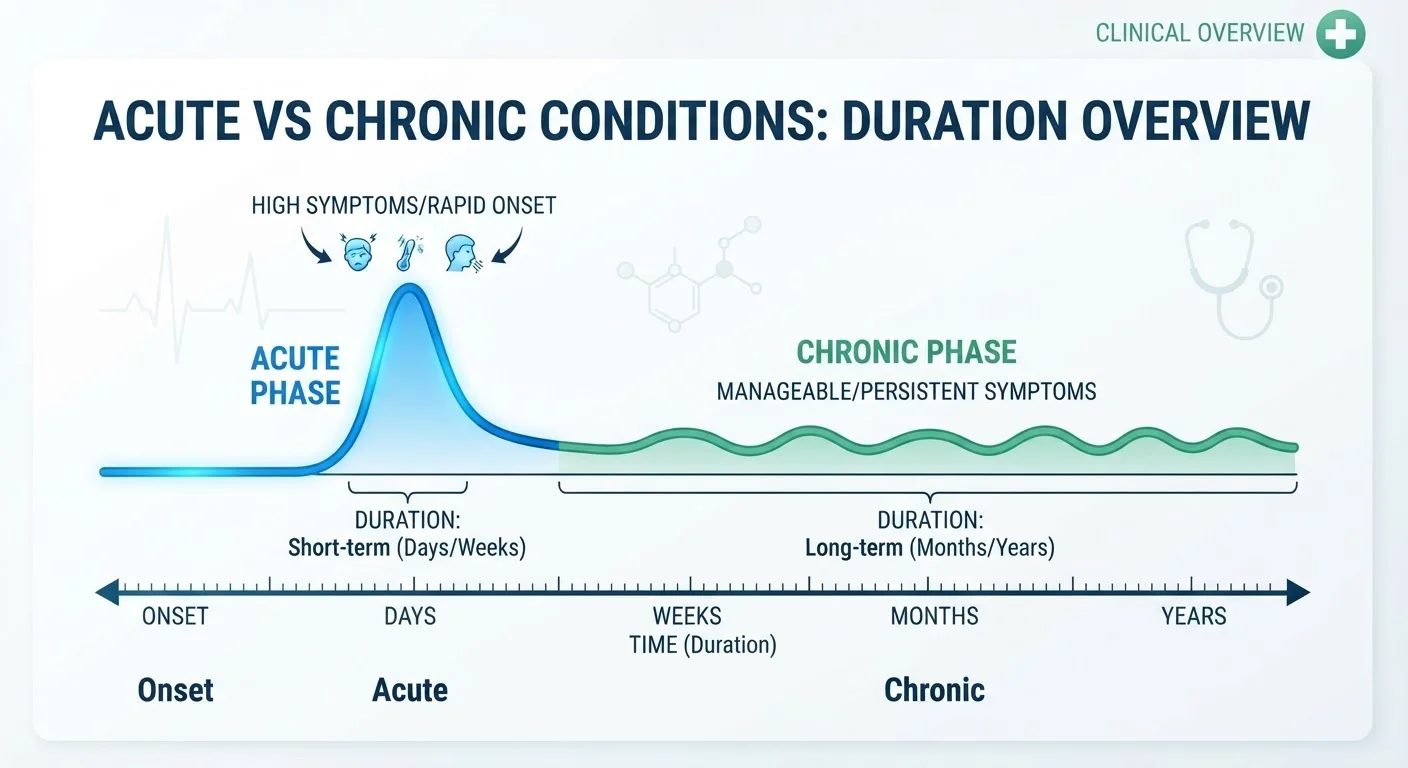
- Chronic conditions are defined by duration — typically lasting three months or more.
- They differ from acute illness in trajectory: most do not resolve on their own.
- Many chronic conditions are manageable but not curable with current medicine.
- Chronic does not always mean severe — some people experience mild, stable symptoms.
- Understanding this distinction helps shape realistic, long-term care planning.
Chronic (medical definition)
In medicine, 'chronic' describes a condition that persists for an extended period — typically three months or longer — and usually cannot be cured outright. Chronic conditions may remain stable, slowly progress, or cycle through periods of worsening (flares) and improvement (remission). Unlike illnesses that resolve on their own, chronic conditions require ongoing management rather than a finite course of treatment.
The three-month threshold is a widely used clinical benchmark, though some definitions vary by specialty. Chronicity is also characterized by pathophysiological changes that outlast any single triggering event.
The Core Meaning of 'Chronic' in Clinical Language
The word chronic comes from the Greek chronos, meaning time — and that etymology points directly to its medical meaning. A condition is classified as chronic primarily because of how long it lasts, not because of how painful, dangerous, or complex it is.
Most clinicians use a threshold of roughly three months. If a condition persists beyond that point without resolving, it is generally considered chronic. The CDC and WHO both describe chronic diseases as conditions that are long-lasting and typically require ongoing medical attention or limit activities of daily living — or both.
Crucially, this definition says nothing about curability, severity, or origin. A condition can be chronic and mild. It can be chronic and well-controlled. It can become chronic after an acute episode, or it can develop so gradually that no single starting point can be identified.
Chronic Pain: A Special Case
Chronic pain is not simply acute pain that has lasted longer — it involves distinct neurological and physiological changes that make it a separate clinical entity. Management strategies differ significantly as a result. For more detail, see our explainer on why chronic pain differs from acute pain.
For readers navigating a new diagnosis, what to realistically expect after a chronic diagnosis is explored in detail in our introductory guide for the newly diagnosed.
Chronic vs. Acute: Why the Distinction Matters
Acute conditions are characterized by a rapid onset and a defined endpoint. A strep throat infection, an appendicitis episode, or a sprained ankle all follow a recognizable arc: they begin, peak, and — with appropriate treatment — resolve. The body's response is intense but time-limited.
Chronic conditions do not follow that arc. They may begin insidiously over years, stabilize at a certain level of dysfunction, or fluctuate unpredictably. The management goal shifts from elimination to control — reducing symptoms, slowing progression, and preserving quality of life.
6 in 10
U.S. adults living with at least one chronic disease
According to the CDC, approximately 60% of American adults have at least one chronic health condition.
4 in 10
U.S. adults with two or more chronic conditions
The CDC also reports that roughly 40% of adults in the U.S. are managing multiple chronic conditions simultaneously.
90%
Share of annual U.S. healthcare spending on chronic and mental health conditions
The CDC estimates that chronic and mental health conditions account for about 90% of the nation's $4.1 trillion in annual healthcare expenditures.
This distinction has direct consequences for how care is structured. Acute care is often reactive and episodic. Chronic care demands proactive, coordinated strategies involving lifestyle, medication adherence, regular monitoring, and often a multidisciplinary team.
It also affects how clinicians classify infections. Not all infections clear quickly — for a closer look at the biological differences, see our article on how acute and chronic infections differ.
Trajectories: What Chronic Can Look Like in Practice
Chronic conditions do not behave identically. Clinicians often describe three broad trajectories:
- Stable chronic conditions — symptoms remain relatively constant and manageable with treatment. Well-controlled hypothyroidism is one example.
- Progressive chronic conditions — the underlying disease advances over time, even with treatment. Chronic kidney disease often follows this pattern.
- Relapsing-remitting chronic conditions — periods of significant symptoms (flares) alternate with stretches of reduced or absent symptoms (remission). Multiple sclerosis and Crohn's disease are commonly cited examples.
Understanding which trajectory applies to a specific condition matters for setting realistic expectations and planning care. Key clinical terms used in chronic care conversations — including flare, remission, and titration — are explained in a dedicated reference guide.
It is also worth noting that chronic physical conditions and mental health are not separate concerns. Long-term illness can significantly affect emotional well-being, and that relationship runs in both directions. Our article on how chronic illness and depression intersect explores why integrated care matters.
This article provides general health information and education only. It is not a substitute for professional medical advice, diagnosis, or treatment. Always consult a qualified healthcare provider about your individual health concerns.