

Key Takeaways
- Acute infections are typically short-lived, resolving within days to weeks as the immune system clears the pathogen.
- Chronic infections persist for months or years, often because pathogens evade or suppress immune clearance.
- The immune response differs significantly between acute and chronic infection, affecting inflammation, tissue damage, and long-term health.
- Some infections can transition from acute to chronic if not fully eliminated early.
- Chronic infections are linked to increased risk of certain cancers, autoimmune conditions, and organ damage over time.
Our Verdict
Acute and chronic infections are fundamentally different in duration, immune dynamics, and health consequences. An acute infection triggers a rapid, self-limiting immune response, while a chronic infection involves ongoing immune activation that can cause lasting harm. Recognising these distinctions helps inform when to seek care and what to expect from treatment.
| Best for | Recommended |
|---|---|
| Those wanting a foundational overview of how infections are classified | Acute vs Chronic framework |
| People managing a long-term diagnosed infection | Chronic infection context |
| Those recovering from a recent illness and wondering about resolution timelines | Acute infection context |
Defining Acute and Chronic Infections
Not all infections follow the same course. Understanding the difference between acute and chronic infections begins with how they're defined clinically. For a broader foundation, see our beginner's overview of infections and immunity.
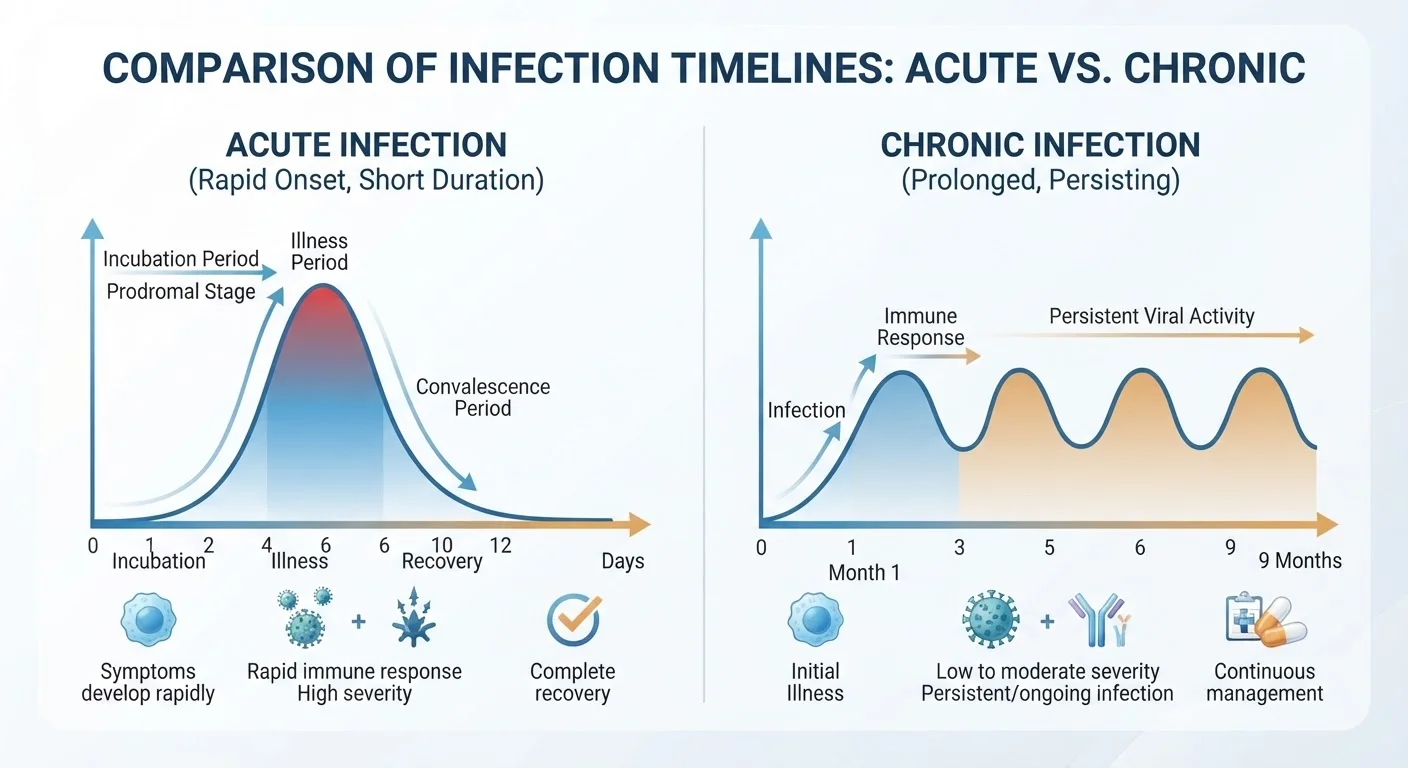
An acute infection develops rapidly, produces noticeable symptoms, and typically resolves within days to a few weeks. The flu, strep throat, and most common colds are familiar examples. The immune system mounts a focused response, eliminates the pathogen, and the body returns to its baseline state.
A chronic infection, by contrast, persists for three months or longer — sometimes indefinitely. Hepatitis B, hepatitis C, HIV, and certain strains of Epstein-Barr virus are well-established examples. In these cases, the pathogen is not fully cleared; it may establish a reservoir in host cells, enter a latent phase, or actively suppress immune mechanisms designed to eliminate it.
Some infections can be acute initially and then transition to a chronic state. Hepatitis B, for instance, resolves acutely in most adults but becomes chronic in a significant proportion of those infected as infants or young children, when the immune system is less equipped to mount a clearing response.
| Acute Infection | Chronic Infection | |
|---|---|---|
| Duration | Days to a few weeks | Months to years (or lifelong) |
| Symptom onset | Rapid, often intense | Gradual or initially silent |
| Immune response | Robust, self-limiting | Prolonged, often dysregulated |
| Pathogen clearance | Typically complete | Incomplete or persistent |
| Long-term health risk | Low (once resolved) | Higher — organ damage, cancer risk |
| Common examples | Flu, strep throat, norovirus | HIV, hepatitis B/C, Epstein-Barr |
| Treatment approach | Supportive or short-course therapy | Long-term antiviral or monitoring |
How the Immune System Responds Differently
The immune response to an acute infection is characterised by rapid mobilisation. Innate immune cells — including neutrophils and macrophages — arrive at the site of infection first, followed by the adaptive immune response involving T cells and B cells that produce targeted antibodies. Once the pathogen is cleared, most of these activated immune cells die off, leaving behind memory cells that enable faster responses to future encounters. To understand these two immune layers in depth, see our explanation of innate vs adaptive immunity.
Chronic infections present a more complex picture. Prolonged exposure to pathogen antigens can lead to a state known as immune exhaustion, where T cells lose their ability to function effectively. This is particularly well-documented in HIV and chronic viral hepatitis. The result is a persistent, low-grade inflammatory environment that, over time, contributes to tissue damage even in the absence of acute symptoms.
Chronic immune activation is not benign. Sustained inflammation is associated with fibrosis (scarring), increased cancer risk — hepatocellular carcinoma in chronic hepatitis B or C, for example — and disruption of normal immune regulation that may contribute to autoimmune phenomena.
Immune Exhaustion Is Reversible in Some Cases
Research has shown that effective antiviral therapy — such as antiretroviral treatment for HIV or direct-acting antivirals for hepatitis C — can partially restore T cell function even after prolonged immune exhaustion. This is one reason early diagnosis and treatment initiation of chronic infections can meaningfully improve immune outcomes. Discuss the timing and type of treatment with your healthcare provider.
Key Differences at a Glance
While individual infections vary considerably, several characteristics reliably distinguish acute from chronic presentations. Duration is the most obvious marker, but the nature of symptoms, immune dynamics, and health consequences also differ meaningfully. Just as chronic pain is biologically distinct from acute pain, chronic infections involve different underlying mechanisms — not simply a prolonged version of the acute process.
The distinction also has treatment implications. Acute infections may resolve with supportive care or a short antibiotic or antiviral course. Chronic infections often require long-term antiviral therapy, immunomodulation, or regular monitoring to prevent complications. Understanding whether an infection is viral or bacterial also shapes how clinicians approach treatment in both acute and chronic contexts. Many chronic infections have specific management pathways, and for those living with long-term conditions, the chronic conditions hub provides broader context on disease management strategies.
When to Seek Medical Evaluation
Most acute infections resolve without medical intervention, but certain features warrant prompt clinical assessment: symptoms that worsen after initial improvement, high or prolonged fever, difficulty breathing, signs of dehydration, or any infection in a person who is immunocompromised, pregnant, elderly, or very young.
Chronic infections are often identified through blood tests rather than acute symptoms — many people with chronic hepatitis B or C, or with HIV, have no obvious symptoms for years. Routine screening is therefore a key tool in detection. If you have risk factors for chronic infections, speak with a healthcare provider about whether screening is appropriate for you.
This article is for informational purposes only and does not constitute medical advice, diagnosis, or treatment. Always consult a qualified healthcare professional for personal health concerns or before making decisions about your care.