

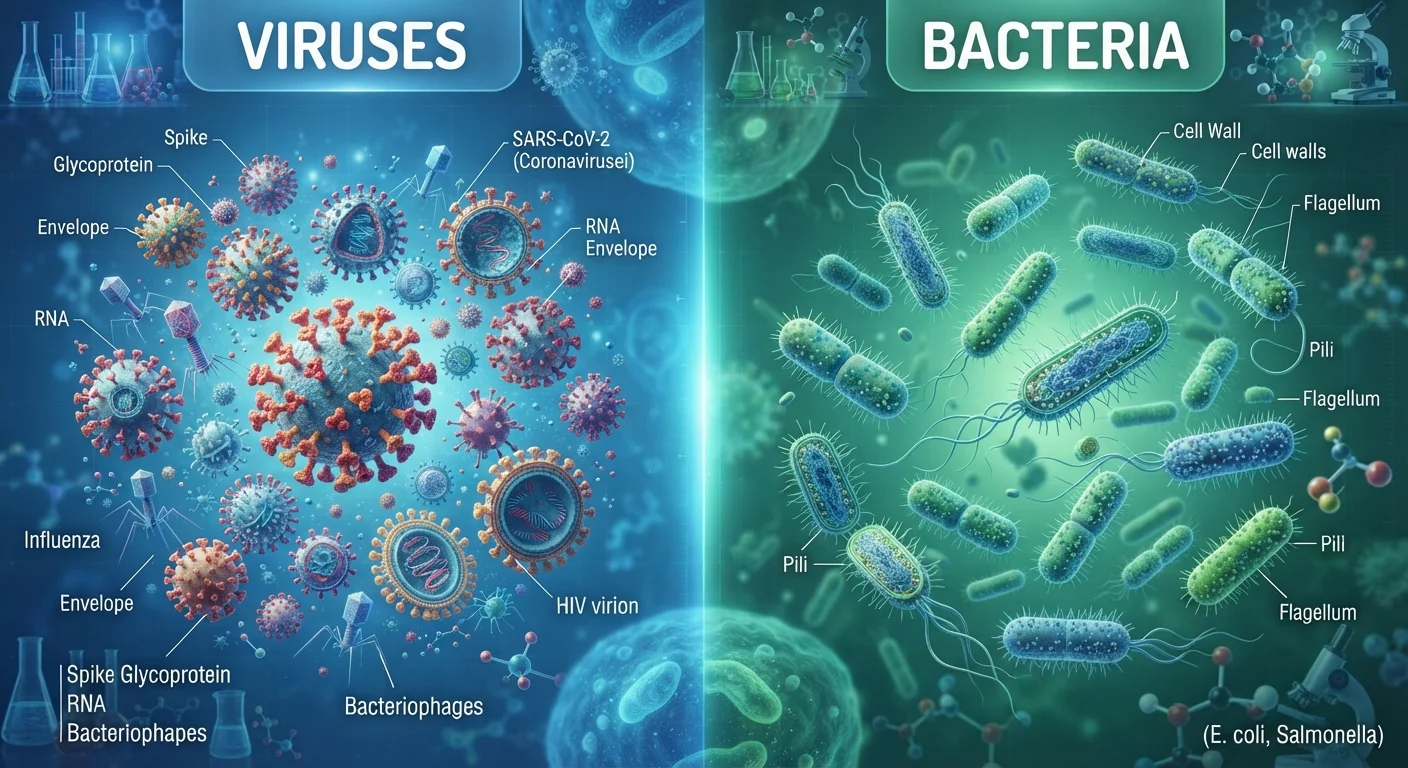
Key Takeaways
- Viruses require a host cell to replicate; bacteria are self-sufficient living organisms.
- Antibiotics treat bacterial infections but are ineffective — and potentially harmful — against viruses.
- Symptoms alone rarely confirm whether an infection is viral or bacterial; clinical testing is often needed.
- Misusing antibiotics for viral illnesses contributes to antibiotic resistance, a serious public health threat.
- Both infection types can range from mild to life-threatening depending on the pathogen and host immune response.
Option A
Viral Infections
Intracellular invaders that hijack your own cells to replicate.
Best for: Understanding illnesses like influenza, COVID-19, and the common cold, where antibiotics offer no benefit.
Option B
Bacterial Infections
Independent single-celled organisms that multiply and release harmful substances.
Best for: Recognizing conditions like strep throat, urinary tract infections, and pneumonia that may respond to antibiotic therapy.
If you have a sore throat and want to know whether antibiotics are appropriate
Bacterial Infections
Strep throat is bacterial and typically requires antibiotic treatment; viral sore throats do not. A throat swab or rapid strep test can clarify the cause.
If you're experiencing classic cold or flu symptoms
Viral Infections
Most respiratory illnesses — runny nose, body aches, fever without localized pain — are viral in origin, and antibiotics will not help. Rest and supportive care are usually appropriate.
If symptoms persist, worsen after initial improvement, or include high fever
Bacterial Infections
Secondary bacterial infections can follow viral illness. Persistent or worsening symptoms warrant a medical evaluation to rule out bacterial involvement requiring treatment.
Fundamentally Different Organisms
Viruses and bacteria represent two entirely distinct categories of pathogen — and understanding that distinction is critical to understanding how illness works and how it should be managed.
Bacteria are single-celled living organisms. They have their own cellular machinery, can reproduce independently, and can survive in a wide range of environments — including soil, water, and the human body. Many bacteria are beneficial; the gut microbiome, for example, is populated by trillions of bacterial species essential to digestion and immune function. It is a minority of bacterial species that cause disease.
Viruses are not truly alive in the biological sense. They are packages of genetic material — either DNA or RNA — encased in a protein shell called a capsid. Viruses cannot replicate on their own; they must invade a host cell and commandeer its machinery to produce copies of themselves. This intracellular behavior is what makes viruses so difficult to target without affecting the host's own cells.
| Criterion | Viral Infections | Bacterial Infections |
|---|---|---|
| Nature of pathogen | Non-living; genetic material in protein shell | Living single-celled organism |
| Replication method | Hijacks host cell machinery | Reproduces independently by division |
| Examples | Influenza, COVID-19, common cold, HIV | Strep throat, UTI, tuberculosis, Lyme disease |
| Primary treatment | Antivirals (where available); supportive care | Antibiotics (when clinically indicated) |
| Antibiotics effective? | No | Yes (for susceptible strains) |
| Vaccine availability | Available for many (flu, COVID-19, MMR) | Available for some (pertussis, pneumococcal) |
| Typical immune response | Systemic; interferon-mediated | Localized; neutrophil-driven |
How the Immune System Responds
The immune response to viruses and bacteria shares some common features — inflammation, fever, fatigue — but the underlying mechanisms differ in important ways.
Against bacteria, the immune system rapidly deploys neutrophils (a type of white blood cell) to engulf and destroy the invaders, often producing the pus characteristic of bacterial infections. The inflammatory response is typically localized and intense.
Viral infections tend to trigger a broader, system-wide response. The body releases interferons — signaling proteins that warn neighboring cells and slow viral spread. This is partly why viral illnesses often produce pronounced fatigue and body aches even when the infection is not concentrated in a single location.
Secondary Infections: When Both Types Overlap
A viral infection can sometimes create conditions favorable for a secondary bacterial infection. For example, influenza can damage the respiratory lining, making it easier for bacteria such as Streptococcus pneumoniae to establish themselves — a pattern seen in some cases of post-influenza pneumonia. If symptoms improve and then sharply worsen, or if new localized symptoms appear, a healthcare provider should evaluate for a possible secondary bacterial infection.
To learn more about why some individuals mount stronger immune responses than others, see why some people get sick more often than others.
Diagnosis and Treatment: Why the Distinction Matters
One of the most clinically consequential differences between viral and bacterial infections is how they are treated — and how they are diagnosed.
Antibiotics work by targeting structures unique to bacteria: their cell walls, ribosomes, or metabolic pathways. Because viruses lack these structures, antibiotics have no effect on viral illness. Prescribing antibiotics for a viral infection does not shorten its course; it does, however, increase the risk of antibiotic-resistant bacteria developing — a growing global health concern.
Conversely, antiviral medications (such as those used for influenza, HIV, or herpes simplex) are designed to interfere with virus-specific processes. They have no utility against bacterial pathogens.
~35%
Antibiotic prescriptions considered unnecessary
The CDC has estimated that roughly 28–35% of outpatient antibiotic prescriptions in the U.S. are unnecessary, often issued for viral conditions.
700,000+
Annual deaths from antibiotic-resistant infections globally
The WHO attributes over 700,000 deaths per year worldwide to antimicrobial resistance, a figure projected to rise without stewardship improvements.
Distinguishing between the two often requires clinical testing. A throat swab, urine culture, blood test, or chest imaging may be necessary — symptoms alone are frequently insufficient for a definitive diagnosis. For context on how infection type relates to disease duration and severity, see acute vs. chronic infections.
This article is for general informational purposes only and does not constitute medical advice. Always consult a qualified healthcare professional for diagnosis, treatment decisions, or concerns about your specific health situation.