

Key Takeaways
- BMI is a simple screening tool, not a direct measure of body fat or health status.
- The formula uses only height and weight, ignoring muscle mass, bone density, and fat distribution.
- BMI categories were developed from predominantly white European populations, which limits accuracy across all ethnicities.
- A BMI result is most useful when reviewed alongside other health indicators by a qualified provider.
- Both very low and very high BMI values are associated with increased health risks at the population level.
- BMI is not an appropriate sole measure for athletes, older adults, pregnant individuals, or children.
Body Mass Index (BMI)
Body Mass Index, or BMI, is a numerical value calculated from a person's height and weight. It is used as a population-level screening tool to broadly categorize individuals into weight status groups — underweight, normal weight, overweight, or obese. BMI does not directly measure body fat, muscle, or overall health.
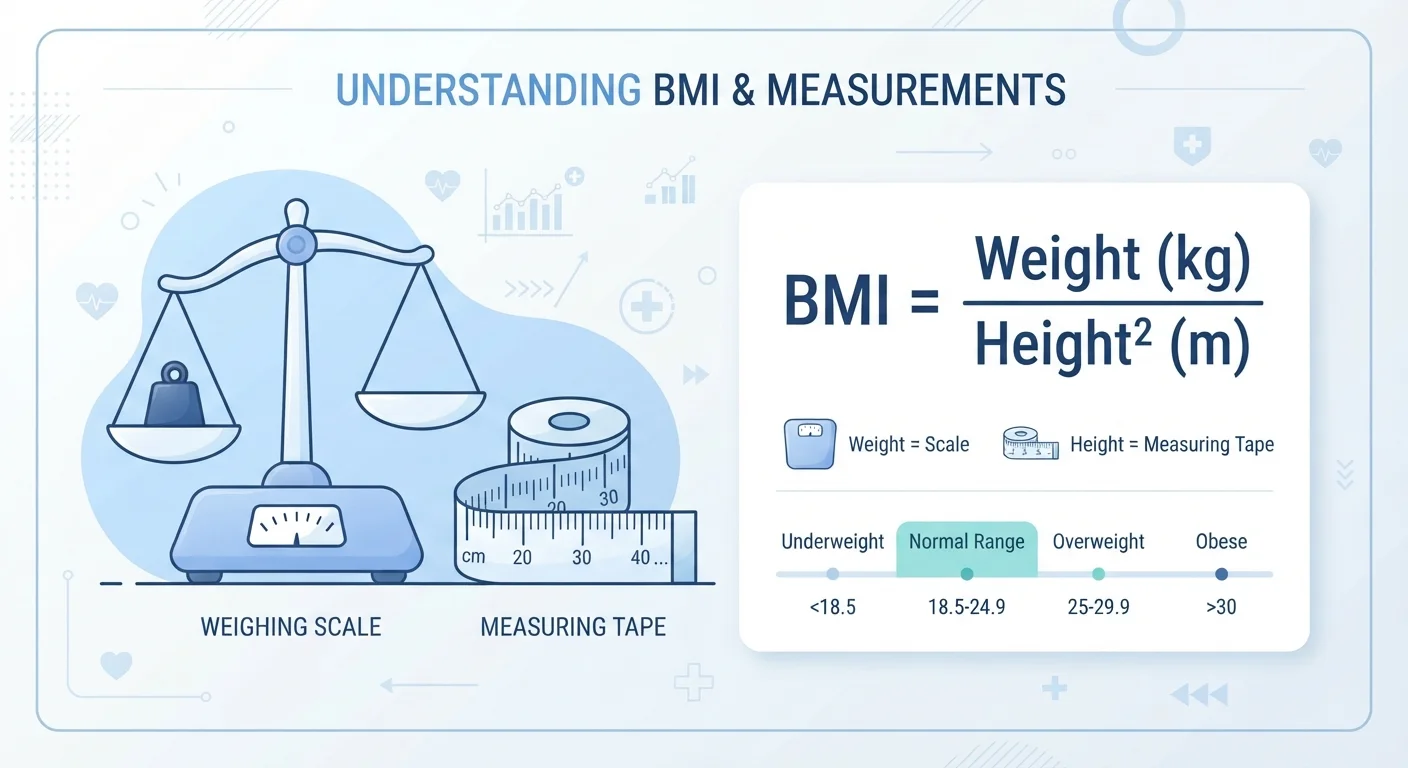
BMI is calculated as weight in kilograms divided by height in meters squared (kg/m²). Standard adult categories set by the CDC are: underweight (<18.5), normal weight (18.5–24.9), overweight (25–29.9), and obese (≥30).
How BMI Is Calculated
Body Mass Index is computed from two measurements: height and weight. The formula — weight (kg) divided by height (m²) — produces a single number. In the United States, calculators typically accept pounds and inches and apply a conversion factor (703) to return the same result.
The output is then matched against four standard adult categories established by the Centers for Disease Control and Prevention (CDC):
- Underweight: Below 18.5
- Normal weight: 18.5 to 24.9
- Overweight: 25.0 to 29.9
- Obese: 30.0 and above
These thresholds were set based on population-level data linking weight-to-height ratios with disease risk. They are not individualized cut-points — they are statistical averages derived from large groups. Understanding this distinction is essential to interpreting your own result accurately.
~42%
US adults classified as obese by BMI
According to CDC National Health and Nutrition Examination Survey (NHANES) data, roughly 42% of US adults fall into the obese BMI category (≥30).
1832
Year the BMI formula was first developed
Belgian mathematician Adolphe Quetelet developed the weight-to-height-squared ratio in 1832 as a statistical tool for studying populations — not as a clinical health measure.
~30%
Individuals misclassified by BMI alone
Research published in peer-reviewed journals estimates that BMI misclassifies the metabolic health status of roughly one in three adults when used as a standalone measure.
What BMI Actually Reflects
At a population level, BMI functions as a practical proxy for identifying groups at higher risk of conditions such as type 2 diabetes, cardiovascular disease, and certain cancers. Public health researchers use it precisely because it is cheap, fast, and requires no lab work.
What the formula genuinely reflects is the relationship between a person's mass and their stature. Higher values indicate more weight relative to height — but that weight could be fat, muscle, bone, or fluid. BMI cannot tell the difference. This is why it correlates with body fat in large population studies yet fails to predict it accurately for specific individuals.
For a broader view of what fitness metrics reveal about your body, see our guide to fitness tracker metrics.
“BMI is a useful screening tool at the population level, but it is a poor diagnostic test for individuals. It tells us something, but not enough on its own to guide clinical decisions.”
— Dr. Frank Sacks, Professor of Cardiovascular Disease Prevention, Harvard T.H. Chan School of Public Health
Where BMI Falls Short
BMI's core limitation is that it ignores body composition — the ratio of fat to lean tissue. Consider two adults of the same height and weight: one is sedentary with low muscle mass and high visceral fat; the other is a strength athlete with dense muscle. Their BMIs are identical, but their health profiles differ substantially.
Additional documented limitations include:
- Ethnicity: Research indicates that people of Asian descent may face increased metabolic risk at BMI levels below the standard "overweight" threshold of 25. Some clinical guidelines use lower cut-points (around 23) for these populations.
- Older adults: Muscle mass naturally declines with age (a process called sarcopenia). An older adult may have a normal BMI while carrying excess fat and insufficient muscle.
- Sex differences: Women typically carry a higher proportion of body fat than men at the same BMI, yet the same thresholds apply to both.
- Height extremes: BMI tends to overestimate adiposity in very tall individuals and underestimate it in shorter individuals.
For a deeper look at why weight alone is an incomplete picture, see body composition vs. body weight. And to untangle common misconceptions directly, visit our article on BMI myths and what the evidence shows.
How to Use Your BMI Result Responsibly
A BMI result is best understood as one data point among several — a starting prompt, not a conclusion. Clinicians typically pair it with waist circumference (a measure of abdominal fat), blood pressure, fasting glucose, and lipid panels before drawing health conclusions.
If you use an online BMI calculator, treat the output accordingly:
- Note which category your result falls into.
- Consider whether your build, ethnicity, age, or activity level might affect interpretation.
- Bring the result to a healthcare provider if you have concerns or if your number falls outside the normal range.
BMI is not designed to diagnose disease, recommend treatment, or serve as a personal fitness goal. For context on how other health numbers relate to energy and metabolism, the article on TDEE vs. BMR is a useful companion read. Pair BMI awareness with sound nutrition habits — our overview of what a balanced diet actually means offers grounded guidance.
This article is for informational purposes only and does not constitute medical advice. Always consult a qualified healthcare provider with questions about your individual health status.