

Key Takeaways
- Popular ideal weight formulas like Devine and Hamwi were created for drug dosing, not general wellness guidance.
- These formulas rely only on height and sex, ignoring muscle mass, bone density, age, and ethnicity.
- Different formulas can produce meaningfully different target weights for the same individual.
- Ideal weight calculators are best used as broad reference points, not precise health targets.
- A healthcare provider can offer personalized context that no single formula can match.
Ideal Weight Calculator
An ideal weight calculator is a tool that estimates a target body weight range based on inputs like height, sex, and sometimes age or frame size. These calculators apply established mathematical formulas originally developed for clinical and pharmaceutical dosing purposes. The resulting number is a statistical estimate, not a personalized prescription for health.
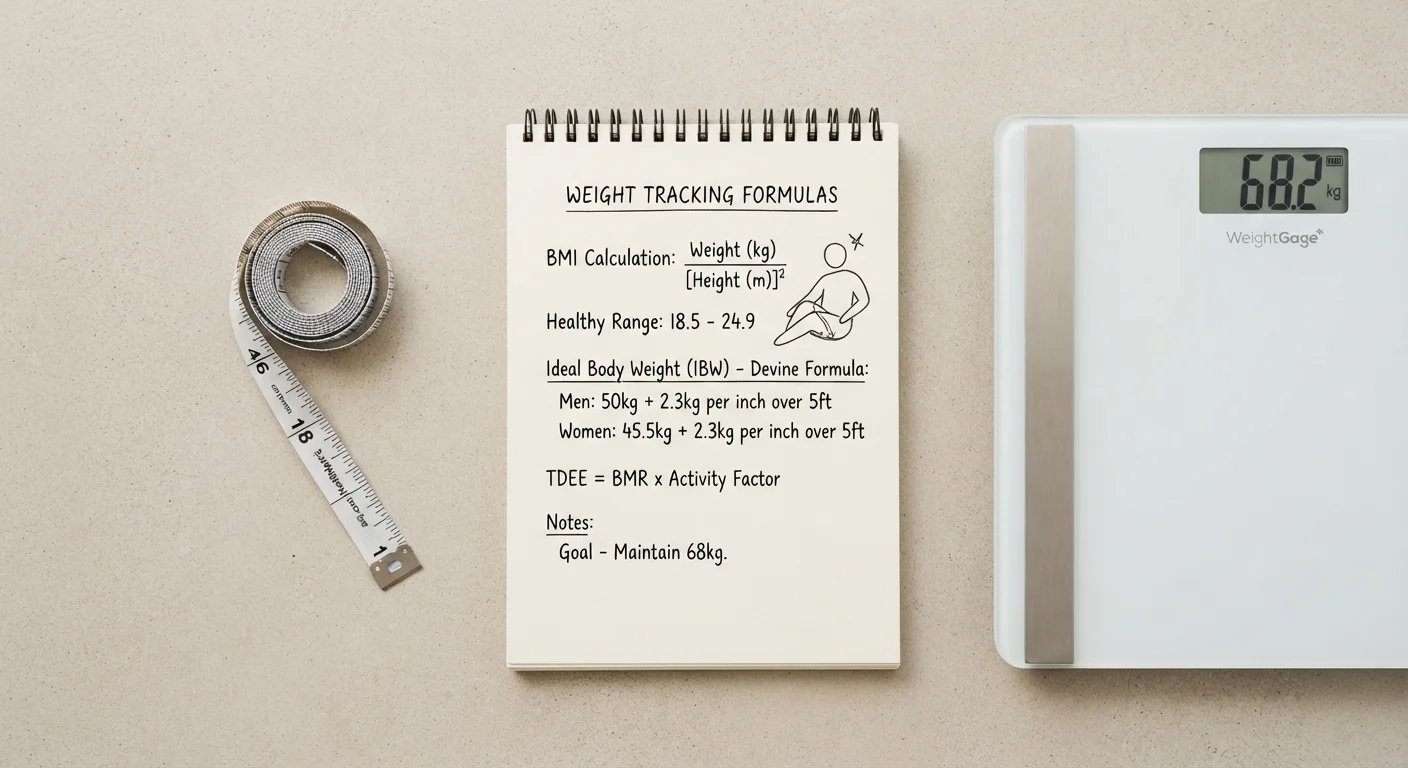
Most widely used formulas — including Devine, Hamwi, and Robinson — are linear equations derived from actuarial or clinical data collected primarily from mid-20th-century populations, limiting their generalizability across diverse body types and ethnic groups.
Where Ideal Weight Formulas Come From
The formulas powering most ideal weight calculators today were not designed with personal fitness goals in mind. The Hamwi formula, published in 1964, was developed to help clinicians estimate appropriate caloric needs for hospitalized patients. The Devine formula, introduced in 1974, was created specifically to calculate drug dosages based on body weight — a context where accuracy in estimating lean mass mattered for medication safety.
The Robinson and Miller formulas followed in the 1980s, each refining the approach slightly using different reference populations. All four share a common structure: a base weight for a standard height (typically 5 feet), with a fixed increment added or subtracted per inch above or below that baseline, split by sex assigned at birth.
Because these formulas originate from narrow clinical applications, they were never validated as universal benchmarks for what any individual should weigh for optimal health. Understanding this origin is the first step to interpreting calculator results responsibly.
These Formulas Were Not Designed for Wellness
The Devine and Hamwi formulas were originally created for pharmaceutical and clinical nutrition applications — specifically for calculating medication doses and caloric needs in hospital settings. Their use in consumer-facing ideal weight calculators is an extension of their original purpose, not their primary design. Keep this in mind when interpreting results.
How the Major Formulas Compare
While all four formulas follow the same basic structure, their outputs diverge in practice. For a 5-foot-10-inch male, the Devine formula yields an estimate of approximately 166 lbs, Robinson produces roughly 160 lbs, and Hamwi arrives at around 165 lbs. These differences may seem small but they widen at extreme heights and can affect how individuals set weight-related goals.
4
Major ideal weight formulas in common use
Devine (1974), Hamwi (1964), Robinson (1983), and Miller (1983) are the four formulas most frequently referenced in clinical and calculator contexts.
~6 lbs
Typical spread between formula outputs
For an average-height adult male, the Devine, Robinson, and Hamwi formulas can differ by approximately 5–7 lbs, illustrating that no single number is definitive.
1964
Year the Hamwi formula was published
The Hamwi formula was introduced as a clinical nutrition tool over 60 years ago, long before modern understanding of body composition and metabolic diversity.
Most online ideal weight calculators default to Devine because of its long history in clinical settings. Some tools display all four estimates side by side, which can be more informative — it signals immediately that these are ranges of probability, not precise measurements. For a more complete picture of body composition, consider pairing results with a body fat percentage calculator that estimates fat versus lean mass directly.
What These Calculators Cannot Measure
Height and sex are the only inputs in standard ideal weight formulas. This means the following factors are entirely invisible to the calculation:
- Muscle mass: A resistance-trained individual may weigh well above the formula's target while carrying very little body fat.
- Bone density: Frame size and skeletal weight vary significantly between individuals and are not captured by any of these equations.
- Age: Body composition shifts across the lifespan; a formula built on mid-century data does not reflect those changes.
- Ethnicity: Metabolic risk is not uniform across ethnic groups. Research has shown that cardiometabolic risk can differ substantially at the same BMI or weight across populations.
For a broader view of weight-related health risk, waist-based measurements such as waist-to-height ratio can flag metabolic risk that weight alone misses.
Pair Weight Data With Composition Metrics
If your weight differs significantly from a formula's estimate, consider also checking your waist circumference or body fat percentage. These measures add meaningful context that height-and-weight formulas simply cannot provide. Discuss any combination of results with a healthcare provider before drawing conclusions.
Using Calculator Results Responsibly
An ideal weight calculator result is best understood as a rough population-level reference, not an individual target. If your current weight falls within or near the estimated range, that is useful context — but it does not confirm good health on its own. If your weight falls well outside the range, that is a prompt to discuss the gap with a qualified provider, not a diagnosis.
Before using any health calculator, reviewing how to input data correctly and interpret outputs with appropriate caution helps prevent misreading results. The guide to getting reliable results from online health calculators covers these practical steps in detail. Those new to health tools may also benefit from the introductory guide to using health calculators responsibly.
Ideal weight calculators are one data point within a larger picture that includes bloodwork, cardiovascular fitness, nutrition, sleep, and mental wellbeing. A healthcare provider can integrate all of these dimensions in a way that no formula can.
This article is for general informational and educational purposes only and does not constitute medical advice. Always consult a qualified healthcare professional before making decisions about your weight, diet, or health.