

Key Takeaways
- Simple questionnaire tools follow fixed decision trees; AI-powered checkers learn from large medical datasets.
- AI tools can handle symptom combinations and context more flexibly than rule-based systems.
- Neither type replaces a clinician — both serve as triage aids, not diagnostic instruments.
- Knowing which tool type you're using helps you interpret its outputs more accurately.
- Always escalate to a healthcare professional if symptoms are severe, worsening, or unclear.
Our Verdict
Simple questionnaire tools are transparent, consistent, and easy to understand, making them useful for straightforward symptom scenarios. AI-powered checkers offer greater adaptability and nuance but can be harder to audit and may carry their own biases. For most users, the right choice depends on the complexity of their symptoms and their need for contextual reasoning — but neither tool should be the final word on any health decision.
| Best for | Recommended |
|---|---|
| Straightforward, single-symptom triage needs | Simple questionnaire tools |
| Complex or multi-symptom scenarios requiring contextual reasoning | AI-powered symptom checkers |
| Users who want to understand how a tool reached its output | Simple questionnaire tools |
| Ongoing or evolving symptom patterns over time | AI-powered symptom checkers |
Two Distinct Approaches to Symptom Assessment
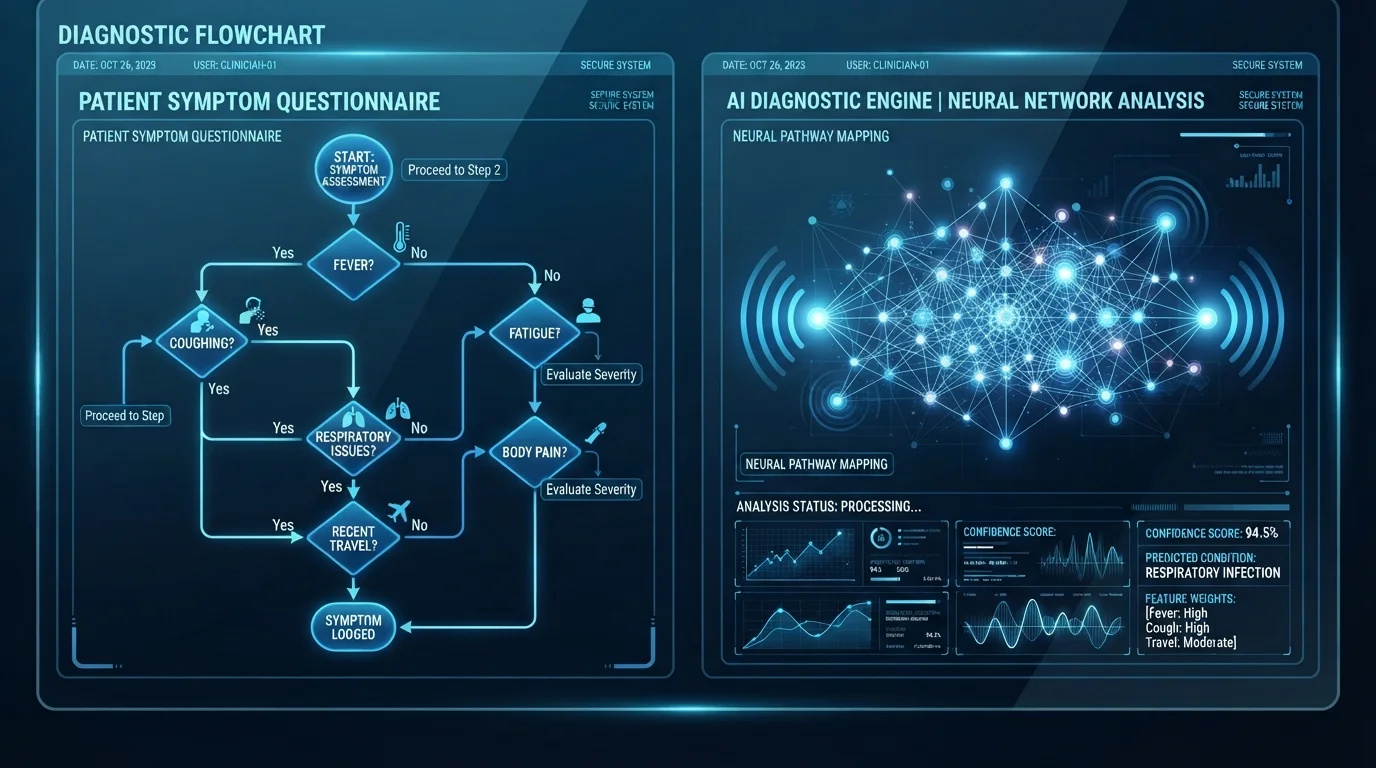
When you use a digital symptom checker, the technology behind it matters enormously. There are two broad categories: rule-based questionnaire tools and AI-powered (machine learning) checkers. Both ask you about your symptoms, but they process your answers in fundamentally different ways.
Rule-based tools use a predetermined decision tree — a structured set of yes/no or multiple-choice questions that map your answers to a fixed set of possible outcomes. The logic is transparent and consistent: the same inputs always produce the same output. AI-powered tools, by contrast, are trained on large datasets of clinical information, enabling them to weigh symptoms probabilistically, recognize patterns across many variables, and adapt their questioning based on your previous answers.
To understand why these differences matter practically, see how symptom checkers triage inputs for a plain-language breakdown of the underlying logic.
| Simple Questionnaire Tools | AI-Powered Symptom Checkers | |
|---|---|---|
| Underlying logic | Fixed decision tree | Machine learning / probabilistic models |
| Adaptability | Static pathways only | Dynamic, adjusts to user responses |
| Transparency | Fully auditable logic | Often opaque ('black box') |
| Handles complex symptom combinations | Limited | Better equipped |
| Consistency of output | Same inputs always yield same output | May vary based on model version or data |
| Risk of algorithmic bias | Lower, but limited scope | Higher if training data is unrepresentative |
| Best use case | Simple, common symptom scenarios | Nuanced or multi-symptom presentations |
Strengths and Limitations of Each Approach
Simple questionnaire tools excel in predictability. Because their logic is hard-coded, clinicians and developers can review and validate every pathway. They are less likely to produce unexpected outputs, and users can often follow the reasoning step by step. However, they struggle with symptom combinations that fall outside their pre-mapped branches. A user with an unusual mix of symptoms may receive a generic or poorly matched result.
AI-powered checkers can handle greater complexity. By drawing on patterns across thousands or millions of cases, they may surface conditions that a simpler tool would miss. They can also adapt their follow-up questions dynamically, narrowing possibilities based on your unique profile. The trade-off is opacity: it can be difficult to understand exactly why the tool reached a particular conclusion, and the training data itself may contain biases that skew results for certain populations.
AI Confidence Can Be Misleading
An AI-powered tool may present a likely condition with apparent authority, but that output reflects a statistical pattern — not a clinical assessment of your individual case. Training datasets may underrepresent certain demographic groups, which can affect accuracy. Always treat any symptom checker result as informational, and consult a clinician before drawing conclusions about your health.
For a fuller picture of where both tool types fall short, explore the strengths and weaknesses of symptom checkers.
What This Means for How You Use These Tools
Understanding the tool type changes how you should interpret its output. With a rule-based tool, take note of the questions it didn't ask — its scope is limited by design. If your situation feels more nuanced than the questions allowed, treat the result as a starting point, not a conclusion.
With an AI-powered tool, be aware that confidence-sounding outputs don't always reflect certainty. These systems estimate probability, and their accuracy varies depending on how well their training data represents people like you. Factors such as age, sex, ethnicity, and pre-existing conditions can all affect reliability.
Regardless of tool type, certain situations always warrant professional evaluation: symptoms that are severe, sudden, or worsening; anything involving chest pain, difficulty breathing, or altered consciousness; and symptoms in pregnant individuals, young children, or those managing chronic conditions. No digital tool should substitute for that judgment call. You can also learn about why symptom checkers sometimes get it wrong to further calibrate your expectations.
For broader context on how these tools fit into everyday health management, read the complete picture on digital symptom assessment tools.
This article is for informational purposes only and does not constitute medical advice. Always consult a qualified healthcare professional for personal health concerns, diagnosis, or treatment decisions.