

Key Takeaways
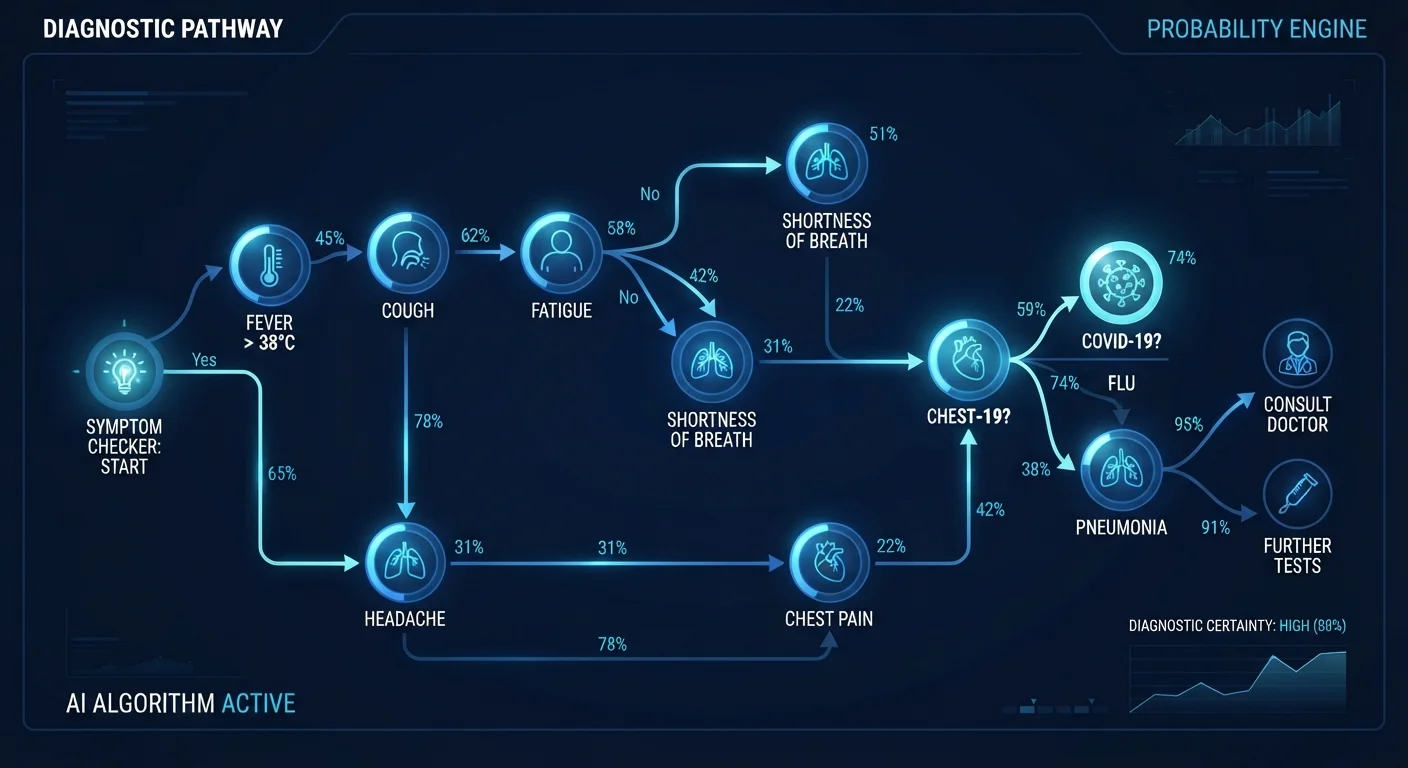
- Symptom checkers use either rule-based decision trees or probabilistic algorithms to evaluate your inputs.
- Your age, sex, and existing conditions significantly influence which conditions the tool surfaces.
- Triage outputs recommend a care urgency level — not a definitive diagnosis.
- The quality of results depends directly on how accurately and completely you describe your symptoms.
- No symptom checker can replicate a clinical examination; results should inform, not replace, professional advice.
Symptom Checker Triage Logic
Symptom checker triage logic is the underlying process a digital tool uses to evaluate the symptoms you enter and rank possible causes by likelihood. It works by comparing your inputs against structured medical databases and applying rules — or probabilities — to generate a prioritized list of potential conditions and a recommended care level. The output is not a diagnosis; it is a structured estimate based on patterns in health data.
More sophisticated tools use Bayesian probabilistic reasoning, updating the likelihood of each condition dynamically as additional symptom inputs are received. Simpler tools rely on deterministic decision trees with fixed branching rules.
The Two Core Architectures Behind Symptom Checkers
Most symptom checkers are built on one of two foundational approaches: rule-based decision trees or probabilistic inference engines. Understanding which type you're using helps you interpret the output correctly.
A decision tree tool follows a fixed script. Each answer you give routes you down a predetermined branch until the tool reaches a terminal conclusion — a suggested condition or care level. These tools are predictable and transparent but rigid; if your symptoms don't fit neatly into the scripted path, accuracy suffers.
A probabilistic tool — most commonly built on Bayesian reasoning — treats every symptom as evidence that adjusts the likelihood of each possible condition. Enter 'fever,' and the tool revises probabilities across hundreds of conditions simultaneously. Add 'stiff neck,' and it elevates meningitis higher while depressing cold and flu. This dynamic updating makes probabilistic tools more flexible, though also more complex. For a deeper comparison of these approaches, see how AI-powered tools differ from simple questionnaire tools.
36+
Symptom checker apps studied in major accuracy reviews
A systematic review published in BMJ Open found that across multiple tested tools, correct condition identification varied widely, underscoring the importance of understanding each tool's underlying methodology.
~51%
Rate at which correct diagnosis appeared as top result
Research aggregated across multiple symptom checker evaluations suggests the correct condition appears as the first-listed result roughly half the time, though it appears within the top 20 results more frequently.
High
Triage safety rating in independent evaluations
Several independent studies found that symptom checkers tend to err on the side of caution in urgency recommendations, generally advising higher-than-necessary care levels more often than dangerously low ones.
How Demographics and Medical History Shape Your Results
Symptom checkers don't evaluate symptoms in a vacuum. Before the algorithm even begins matching conditions, it applies a demographic filter using the age, sex assigned at birth, and sometimes geographic location you provide.
This matters because disease prevalence is not uniform. A 65-year-old reporting chest pain faces a very different statistical landscape than a 22-year-old with the same complaint. Epidemiological data — population-level records of who gets which conditions and at what rate — is embedded in the tool's weighting system to reflect this reality.
Pre-existing conditions and current medications, when the tool asks for them, add another filtering layer. A person with a history of blood clots reporting leg swelling will see different condition rankings than someone with no such history. Providing this information accurately is critical: prepare the right details before you start to get the most useful output.
From Inputs to Triage: How Urgency Levels Are Assigned
After ranking possible conditions, a symptom checker assigns a triage recommendation — typically one of three to five urgency tiers such as 'seek emergency care now,' 'see a doctor within 24 hours,' 'schedule a routine appointment,' or 'manage at home.' These levels are derived from clinical urgency criteria, not arbitrary choices.
The tool identifies which conditions in your ranked list carry the highest potential for serious harm if untreated. If any high-acuity condition appears plausible given your inputs — even if not the top result — most well-designed tools will escalate the triage recommendation to a higher urgency tier. This conservative bias is intentional: the cost of urging unnecessary caution is lower than the cost of missing an emergency.
It's worth noting that triage logic cannot account for how you look, how you sound, or the clinical signs a provider would observe in person. Tools that explain this limitation transparently are generally more trustworthy. Learn more about what these tools can and cannot assess in our overview of what a symptom checker actually does.
Get More Accurate Results From Any Tool
Before using a symptom checker, write down the exact onset time, location, severity (on a 1–10 scale), and any factors that make symptoms better or worse. Entering precise, specific symptom descriptions — rather than broad terms like 'feel bad' — gives the algorithm more signal to work with and reduces the chance of a misleading output.
What Can Go Wrong — and How to Account for It
No triage algorithm is infallible. Results can drift in several well-documented ways. Anchoring errors occur when the first symptom entered disproportionately weights early results. Input ambiguity happens when a user selects a symptom term that doesn't quite match their experience — 'dizziness' in a tool's database may mean vertigo, lightheadedness, or presyncope, each pointing to different conditions.
Rare conditions are systematically underrepresented because probabilistic tools weight by population frequency. A condition affecting one in a million people will score low even when it's the correct explanation. Atypical presentations of common diseases — heart attacks in younger women often present without classic chest pain — can also be missed.
The best way to account for these limitations is to treat the output as a starting point, not a verdict. If the result doesn't feel right, or if your symptoms change or worsen, don't rely on the tool's earlier output. For a fuller treatment of where these tools fall short, explore why symptom checkers sometimes get it wrong.
This article is for general informational and educational purposes only and is not a substitute for professional medical advice, diagnosis, or treatment. Always consult a qualified healthcare provider with questions about your health or any symptoms you are experiencing. If you believe you are experiencing a medical emergency, call emergency services immediately.