

Key Takeaways
- Serving size is the anchor for every number on the label — always check it first.
- % Daily Value shows how much a nutrient contributes to a 2,000-calorie reference diet.
- Ingredients are listed by weight, so the first few dominate the product's composition.
- Added sugars and sodium are key figures to monitor for cardiovascular and metabolic health.
- Fiber, potassium, vitamin D, and calcium are nutrients most adults need more of, not less.
What you will need
Why the Nutrition Facts Panel Is Designed the Way It Is
The U.S. FDA's Nutrition Facts label follows a deliberate structure, updated most recently in 2020, to prioritize the information that public health data shows most Americans need to act on. Its layout moves from serving context at the top, through energy and macronutrients in the middle, to micronutrients at the bottom — reflecting a hierarchy of what most people need to evaluate first.
Understanding the panel's logic makes it far easier to use. Rather than reading every line with equal attention, you can apply a consistent mental filter: start with serving size, scan for nutrients to limit, then check nutrients to encourage. This article walks through each section in that order.
For foundational vocabulary — terms like macronutrients, glycaemic index, or dietary fiber — the Nutrition & Diet Reference Glossary is a useful companion before diving in.
What you will need
Nutrition Facts Panel
The standardized label on U.S. packaged foods providing calorie, nutrient, and ingredient information per serving.
Diet or tracking app (optional)
Helps log and contextualize label data within your overall daily nutrient intake.
Step-by-Step: Reading Each Section of the Label
Follow these steps each time you pick up a packaged food. With practice, scanning a label takes under 30 seconds and gives you a reliable picture of what you are actually eating.
Identify the serving size and servings per container
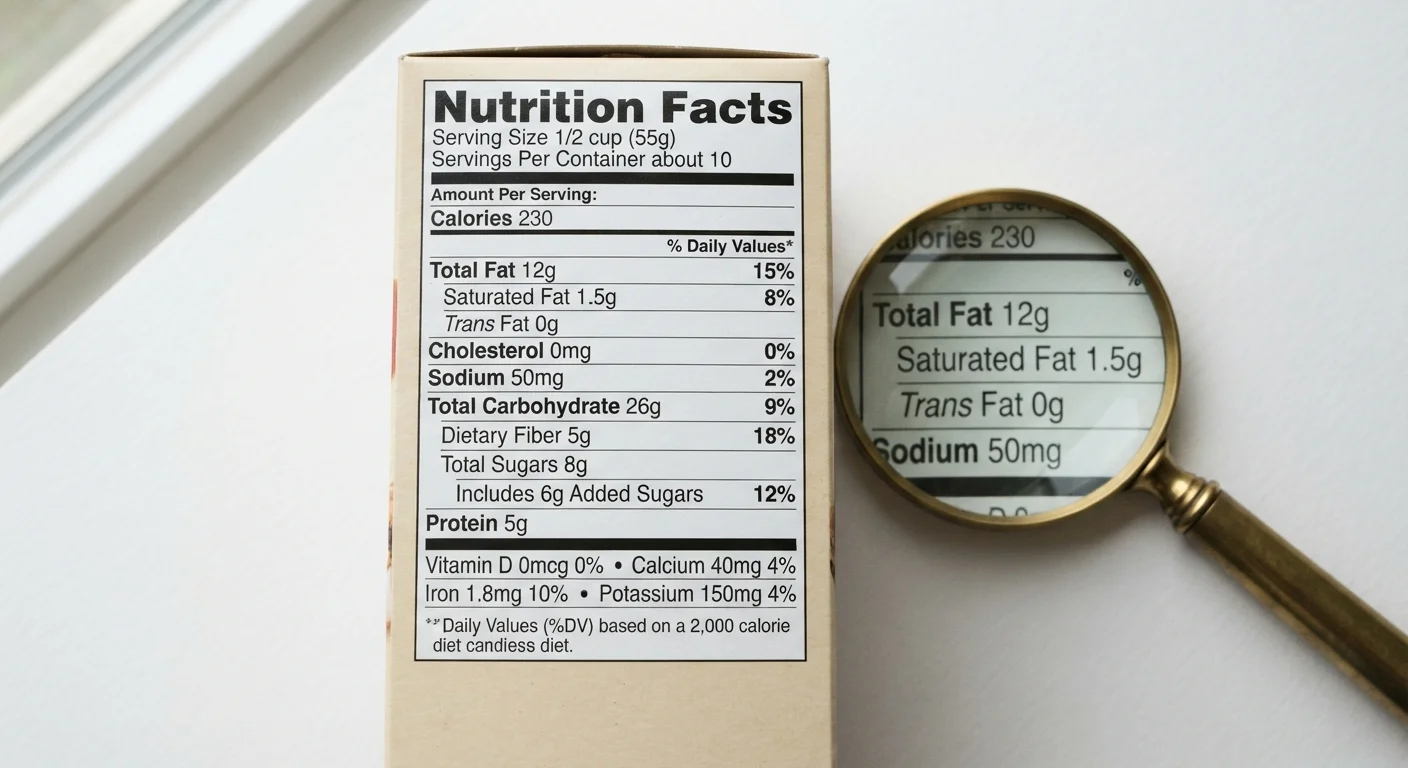
The serving size appears at the very top of the panel in bold, listed in common household units (e.g., "2/3 cup") alongside a gram weight in parentheses. This is not a recommendation — it is a standardized reference amount that makes every number below it meaningful.
Check servings per container next. A bag labeled 150 calories per serving that contains 3.5 servings delivers over 500 calories if consumed entirely. Every figure on the label — fat, sodium, vitamins — scales directly with this number.
Read the calorie count in context
Calories per serving appear in the largest print on the label. They represent total energy from all macronutrients: fat (9 kcal/g), carbohydrates (4 kcal/g), and protein (4 kcal/g). Alcohol, when present, contributes 7 kcal/g.
Calories are a useful starting point but not the only measure of a food's nutritional quality. A food can be calorie-dense yet nutrient-rich (like nuts) or calorie-moderate yet nutritionally sparse. Always read calories alongside the nutrient breakdown below.
Examine total fat and its subtypes
Total fat is broken into subcategories: saturated fat, trans fat, and sometimes monounsaturated and polyunsaturated fats. Current dietary guidance from the USDA recommends limiting saturated fat and avoiding industrially produced trans fats, which are linked to adverse cardiovascular outcomes.
Not all fat is problematic. Unsaturated fats — found in fish, nuts, seeds, and olive oil — support heart and brain health. Look for products low in saturated fat and with zero grams of trans fat per serving.
Assess sodium and carbohydrate details
Sodium is listed in milligrams. The Dietary Guidelines for Americans recommend no more than 2,300 mg per day for most adults. A single processed food can account for a substantial portion of this — some soups and sauces exceed 800 mg per serving.
Under total carbohydrates, look at dietary fiber and total sugars. Fiber slows glucose absorption and supports digestive health; most adults fall significantly short of the recommended 25–38 g per day. Added sugars — now a mandatory line item — reveal how much sugar was introduced during processing, distinct from naturally occurring sugars in fruit or dairy.
Check protein and key micronutrients
Protein is listed in grams but has no established % Daily Value on the label for general adults. Use it directionally: higher-protein foods tend to support satiety and muscle maintenance.
The updated FDA label (phased in since 2020) mandates reporting of vitamin D, calcium, iron, and potassium — nutrients identified as commonly underconsumed. These are nutrients to seek more of, rather than limit. Vitamins A and C were removed from mandatory reporting as deficiency is now less common in the general U.S. population.
Use % Daily Value as a quick benchmark
The % Daily Value (% DV) column on the right side of the label is based on a 2,000-calorie reference diet. It gives you a fast snapshot of how much of a day's worth of a nutrient one serving provides. The FDA's general guide: 5% DV or less is low; 20% DV or more is high.
Apply this directionally — aim for high % DV in fiber, vitamin D, calcium, iron, and potassium; aim for low % DV in sodium, saturated fat, and added sugars. The 2,000-calorie baseline is a reference, not a universal target, so individual needs will vary.
Read the ingredient list
Ingredients are listed in descending order by weight, so the first three to five entries represent the bulk of what you are consuming. If refined sugar, sodium, or a partially hydrogenated oil appears near the top, the product is heavily weighted toward those components.
Long ingredient lists are not automatically problematic — yogurt with live cultures or a multigrain bread may list many items. What matters is the nature of those ingredients. Whole food ingredients near the top and minimal additives generally signal a less processed product. For a deeper look at how processing affects nutritional value, see our guide on whole foods vs. ultra-processed foods.
Comparing Products on the Shelf
When choosing between two similar products, look at the serving size first to ensure you are comparing equivalent amounts. Then scan % DV for sodium, added sugars, and fiber — these three figures often reveal the most meaningful nutritional differences quickly. For a broader vocabulary of label terms, the Nutrition Tracking Glossary is a useful companion reference.
Labels Reflect One Serving, Not the Package
It is easy to underestimate intake when a product contains multiple servings in a single-looking container. Always multiply all nutrient values by the number of servings you actually consume. This single habit prevents the most common misreading of nutrition panels.
Label Reading Is a Tool, Not a Rulebook
Nutrition labels provide standardized data, but they cannot account for your individual health status, dietary needs, or medical history. Use labels to make more informed choices — not to self-diagnose deficiencies or design therapeutic diets. If you have a specific health condition or are managing a chronic disease, work with a registered dietitian or physician to interpret nutritional information in your personal context.
Once you are comfortable reading individual labels, the next step is understanding how your choices add up across a full day's eating. What a Balanced Diet Actually Means explores how individual foods fit into broader nutritional patterns. For a practical, no-math approach to structuring meals, see Building a Plate That Works.
This article is for general informational and educational purposes only and does not constitute medical or dietary advice. Consult a qualified healthcare professional or registered dietitian for guidance tailored to your individual health needs.