

Key Takeaways
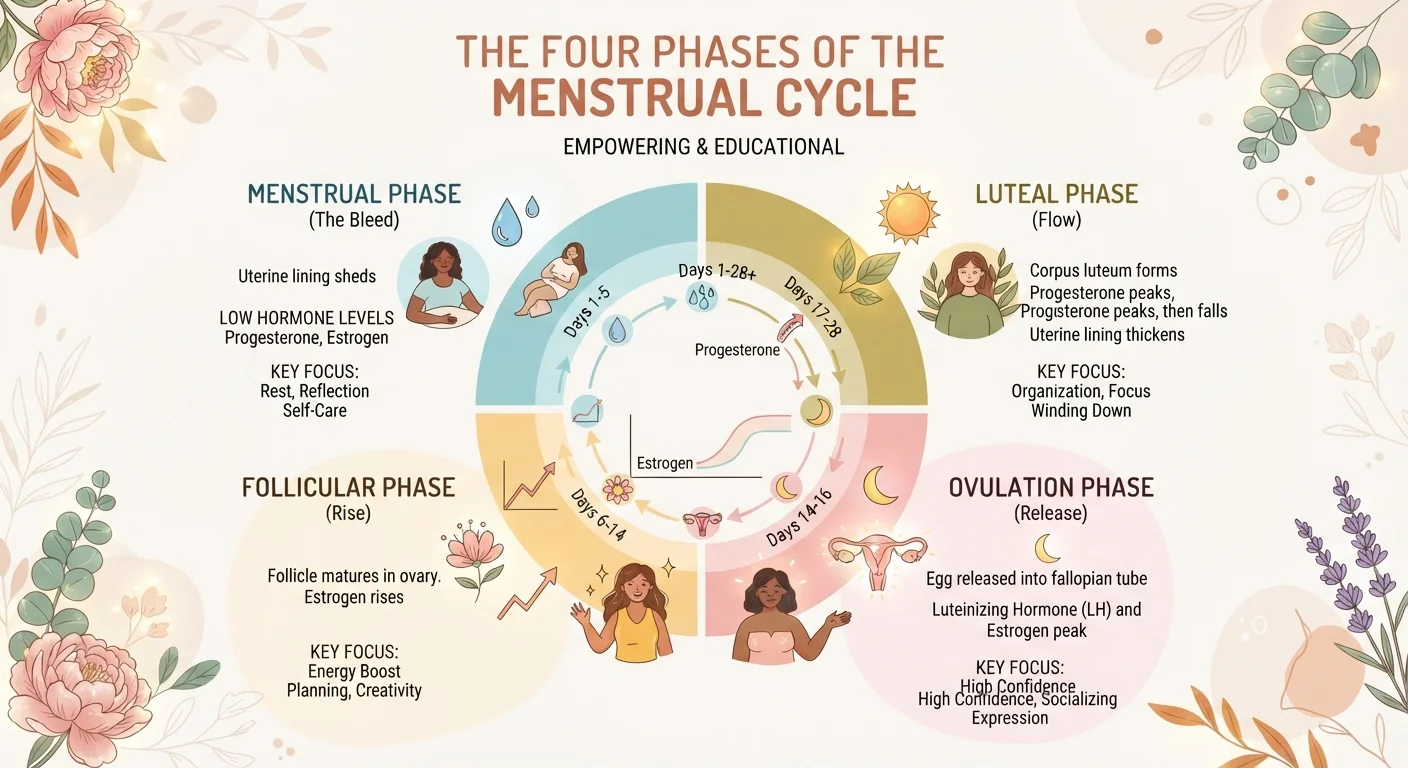
- The menstrual cycle has four phases, each governed by different hormones and serving distinct biological purposes.
- Estrogen rises during the follicular phase, while progesterone dominates the luteal phase.
- Ovulation — the release of an egg — occurs roughly in the middle of the cycle but timing varies person to person.
- Mood, energy, and physical symptoms commonly shift across phases due to changing hormone levels.
- Cycle length varies naturally; only consistent irregularities may warrant medical attention.
The Menstrual Cycle
The menstrual cycle is a monthly series of hormonal and physical changes that prepare the body for a potential pregnancy. It typically lasts between 21 and 35 days and is divided into four distinct phases: menstrual, follicular, ovulatory, and luteal. Each phase involves specific hormone fluctuations that affect the uterus, ovaries, and how you feel day to day.
The cycle is regulated by a feedback loop involving the hypothalamus, pituitary gland, and ovaries — a system clinicians call the hypothalamic-pituitary-ovarian (HPO) axis.
Phase 1: Menstruation
The cycle begins on the first day of your period — day 1 by clinical convention. During menstruation, the uterine lining (endometrium) that built up in the previous cycle is shed, because fertilization did not occur. Estrogen and progesterone levels are at their lowest, signaling the uterus to contract and expel this tissue through the cervix and vagina.
Bleeding typically lasts two to seven days. Cramping is caused by prostaglandins — hormone-like compounds that trigger uterine muscle contractions. Fatigue and lower energy are common, as iron-containing blood is lost and hormone levels are minimal.
For a deeper look at how these hormones behave across the full cycle, see The Hormonal Cycle: What Your Body Is Actually Doing Each Month.
Phase 2: The Follicular Phase
The follicular phase overlaps with menstruation and continues after bleeding stops — running from day 1 through ovulation. During this time, the pituitary gland releases follicle-stimulating hormone (FSH), which prompts several follicles in the ovaries to begin maturing. Each follicle contains an immature egg.
As follicles develop, they produce estrogen, which rises steadily throughout this phase. Rising estrogen does two important things: it stimulates the uterine lining to thicken and rebuild, and it signals the brain to reduce FSH output — a feedback mechanism that eventually allows only one dominant follicle to continue growing.
21–35 days
Normal menstrual cycle length range
According to the American College of Obstetricians and Gynecologists, cycle length naturally varies among individuals and across a lifetime.
~400
Ovulations in an average lifetime
Estimates from reproductive medicine literature suggest most people with ovaries ovulate roughly 400 times between puberty and menopause.
Up to 5 days
How long sperm can survive in the reproductive tract
This is why the fertile window extends beyond ovulation day itself, as noted in fertility research and reproductive health guidelines.
Many people notice improved energy, mood, and mental clarity during the late follicular phase as estrogen peaks. This is also when cervical mucus begins to increase in volume and takes on a wetter, clearer quality — a sign the body is approaching ovulation.
Phase 3: Ovulation
Ovulation is the cycle's main event: a surge of luteinizing hormone (LH) triggers the dominant follicle to rupture and release a mature egg into the fallopian tube. This typically occurs around day 14 of a 28-day cycle, though it can happen anywhere from day 11 to 21 depending on the individual and cycle length.
The egg survives for approximately 12–24 hours after release. Sperm, however, can survive in the reproductive tract for up to five days, which means the fertile window spans several days before and on the day of ovulation.
Charting Your Cycle Can Reveal Patterns
Keeping a simple log of when your period starts and stops, along with any notable symptoms, gives you a personalized baseline for what's normal for your body. Even a few months of consistent tracking can help you — and your healthcare provider — spot changes worth investigating. Cycle-tracking apps can streamline this, though no app can replace clinical assessment.
Physical signs around ovulation may include a brief, one-sided pelvic twinge (called mittelschmerz), increased cervical mucus that resembles raw egg whites, a slight rise in basal body temperature, and sometimes a heightened sense of smell or libido. These cues can be useful for those who wish to understand their fertility patterns.
Tools that help you monitor these shifts are explored in Tracking Hormonal Patterns: Symptom Journals, Cycle Apps, and What Each Can Tell You.
Phase 4: The Luteal Phase
After the egg is released, the ruptured follicle transforms into a temporary glandular structure called the corpus luteum, which secretes progesterone. This hormone dominates the second half of the cycle, working to stabilize and mature the uterine lining so it's ready to support a fertilized egg.
Estrogen also rises again modestly during this phase. If fertilization and implantation occur, the corpus luteum continues producing progesterone, supported by pregnancy hormones. If no pregnancy occurs, the corpus luteum breaks down around day 24–26, causing progesterone and estrogen to fall sharply — triggering the start of menstruation and a new cycle.
The decline in progesterone before menstruation is associated with premenstrual syndrome (PMS) symptoms: bloating, breast tenderness, mood changes, irritability, and disrupted sleep are all common. In some people, these symptoms are more intense, a pattern known as premenstrual dysphoric disorder (PMDD), which warrants professional evaluation.
As cycles evolve over a lifetime, hormonal patterns shift. Understanding how this continues into later life is covered in Perimenopause vs Menopause: Understanding Where One Ends and the Other Begins.
This article is for general informational and educational purposes only and is not a substitute for professional medical advice. Always consult a qualified healthcare provider with questions about your menstrual health or any symptoms you experience.