
VO2 Max, Heart Rate Zones, and Lactate Threshold: A Plain-English Reference

| VO2 Max unit of measure | mL/kg/min (milliliters of oxygen per kilogram of body weight per minute) (American College of Sports Medicine (ACSM)) |
| Common heart rate zone scales | 3-zone, 5-zone, and 6-zone models (varies by framework) (ACSM and training literature) |
| Lactate threshold as % of VO2 max (trained individuals) | Approximately 80–90% in well-trained endurance athletes (Exercise physiology research consensus) |
| Estimated MHR formula (common) | 220 minus age (widely used; individual variation is significant) (Standard estimation; not a clinical measurement) |
| VO2 Max test gold standard | Graded exercise test in a laboratory with metabolic gas analysis (ACSM Guidelines for Exercise Testing and Prescription) |
| Zone 2 heart rate range (5-zone model) | Roughly 60–70% of maximum heart rate (Varies by model; use as a general guideline) |
What Is VO2 Max and Why Does It Matter?
VO2 max — short for maximal oxygen uptake — is the maximum rate at which your body can consume oxygen during intense, sustained exercise. It is expressed in milliliters of oxygen per kilogram of body weight per minute (mL/kg/min) and is considered one of the strongest objective indicators of cardiovascular fitness.
Higher VO2 max values generally reflect a more efficient cardiovascular system: a heart that pumps more blood per beat, muscles that extract oxygen more effectively, and lungs that ventilate efficiently under load. Importantly, VO2 max is also associated with reduced risk of cardiovascular disease and all-cause mortality in the general population — making it relevant beyond competitive sport.
Laboratory measurement requires a graded exercise test with metabolic gas analysis — expensive and not widely accessible. Consumer wearables estimate VO2 max using heart rate and pace data, which can be useful for tracking trends over time but should not be treated as clinical measurements. For context on how wearables interpret these numbers, see Fitness Tracking 101.
| VO2 Max unit of measure | mL/kg/min (milliliters of oxygen per kilogram of body weight per minute) (American College of Sports Medicine (ACSM)) |
| Common heart rate zone scales | 3-zone, 5-zone, and 6-zone models (varies by framework) (ACSM and training literature) |
| Lactate threshold as % of VO2 max (trained individuals) | Approximately 80–90% in well-trained endurance athletes (Exercise physiology research consensus) |
| Estimated MHR formula (common) | 220 minus age (widely used; individual variation is significant) (Standard estimation; not a clinical measurement) |
| VO2 Max test gold standard | Graded exercise test in a laboratory with metabolic gas analysis (ACSM Guidelines for Exercise Testing and Prescription) |
| Zone 2 heart rate range (5-zone model) | Roughly 60–70% of maximum heart rate (Varies by model; use as a general guideline) |
Heart Rate Zones: A Framework for Training Intensity
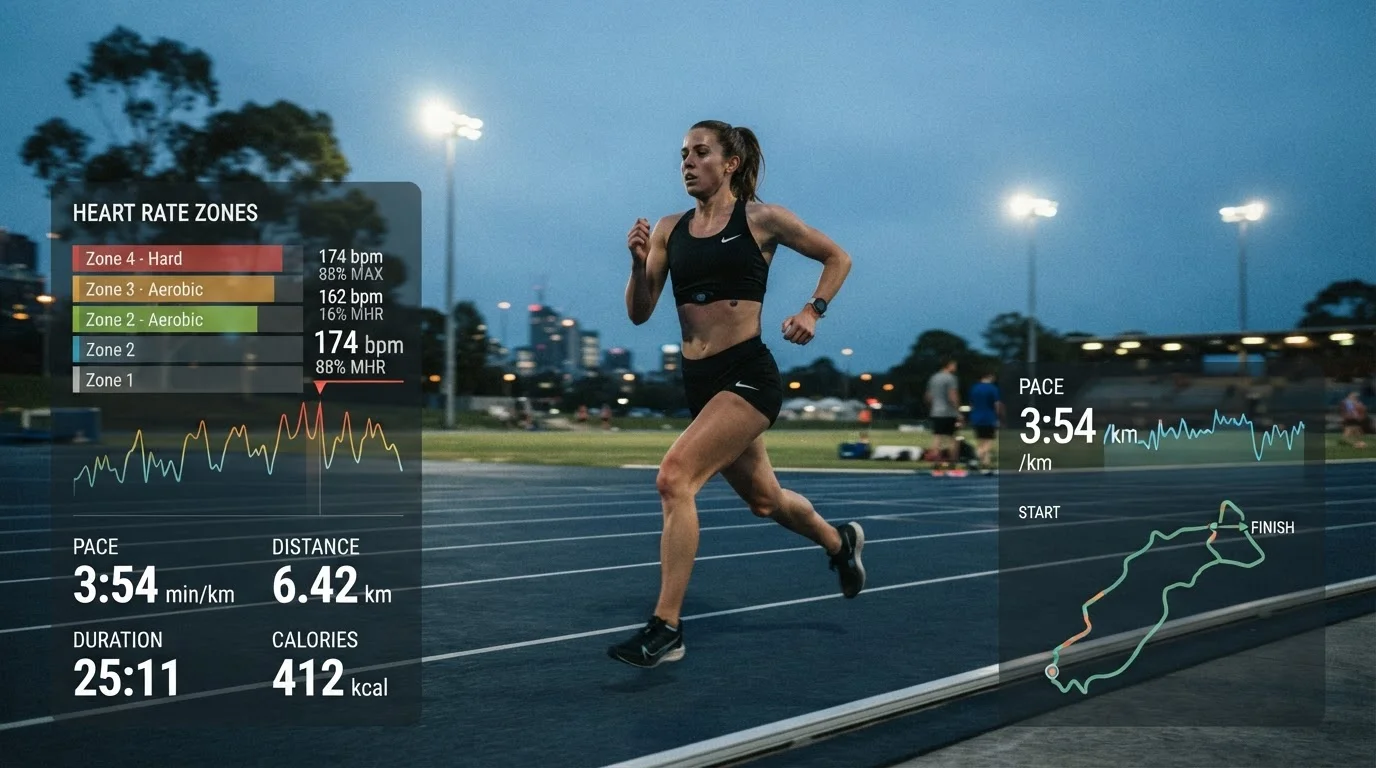
Heart rate zones divide the spectrum of exercise intensity — from light movement to maximum effort — into ranges tied to a percentage of your maximum heart rate (MHR). They give you a practical way to ensure your training includes the right mix of intensities rather than defaulting to a single, middle-ground effort every session.
The most commonly used model divides effort into five zones:
- Zone 1 (50–60% MHR): Very light; active recovery and warm-up.
- Zone 2 (60–70% MHR): Light aerobic effort; conversational pace; central to building an aerobic base. See the case for Zone 2 training for more detail on its proposed benefits.
- Zone 3 (70–80% MHR): Moderate intensity; breathing is labored but sustainable.
- Zone 4 (80–90% MHR): Hard effort; near or at lactate threshold; useful for improving speed and threshold fitness.
- Zone 5 (90–100% MHR): Near-maximal; short intervals; improves VO2 max ceiling.
Maximum heart rate is most accurately determined by a supervised maximal test. The common formula — 220 minus age — is a population estimate with meaningful individual variation; some people will measure 10–15 beats per minute above or below it.
These Metrics Are Reference Points, Not Prescriptions
VO2 max estimates from consumer wearables, age-based heart rate formulas, and zone calculators are useful approximations — not clinical measurements. Individual variation is significant. If you have a heart condition, are new to exercise, or are returning after an extended break, consult a qualified healthcare professional before beginning or intensifying a training program.
Lactate Threshold: The Performance Tipping Point
As exercise intensity increases, muscles produce lactate (a byproduct of anaerobic energy production). At moderate intensities, the body clears lactate as fast as it accumulates. The lactate threshold — sometimes called the anaerobic threshold — is the intensity point where production begins to outpace clearance, causing lactate to build up in the blood and contributing to fatigue.
In practical terms, the lactate threshold roughly corresponds to the effort level at which you can no longer hold a full conversation but haven't yet shifted into an unsustainable sprint. For untrained individuals this often falls around 50–60% of VO2 max; for trained endurance athletes it can be as high as 80–90%.
Training at or just below lactate threshold — often called threshold training — is one of the most effective ways to push that tipping point higher, allowing you to sustain a faster pace at the same physiological strain. This connects directly to why balancing easy aerobic work with occasional harder efforts matters. For a broader view of how cardio and strength training fit together, see Strength and Cardiovascular Fitness: A Complete Overview.
VO2 Max
The maximum volume of oxygen your body can consume and use during intense exercise, measured in milliliters per kilogram of body weight per minute (mL/kg/min). It is widely regarded as one of the best single indicators of aerobic fitness and cardiovascular health.
Heart Rate Zone
A defined range of heart rate intensities, typically expressed as a percentage of your maximum heart rate, used to categorize exercise effort from easy recovery to near-maximal exertion. Training in different zones produces different physiological adaptations.
Lactate Threshold
The exercise intensity at which lactate begins to accumulate in the bloodstream faster than the body can clear it. Training near or slightly below this threshold is associated with improvements in endurance performance and aerobic capacity.
Maximum Heart Rate (MHR)
The highest number of times your heart can beat per minute during all-out exercise. It is most accurately measured during a maximal effort test but is commonly estimated using age-based formulas such as 220 minus age.
Aerobic Capacity
The body's overall ability to take in, transport, and use oxygen to produce energy during sustained physical activity. VO2 max is the primary laboratory measure of aerobic capacity.
Steady-State Exercise
Exercise at an intensity where oxygen supply meets demand and the body can maintain effort without rapidly accumulating fatigue byproducts. This corresponds roughly to Zone 2 on most heart rate zone scales.
Putting It All Together: Using These Metrics Practically
These three metrics — VO2 max, heart rate zones, and lactate threshold — are interconnected. VO2 max sets your ceiling; lactate threshold determines how close to that ceiling you can sustain effort; heart rate zones give you a practical, everyday tool for navigating intensity without laboratory equipment.
For most adults, a well-structured approach involves spending the majority of cardio time in Zones 2–3 (aerobic base building) with a smaller portion in Zones 4–5 (threshold and high-intensity work). This distribution, sometimes described as polarized or pyramid training in research literature, supports VO2 max improvement and lactate threshold gains while managing recovery demands.
It is also worth revisiting assumptions about what cardio training should look like. Many common beliefs about intensity and fat burning don't align with the evidence — the article Cardio Myths That May Be Holding Your Fitness Back addresses several of them directly.
This article is for general informational purposes only and does not constitute medical advice. Always consult a qualified healthcare professional before starting or significantly changing an exercise program, especially if you have a known health condition or cardiovascular risk factors.