

Key Takeaways
- A realistic meal plan is built around your actual schedule, not an idealized version of it.
- Balancing macronutrients — protein, carbohydrates, and fats — across meals supports consistent daily energy.
- Batch cooking two or three foundational ingredients each week reduces daily decision fatigue significantly.
- Flexible meal templates outperform rigid menus because they adapt to changing schedules and food availability.
- Reviewing and adjusting your plan weekly is what makes the habit stick over the long term.
What you will need
Why Most Meal Plans Fall Apart — and What to Do Instead
The most common reason weekly meal plans fail isn't lack of motivation — it's a mismatch between the plan's demands and the reality of a normal week. Plans built around elaborate recipes, rare ingredients, or daily cooking assume an amount of time and energy that most adults don't reliably have. Research in behavioral nutrition consistently points to decision fatigue and environmental friction as the primary barriers to consistent healthy eating, not knowledge deficits.
An effective meal plan reduces the number of food decisions you make each day by pre-committing to structures that are simple enough to execute even when tired, rushed, or distracted. This is fundamentally different from a diet — it's a system for organizing eating that can accommodate any reasonable nutritional approach. For context on how meal timing and macronutrient balance affect your energy through a working day, see nutrition strategies that support consistent energy through the workday.
This Is General Nutrition Information
The guidance in this article is educational and does not constitute personalized medical or dietary advice. Individual nutritional needs vary based on age, health status, activity level, and medical history. If you have a health condition, food allergy, or specific dietary concern, consult a registered dietitian or qualified healthcare professional before making significant changes to your eating pattern.
Tools, Prerequisites, and Getting Set Up
Effective meal planning doesn't require sophisticated tools or culinary expertise. What it does require is a brief investment in setup: understanding your schedule, stocking a few reliable pantry staples, and having storage containers that make batch cooking practical. Before working through the steps below, gather what you need.
What you will need
Weekly planner or calendar
Map meals to specific days and flag high-demand days that need simpler options.
Grocery list template
Organize shopping by category (produce, proteins, grains) to reduce store time and impulse gaps.
Kitchen scale or measuring cups
Helps with portion awareness during batch cooking without obsessive tracking.
Airtight storage containers
Keep batch-cooked ingredients fresh and ready for quick weekday assembly.
Food diary or nutrition tracking app
Supports awareness of nutritional patterns over time without requiring daily perfection.
If you want to track your nutritional patterns more rigorously over time, setting up a food diary that actually reflects what you eat provides practical guidance on logging meals without distortion.
Step-by-Step: Building Your Weekly Meal Plan
Follow these six steps to construct a plan that is nutritionally sound, schedule-appropriate, and realistic enough to sustain beyond the first week. Each step builds on the previous one — resist the urge to skip ahead to recipe selection before you've mapped your week.
Map your week before you plan a single meal
Before choosing any recipes, look at your actual week. Identify which days involve long work hours, commutes, social commitments, or low energy. These are low-cook days that need simple, assembly-based meals — think grain bowls, wraps, or reheated batch portions. Days with more time at home are your higher-effort cooking opportunities. Matching meal complexity to your realistic schedule is the single most important factor in whether the plan gets followed.
Choose a dietary framework that fits your lifestyle
No single diet pattern is universally optimal. Rather than adopting a prescriptive label, identify the eating principles that align with your health goals, food preferences, cultural background, and budget. For most adults, evidence-informed frameworks emphasize plenty of vegetables and legumes, whole grains, lean or plant-based proteins, and healthy unsaturated fats — consistent with patterns like the Mediterranean or DASH approaches. For a comprehensive comparison of dietary patterns, see the end-to-end guide for adults navigating dietary change.
Build your plan around flexible meal templates
Rigid meal plans fail when one ingredient is unavailable or a day goes sideways. Instead, plan using templates rather than fixed recipes. A template might be: Dinner = protein + roasted vegetable + whole grain. This structure gives you nutritional consistency while allowing ingredient swaps. Aim for three to four dinner templates, two lunch formats, and two to three breakfast patterns per week. This approach reduces decision fatigue without eliminating flexibility — a key driver of long-term consistency.
Select two or three batch-cook anchor ingredients
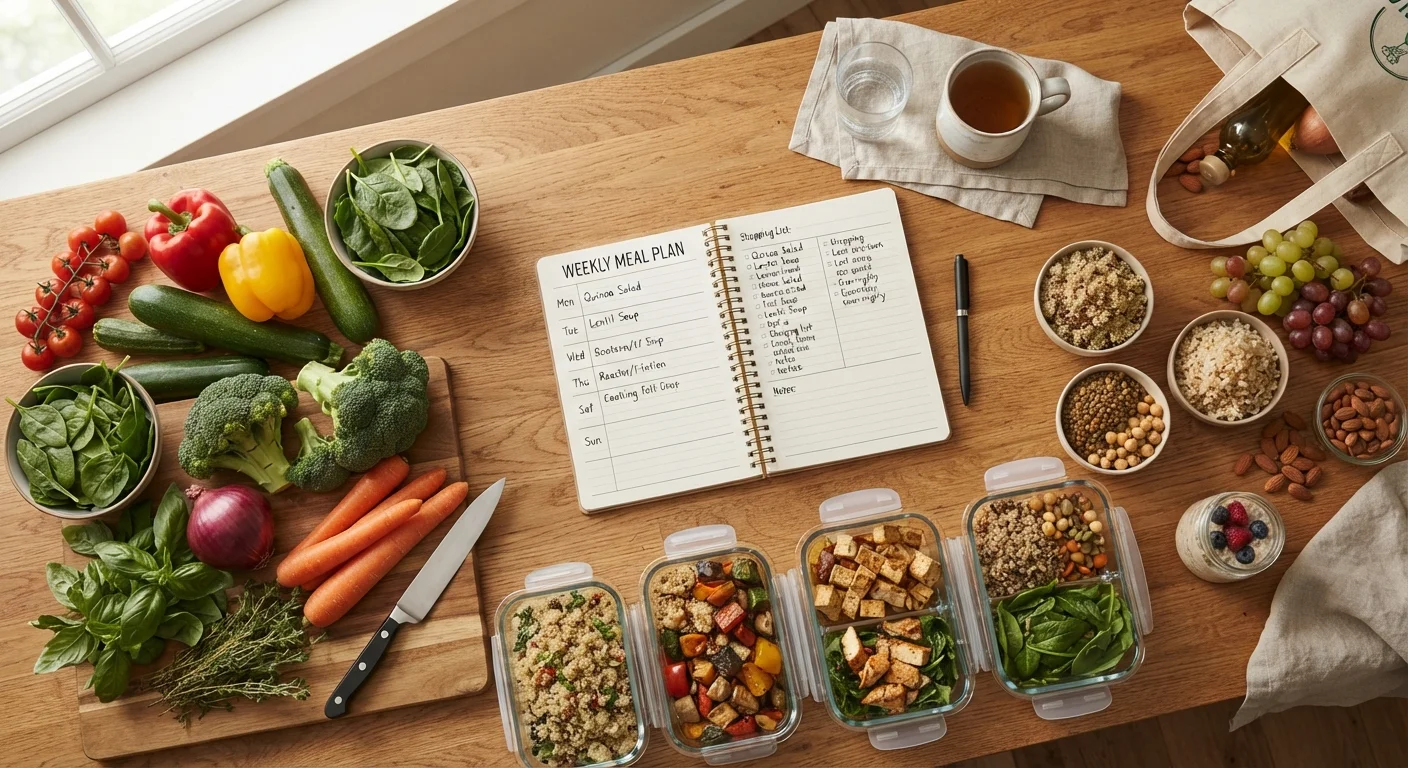
Identify ingredients that can be cooked in bulk and used across multiple meals during the week. Common examples include: a cooked whole grain (brown rice, farro, or quinoa), a legume or protein source (roasted chickpeas, poached chicken, hard-boiled eggs), and a roasted or blanched vegetable medley. These anchor ingredients form the backbone of quick weekday meals. Spending 60–90 minutes on a weekend or mid-week batch session can supply components for four to five meals with minimal daily effort.
Write your grocery list by category, not by meal
Once your templates and anchor ingredients are set, compile a single grocery list organized by store section: produce, proteins, dairy or dairy alternatives, grains and pulses, pantry staples. This reduces shopping time, minimizes forgotten items, and helps you spot redundancies. Cross-check against what you already have at home before you shop. A well-structured list also supports budget awareness — you can identify where to substitute lower-cost options without compromising nutritional quality.
Review and iterate at the end of each week
Set aside five to ten minutes at the end of each week to reflect on what worked. Which meals did you actually eat? Where did the plan break down — and why? This brief review loop is what separates a one-time effort from a durable habit. Over two to three weeks, patterns will emerge: the meals you reliably make, the days that always derail you, and the ingredients that consistently go to waste. Use these observations to refine your next plan. For structured support tracking your habits across nutrition and other lifestyle factors, a practical weekly health audit offers a useful framework.
Use a Weekly Nutrition Checklist
Pairing your meal plan with a structured audit of your food environment — pantry staples, hydration habits, and prep conditions — dramatically improves follow-through. The Weekly Nutrition Readiness Checklist is a practical companion resource for exactly this purpose.
Avoid Overly Restrictive Planning
Meal plans that eliminate entire food groups or set very low calorie targets can be difficult to sustain and may not meet your nutritional needs. If you find yourself frequently hungry, fatigued, or anxious about food choices, treat these as signals to revisit your approach. A sustainable plan should feel manageable, not punishing.
Connecting Nutrition Planning to Your Broader Health Habits
A meal plan doesn't exist in isolation. How you eat interacts directly with how you move, sleep, and manage stress. If you're also working to build consistent exercise habits, the principles of scheduling and template-based thinking apply equally — see how to build a weekly exercise routine that actually sticks for a parallel framework. The Healthy Eating Basics hub provides additional foundational context on balanced nutrition across different life stages.
Meal planning is a skill that improves with repetition. Expect your first plan to be imperfect and your third to feel almost automatic. The goal is a sustainable rhythm — not a flawless week.
This article is for informational purposes only and does not constitute personalized dietary or medical advice. Consult a registered dietitian or qualified healthcare professional for guidance tailored to your individual health needs.