

Key Takeaways
- Serving size anchors every number on the label — always confirm it before reading further.
- % Daily Value helps you judge whether a nutrient amount is high or low relative to daily needs.
- Ingredients are listed by weight from most to least, revealing a product's true composition.
- Added sugars appear separately from total sugars, making it easier to spot hidden sweeteners.
- Nutrients to limit include saturated fat, sodium, and added sugars; prioritize fiber, potassium, and vitamin D.
What you will need
Why Nutrition Labels Exist — and What They're Based On
Nutrition Facts panels on packaged foods in the United States are regulated by the Food and Drug Administration (FDA). The current label format, updated in 2020, reflects revisions to the DRIs and growing evidence about the relationship between diet and chronic disease. Every number on that panel is tied to a standardized framework — understanding the framework makes the numbers meaningful rather than arbitrary.
The label's reference point is a theoretical 2,000-calorie daily diet, used to calculate % Daily Value (% DV). This reference doesn't mean you should eat exactly 2,000 calories; individual needs vary based on age, sex, body size, and activity level. The % DV is a relative benchmark, not a personal prescription. As a general rule, 5% DV or less is considered low for a nutrient, while 20% DV or more is considered high. For context on how individual calorie and nutrient needs are estimated, tools like those in the Health Calculators hub can be a useful complement.
For plain-language definitions of nutritional terms you'll encounter on labels — such as dietary fiber, micronutrients, and macronutrients — the Nutrition & Diet Reference Glossary is a helpful companion resource.
Step-by-Step: How to Read Every Section of a Nutrition Label
Follow these steps the next time you pick up a packaged food. With a little practice, scanning a label takes less than 30 seconds and gives you genuine insight into what you're eating.
Start with serving size and servings per container
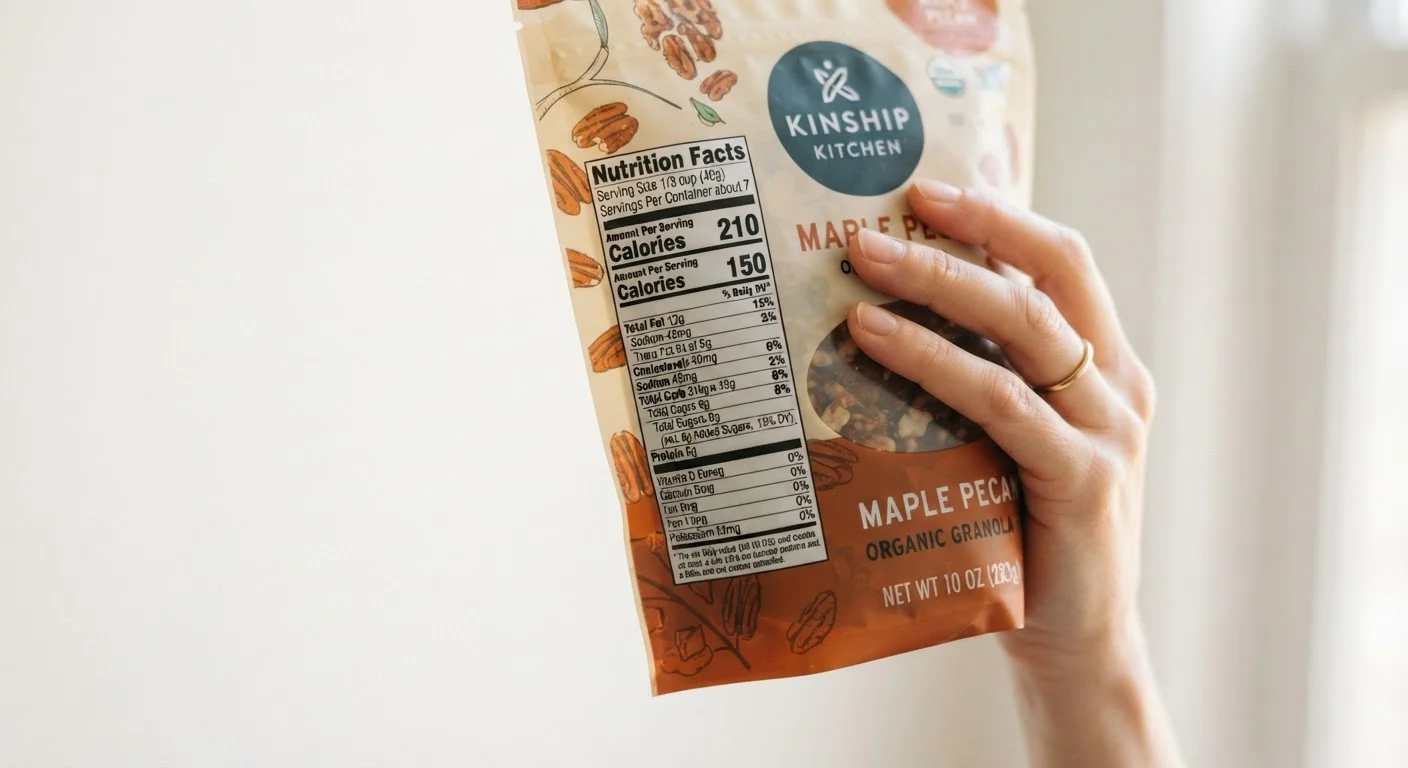
The serving size appears at the very top of the panel in bold. Every calorie count and nutrient value listed below applies to one serving, not the whole package. Check the servings per container: a bag labeled 150 calories that contains 3 servings delivers 450 calories if you eat it all. Portion sizes on labels are standardized by the FDA based on typical consumption amounts — they are not dietary recommendations.
Read calories in context of the whole serving
Calories measure total energy per serving. While calorie counting alone is an oversimplified approach to diet quality, the calorie figure gives you a baseline for understanding energy contribution. A 400-calorie snack and a 400-calorie meal are nutritionally very different — what matters alongside calories is the nutrient profile that accompanies them.
Identify nutrients to limit
Three nutrients warrant particular attention for most adults: saturated fat, sodium, and added sugars. Current U.S. dietary guidelines recommend limiting saturated fat to less than 10% of total daily calories and sodium to less than 2,300 mg per day. High intake of these nutrients is associated with increased risk of cardiovascular disease and other chronic conditions. Use % DV to quickly flag products where a single serving delivers a disproportionately large share of your daily limit.
Identify nutrients to prioritize
On the lower portion of the panel, look for dietary fiber, potassium, calcium, iron, and vitamin D — nutrients that many Americans consume in insufficient amounts. A food with 20% DV or more for fiber or potassium per serving makes a meaningful contribution toward filling these common dietary gaps. These nutrients support digestive health, blood pressure regulation, bone density, and immune function, among other roles detailed in the Nutrients & Food Groups hub.
Cross-reference the ingredient list
After reviewing the numbers, scan the ingredient list. Confirm that the first few ingredients match what you'd expect the food to primarily be. A product with 'whole grain oats' as the first ingredient and sugar third or lower tells a different story than one with sugar or syrup in the top two positions. The ingredient list also reveals the presence of additives, preservatives, and allergens that don't appear in the nutrient panel itself.
Once you're comfortable with the basics, explore how these concepts connect to broader eating patterns in our guide to what a balanced diet actually means.
Use % DV as a Quick Comparison Tool
When comparing two similar products, % Daily Value makes it easy to choose without doing any math. Look for higher % DV on fiber and key micronutrients, and lower % DV on saturated fat, sodium, and added sugars. This approach works especially well when evaluating cereals, breads, snacks, and condiments where formulations vary widely between brands.
The Ingredient List: What It Reveals Beyond the Numbers
The Nutrition Facts panel tells you how much; the ingredient list tells you what. Ingredients are listed in descending order by weight — the first ingredient makes up the largest proportion of the product. If a refined grain or added sugar appears within the first two or three ingredients of a food marketed as healthy, that's meaningful information.
Added sugars in particular can appear under many names: high-fructose corn syrup, cane juice, dextrose, maltose, fruit juice concentrate, and agave nectar, among others. The Nutrition Facts panel now requires Added Sugars to be listed separately beneath Total Sugars, which makes it easier to identify how much sweetening has been introduced beyond what occurs naturally in ingredients like fruit or dairy.
Front-of-Pack Claims Don't Replace Label Reading
Terms like 'natural,' 'multigrain,' 'light,' or 'reduced fat' on the front of a package are marketing descriptors with limited regulatory specificity. A 'reduced fat' product, for example, may compensate with added sugars to maintain palatability. Always verify front-of-pack claims by checking the Nutrition Facts panel and ingredient list — they tell the complete story.
For a deeper look at how nutrient and calorie density interact — two concepts that go well beyond what the label alone conveys — see our explainer on nutrient density vs. calorie density. If you track your food digitally, the Nutrition Tracking Glossary explains how label data translates into app metrics like net carbs and TDEE.
This article provides general nutrition education and is not a substitute for personalized dietary advice from a registered dietitian or qualified healthcare provider.