

Key Takeaways
- The immune system has two layers: a fast innate response and a slower, targeted adaptive response.
- Physical barriers like skin and mucous membranes form the first line of defence before the immune response begins.
- Dendritic cells act as messengers, presenting pathogen information to adaptive immune cells.
- B cells produce antibodies that neutralise pathogens; T cells destroy infected cells directly.
- Immunological memory allows the body to mount a stronger, faster response upon re-exposure.
- Inflammation is a normal immune tool but can cause harm if prolonged or misdirected.
Immune Response to Infection
When a pathogen — such as a virus, bacterium, or fungus — enters the body, the immune system launches a structured defence. It first detects foreign molecules, then activates specialised cells to neutralise the threat, and finally builds a memory to respond faster if the same pathogen appears again.
Detection relies on pattern recognition receptors (PRRs) that identify pathogen-associated molecular patterns (PAMPs) — conserved molecular signatures present on microorganisms but absent from human cells.
The First Line: Barriers and Early Detection
Before the immune system's cellular machinery engages, the body relies on physical and chemical barriers. The skin forms an almost impermeable surface, while mucous membranes lining the respiratory and digestive tracts trap particles and pathogens. Saliva, tears, and stomach acid contain enzymes and acids hostile to most microorganisms.
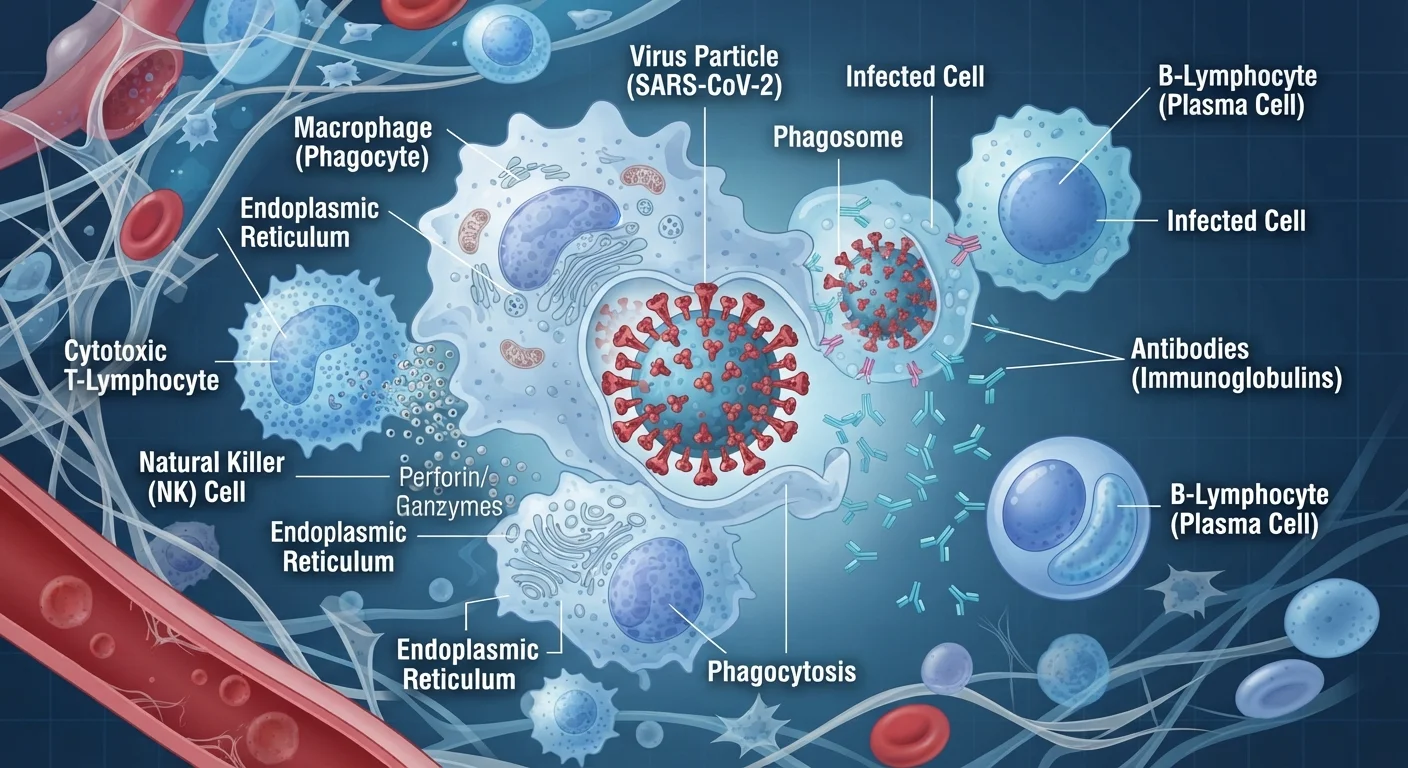
When a pathogen breaches these defences — through a cut, inhalation, or ingestion — the innate immune system responds within minutes. Tissue-resident cells called macrophages and dendritic cells detect foreign molecular patterns using pattern recognition receptors. These receptors identify structures common to broad classes of pathogens but absent from human cells, triggering an immediate alarm signal.
For a plain-language breakdown of key immune terms, see our immune system glossary.
When the Immune System Misfires
Sometimes the immune system directs its response against the body's own healthy tissues — a process underlying autoimmune conditions such as rheumatoid arthritis or lupus. In other cases, it may overreact to harmless substances, causing allergies. Understanding normal immune function is the first step to recognising when something has gone wrong. Always consult a healthcare professional for a proper diagnosis.
The Innate Response: Fast, Broad, and Inflammatory
Once a threat is detected, the innate immune system acts swiftly and without specificity — it responds to any foreign invader rather than targeting one particular pathogen. Macrophages engulf and digest pathogens in a process called phagocytosis. They also release chemical signals called cytokines, which alert surrounding cells and recruit additional immune reinforcements to the site of infection.
This cytokine release drives the familiar signs of inflammation: redness, swelling, heat, and pain. These are protective effects. Increased blood flow delivers more immune cells; raised local temperature inhibits pathogen replication. Natural killer (NK) cells patrol for host cells that have been hijacked by viruses, destroying them before viral replication can escalate.
Meanwhile, dendritic cells perform a critical hand-off function — they capture fragments of the pathogen and transport them to the lymph nodes, where the adaptive immune system is activated. To understand how inflammation fits into this picture, read when inflammation is protective and when it isn't.
~100 billion
B cells produced by the body daily
The human body generates an estimated 100 billion B cells per day, according to immunology research, maintaining a vast repertoire of potential antibody responses.
4–7 days
Typical time for adaptive response to peak
The adaptive immune response generally peaks around 4–7 days after pathogen exposure, which aligns with the typical duration before symptoms begin to improve in common infections.
Decades
Duration some immune memories persist
Studies on measles and smallpox survivors show that immunological memory can persist for decades, and in some cases lifelong, according to research published in immunology literature.
The Adaptive Response: Precision Targeting and Memory
The adaptive immune response takes several days to mobilise but offers a level of precision the innate system cannot match. Dendritic cells present pathogen-derived fragments — called antigens — to T cells in the lymph nodes. Two key T cell types emerge: cytotoxic T cells, which destroy infected host cells, and helper T cells, which coordinate the wider immune response.
Helper T cells activate B cells, which differentiate into plasma cells and begin producing antibodies. Antibodies are highly specific proteins that bind to the pathogen's surface antigens — neutralising the pathogen, blocking its ability to infect cells, or marking it for destruction by phagocytes.
After the infection clears, most effector cells die off, but a subset survives as memory cells. These long-lived cells retain the blueprint of the pathogen so that re-exposure triggers a faster, stronger response — often clearing the infection before symptoms develop. This principle underpins vaccination. See how vaccines leverage immune memory for a detailed explanation.
For an overview of how innate and adaptive immunity operate as complementary systems, visit innate vs. adaptive immunity explained.
This article is for informational purposes only and does not constitute medical advice. If you have concerns about an infection or your immune health, consult a qualified healthcare professional.