

| Two main immune branches | Innate (non-specific) and Adaptive (targeted) |
| Primary antibody type in blood | Immunoglobulin G (IgG) |
| Time for adaptive response to develop | Typically 7–14 days on first exposure |
| Key site of T cell maturation | Thymus gland |
| Key site of B cell development | Bone marrow |
| Fastest innate immune responders | Neutrophils — arrive at infection sites within minutes |
Why Immune System Terminology Matters
Immunology has its own vocabulary, and that language appears everywhere — in health news, patient leaflets, vaccine discussions, and clinical consultations. Without a working grasp of the core terms, it can be difficult to evaluate what you read or understand what a clinician is explaining.
This reference guide defines the most important immune system concepts in plain language. Whether you're reading about an infection, exploring how vaccines work, or following up on a diagnosis, these definitions provide essential context. For a fuller narrative on how these components interact during an actual infection, see how the immune system recognises and fights infection.
| Two main immune branches | Innate (non-specific) and Adaptive (targeted) |
| Primary antibody type in blood | Immunoglobulin G (IgG) |
| Time for adaptive response to develop | Typically 7–14 days on first exposure |
| Key site of T cell maturation | Thymus gland |
| Key site of B cell development | Bone marrow |
| Fastest innate immune responders | Neutrophils — arrive at infection sites within minutes |
Core Terms: From Innate to Adaptive Immunity
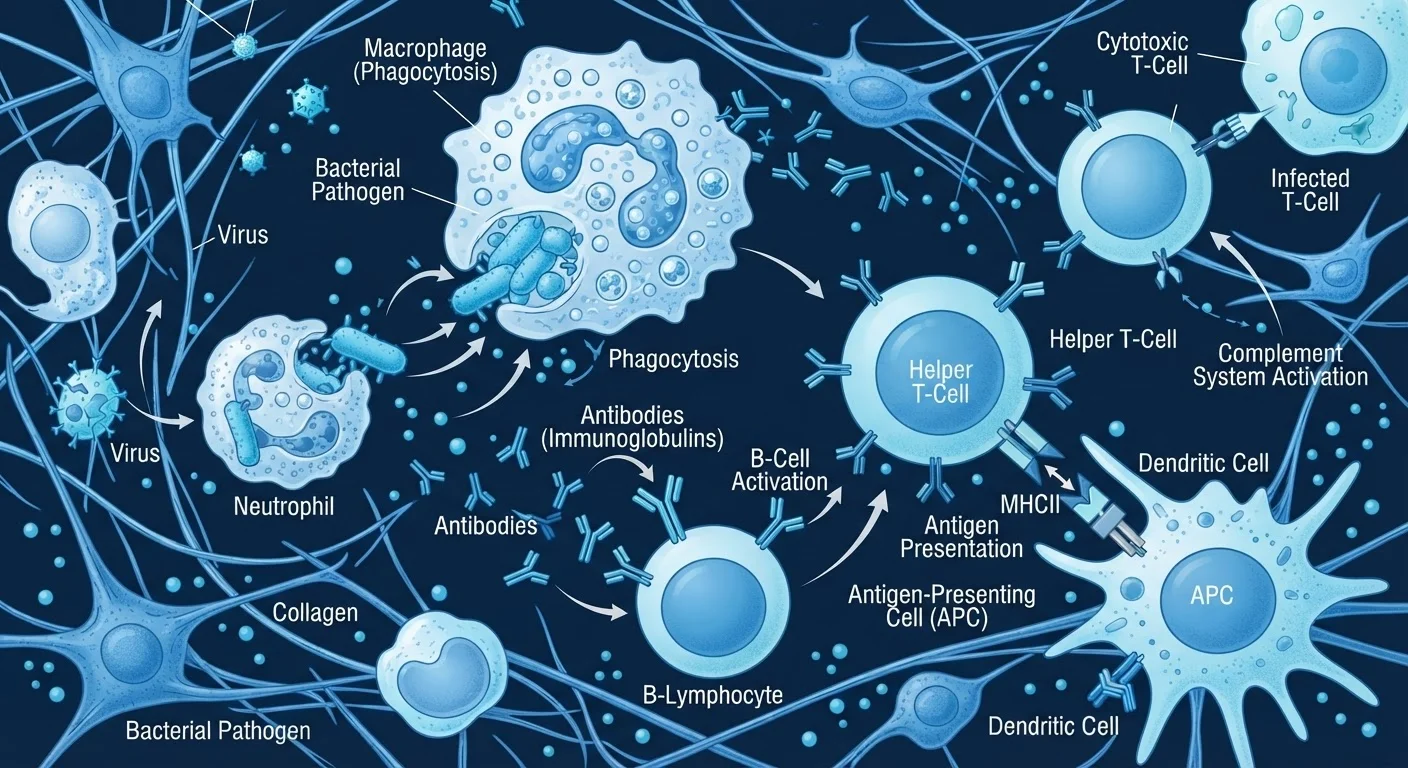
The immune system operates in two coordinated layers. Innate immunity is immediate and broadly reactive — it responds within minutes to hours using physical barriers, inflammatory signals, and cells like macrophages and natural killer cells. Adaptive immunity is slower but far more precise, deploying antigen-specific T cells and B cells that also form lasting immunological memory.
Central to adaptive immunity are antigens — the molecular signals that mark a cell or particle as foreign — and antibodies, the proteins engineered to bind those signals with high specificity. Cytokines act as the immune system's communication network, transmitting alarm signals and coordinating multi-cell responses. Understanding these relationships helps make sense of why illnesses progress as they do, and why the body responds differently to a pathogen on second exposure.
Antibody
A Y-shaped protein produced by B cells in response to a specific antigen. Antibodies bind to their target antigen to neutralize it or flag it for destruction by other immune cells.
Antigen
Any molecule — typically a protein on the surface of a pathogen — that the immune system recognizes as foreign and mounts a response against. Antigens trigger antibody production.
T Cell (T Lymphocyte)
A type of white blood cell central to adaptive immunity. Helper T cells coordinate the immune response, while cytotoxic T cells directly destroy infected or abnormal cells.
B Cell (B Lymphocyte)
A white blood cell responsible for producing antibodies. When activated by an antigen, B cells mature into plasma cells that release large quantities of targeted antibodies.
Cytokine
Signaling proteins secreted by immune cells that regulate the intensity and duration of the immune response. Examples include interleukins and interferons.
Innate Immunity
The body's first line of defense — a rapid, non-specific response present from birth. It includes physical barriers like skin, and immune cells like neutrophils and macrophages.
Adaptive Immunity
A slower but highly targeted immune response that develops after exposure to a specific antigen. It involves T and B cells and creates immunological memory for future protection.
Pathogen
Any microorganism capable of causing disease, including bacteria, viruses, fungi, and parasites. The immune system is designed to detect and eliminate pathogens.
Macrophage
A large immune cell that engulfs and digests pathogens and cellular debris through a process called phagocytosis, and also presents antigens to T cells.
Immunological Memory
The immune system's ability to remember a previously encountered antigen, enabling a faster and stronger response upon re-exposure. This is the basis of vaccine-acquired protection.
Inflammation
A protective immune response characterized by redness, heat, swelling, and pain at a site of injury or infection. Chronic inflammation, however, can contribute to tissue damage.
Natural Killer (NK) Cell
A type of innate immune cell that detects and destroys virus-infected cells and tumor cells without prior sensitization to a specific antigen.
If you're newer to these concepts, our beginner's overview of infections and immunity covers the broader landscape without assuming prior knowledge.
Putting the Terms Together: What They Mean in Practice
These definitions gain real meaning when applied to familiar scenarios. During a respiratory infection, for instance, innate immune cells respond first — macrophages engulf invading pathogens and release cytokines that trigger inflammation and recruit further immune cells. Several days later, adaptive immunity activates: helper T cells orchestrate the response while cytotoxic T cells destroy infected host cells, and B cells begin producing antigen-specific antibodies.
After recovery, immunological memory persists — a pool of long-lived memory B and T cells that can mount a far faster, stronger response if the same pathogen appears again. Vaccines deliberately exploit this mechanism. For a detailed explanation of that process, vaccines and the immune system: how protection actually develops is a recommended read.
This Article Is General Health Information
The terms and explanations here are educational and intended for a general adult audience. They do not constitute medical advice, diagnosis, or treatment guidance. If you have concerns about your immune health or symptoms of infection, consult a qualified healthcare professional.
Supporting the immune system also involves everyday choices around sleep, nutrition, and stress. Everyday habits that support a well-functioning immune system outlines the evidence-backed factors worth understanding.
This article is for informational purposes only and does not constitute medical advice. Always consult a qualified healthcare professional for personal health concerns or symptoms.