

Key Takeaways
- Innate immunity responds within minutes to hours; adaptive immunity takes days to develop.
- Innate immunity is non-specific, while adaptive immunity targets precise pathogens via antibodies and T-cells.
- Adaptive immunity generates immunological memory, forming the basis for how vaccines work.
- Both systems communicate continuously and are essential for effective infection clearance.
- Neither system alone is sufficient — their coordination determines overall immune effectiveness.
Option A
Innate Immunity
The fast-acting, broad first line of defence.
Best for: Immediate, non-specific responses to any pathogen encountered at the body's barriers and tissues.
Option B
Adaptive Immunity
The precision, memory-forming second line of defence.
Best for: Targeted elimination of specific pathogens and long-term immunological memory that improves future responses.
If you want to understand why symptoms appear immediately after infection
Innate Immunity
Fever, inflammation, and fatigue in the first hours of illness are driven by innate immune responses, not the slower adaptive system.
If you want to understand how vaccines create lasting protection
Adaptive Immunity
Vaccines work by training the adaptive immune system to form memory B- and T-cells that respond rapidly if the real pathogen is encountered later.
If you are learning how the immune system handles a new pathogen
Innate Immunity
Innate immunity acts first and buys critical time for the adaptive system to mobilise its tailored response.
If you want to understand why some infections recur and others do not
Adaptive Immunity
Immunological memory means the adaptive system can recognise and neutralise previously encountered pathogens far more efficiently on re-exposure.
The Two Layers of Immune Defence
The human immune system is not a single mechanism — it is a layered network of cells, proteins, and signalling molecules operating across two interconnected arms. Understanding how innate and adaptive immunity differ, and how they work together, is fundamental to grasping how the body fights infection. For a broader introduction, see Infections & Immunity: A Beginner's Overview.
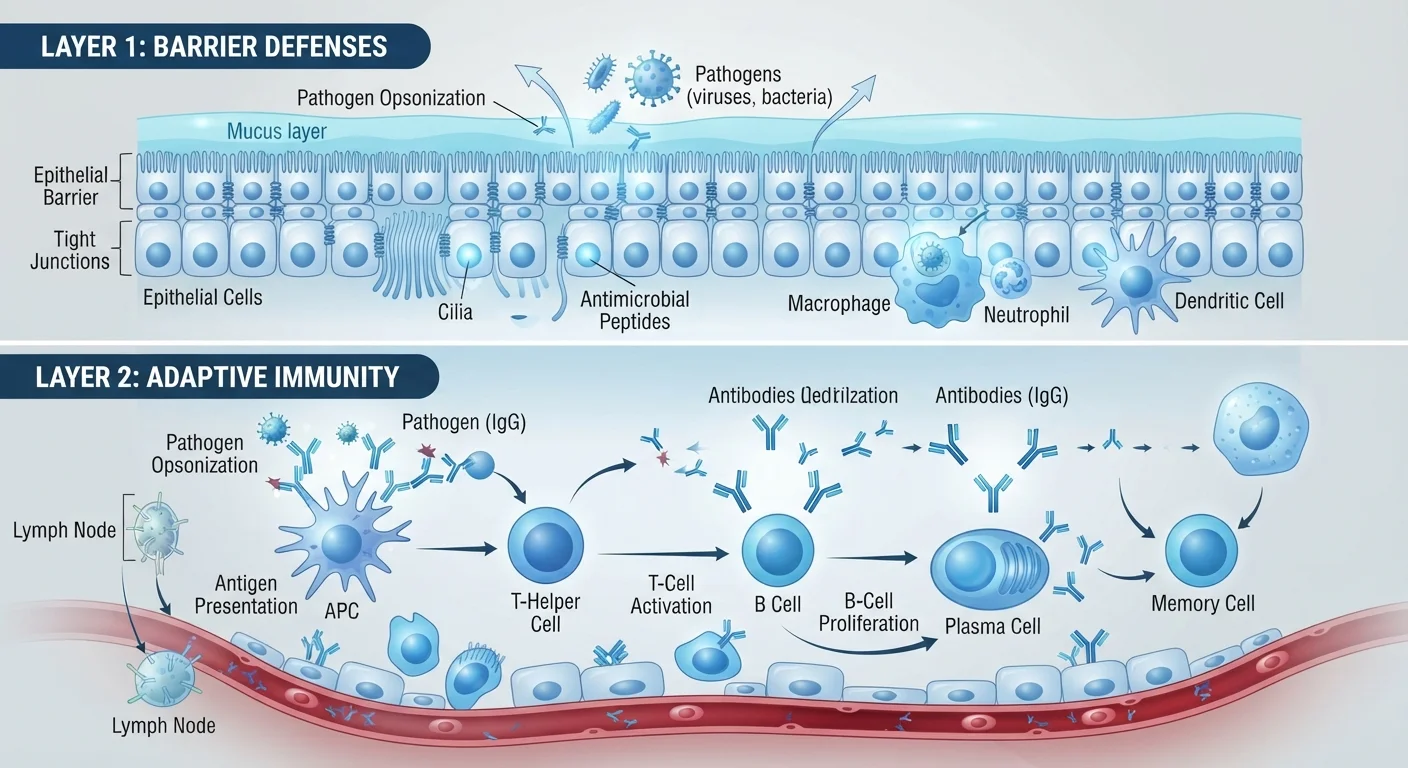
The innate immune system is your body's first and fastest responder. It activates within minutes to hours of detecting a threat, deploying physical barriers (skin and mucous membranes), cellular defences (neutrophils, macrophages, and natural killer cells), and chemical signals called cytokines. Critically, innate immunity is non-specific — it recognises broad molecular patterns shared by many pathogens rather than identifying individual microbes.
The adaptive immune system develops more slowly — typically over several days — but with far greater precision. It deploys B-cells (which produce antibodies) and T-cells (which directly kill infected cells or coordinate the response). Crucially, adaptive immunity generates immunological memory, enabling faster and stronger responses to pathogens encountered before.
| Criterion | Innate Immunity | Adaptive Immunity |
|---|---|---|
| Speed of response | Minutes to hours | Days to weeks |
| Specificity | Non-specific (broad patterns) | Highly specific (individual antigens) |
| Key cells | Neutrophils, macrophages, NK cells | B-cells, T-cells, dendritic cells |
| Memory | None | Long-lasting immunological memory |
| Primary mechanisms | Inflammation, phagocytosis, cytokines | Antibodies, cytotoxic T-cells, helper T-cells |
| Role in vaccination | Provides initial adjuvant-like signals | Generates protective memory |
| Pathogen recognition | Pattern recognition receptors (PRRs) | Antigen-specific B- and T-cell receptors |
How Each System Recognises a Threat
Innate immune cells carry pattern recognition receptors (PRRs) — molecular sensors that detect conserved structures on pathogens, known as pathogen-associated molecular patterns (PAMPs). Examples include components of bacterial cell walls or viral RNA. This recognition triggers immediate inflammation, a key mechanism for containing the threat and alerting the adaptive system.
Adaptive immunity operates differently. Antigen-presenting cells (dendritic cells and macrophages, which are also innate players) capture fragments of the pathogen and present them to T-cells via specialised molecules called MHC proteins. Each T-cell and B-cell carries a unique receptor shaped to recognise one specific antigen. The adaptive system then clonally expands the cells that match — producing large numbers of precisely targeted effectors.
For plain-language definitions of terms like antigens, antibodies, and MHC, the immune system glossary provides a useful reference.
~4 days
Time for adaptive response to mobilise
Research in immunology consistently shows the primary adaptive immune response typically peaks around 4–7 days after initial antigen exposure.
10⁸–10¹¹
Unique antigen receptors in adaptive system
Estimates from immunology literature suggest the human adaptive immune repertoire can recognise between 100 million and 100 billion distinct antigens.
~30 min
Time for neutrophils to reach infection site
Innate immune neutrophils are among the fastest responders, arriving at sites of infection within approximately 30 minutes via chemotaxis.
Memory, Vaccines, and Long-Term Protection
One of the most clinically significant differences between the two arms is memory. The innate system has no memory — it responds identically each time it encounters a pathogen. The adaptive system, by contrast, retains a population of long-lived memory B- and T-cells after clearing an infection. On re-exposure, these cells enable a dramatically faster and more potent response — often neutralising the threat before symptoms appear.
This principle underpins vaccination. Vaccines present the immune system with a harmless representation of a pathogen (or part of one), triggering an adaptive response and establishing memory — without causing disease. The science behind vaccine-induced immunity explains this process in depth.
It is also worth noting that innate and adaptive immunity are not independent. The innate response actively shapes the adaptive response — cytokines released during innate activation influence which type of adaptive response develops, and dendritic cells serve as a critical bridge between the two systems.
Clinical Relevance: What Happens When Either System Fails
Both systems must function adequately for effective infection control. Deficiencies in innate immunity — such as impaired neutrophil function — typically lead to frequent bacterial infections that are difficult to clear. Deficiencies in adaptive immunity, as seen in primary immunodeficiency disorders or conditions like HIV (which depletes CD4+ T-cells), leave individuals vulnerable to a much broader range of infections, including opportunistic pathogens that healthy immune systems suppress easily.
Understanding how chronic infections interact with both systems is an important extension of this topic — acute vs. chronic infection patterns illustrate how sustained pathogen presence can progressively exhaust adaptive immune responses.
For a comprehensive view of how these systems integrate during a real infection, the article How the Immune System Recognises and Fights Infection walks through the full sequence from first contact to pathogen clearance.
This article is for general informational purposes only and does not constitute medical advice. If you have concerns about your immune health or recurring infections, consult a qualified healthcare professional.