

Key Takeaways
- Vaccines train the immune system by mimicking a pathogen without causing the actual disease.
- Memory B-cells and T-cells are the biological mechanism behind long-lasting vaccine protection.
- Protection typically takes one to two weeks to develop after vaccination.
- Individual immune responses vary based on age, health status, and vaccine type.
- Some vaccines require multiple doses or boosters to sustain protective immunity.
- Herd immunity occurs when enough vaccinated individuals reduce pathogen spread to protect vulnerable people.
Vaccine-Induced Immunity
Vaccine-induced immunity is the protection your immune system builds after receiving a vaccine. Instead of catching a disease to develop natural immunity, a vaccine introduces a safe signal — such as a weakened pathogen, a protein fragment, or genetic instructions — that prompts your body to mount a defensive response. The result is an immunological memory that prepares you to fight the real pathogen if you ever encounter it.
This process engages both the humoral immune response (antibody production by B-cells) and the cell-mediated response (activation of cytotoxic T-cells), providing layered, durable protection against infection.
What a Vaccine Actually Does Inside Your Body
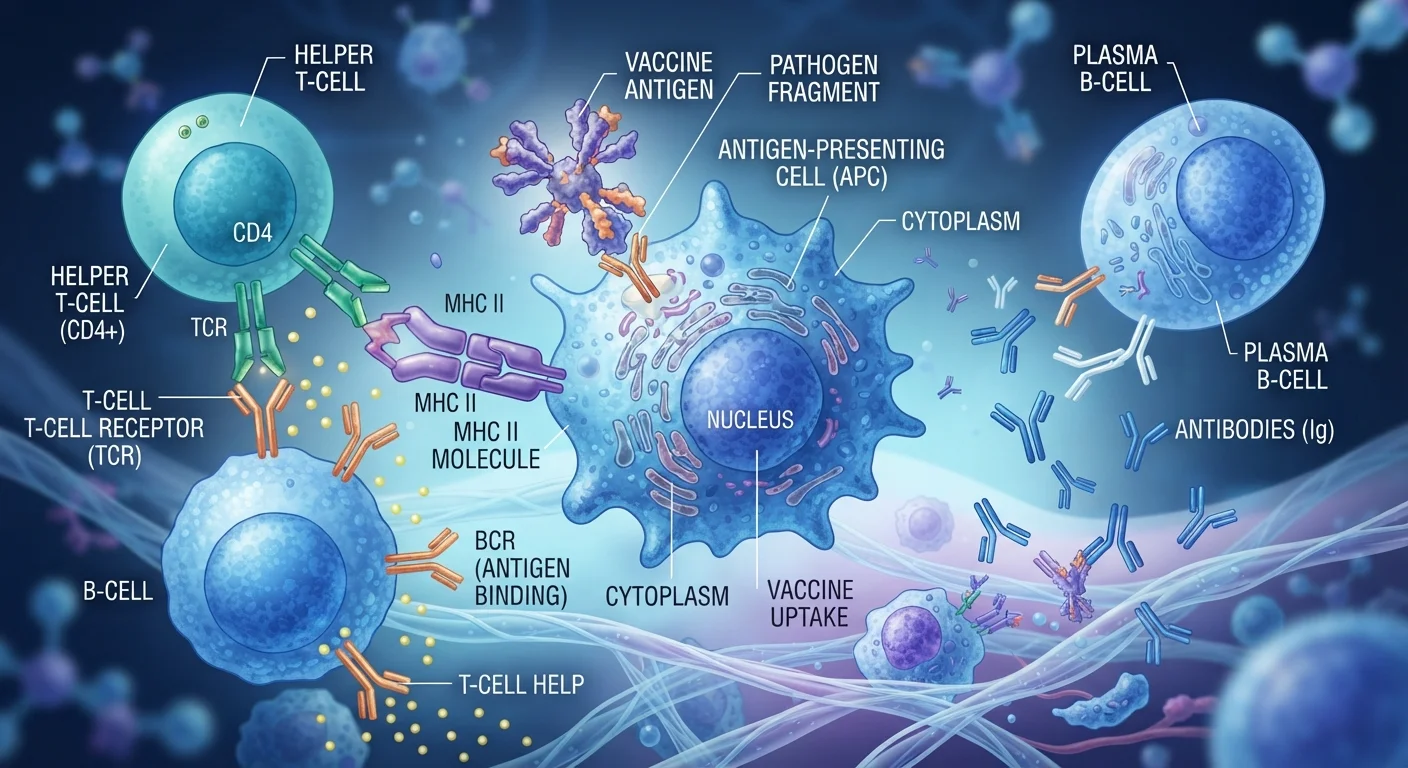
When a vaccine is administered, it delivers a carefully designed signal to your immune system — one that resembles a pathogen without posing any real infectious threat. Depending on the vaccine type, this signal might be an inactivated virus, a purified protein from the pathogen's surface, a live but weakened microorganism, or, in the case of mRNA vaccines, instructions telling your own cells to briefly produce a recognizable protein fragment.
Your immune system cannot distinguish this signal from a genuine early-stage infection. It responds accordingly, activating both arms of adaptive immunity. For a fuller explanation of how this detection process begins, see how your immune system recognizes and fights infection.
Within days, specialized white blood cells called B-cells begin producing antibodies — proteins that bind specifically to the pathogen's identifiable features, known as antigens. Simultaneously, T-cells are activated: helper T-cells coordinate the response, while cytotoxic T-cells learn to destroy cells that display the antigen. Once the signal fades, most of these activated cells die off — but a critical subset survives as long-lived memory cells.
2–3 weeks
Typical window for full antibody response after vaccination
According to the U.S. Centers for Disease Control and Prevention (CDC), it generally takes this long for the body to build maximum protection after vaccination.
95%
Efficacy of measles vaccine against infection
The CDC reports that two doses of the MMR vaccine are approximately 97% effective at preventing measles; a single dose is around 93%.
70–90%+
Herd immunity threshold for highly contagious diseases
Estimates from the World Health Organization suggest measles requires roughly 95% population immunity; thresholds vary significantly by pathogen.
The Biology of Immune Memory
Memory cells are the cornerstone of vaccine protection. Memory B-cells circulate in the bloodstream and lymph nodes for years — sometimes decades — carrying a precise molecular record of the antigen they were trained against. Memory T-cells do the same, persisting as a surveillance force ready to respond to future exposures.
When the real pathogen appears, these memory cells recognize it almost immediately and trigger a response that is faster, stronger, and more targeted than the initial vaccine response. Antibody levels surge rapidly, and cytotoxic T-cells mobilize to contain infected cells before the virus or bacteria can replicate widely. This accelerated second response is why vaccinated individuals typically experience milder illness or none at all.
The relationship between innate and adaptive immunity matters here too — the innate system buys time during an initial infection while the slower but more precise adaptive response develops. Vaccines effectively pre-load the adaptive system, narrowing that window dramatically.
Timing Matters for Peak Protection
If you're planning travel, a medical procedure, or approaching a flu season, factor in the two-to-three-week window your immune system needs to build full protection after vaccination. Scheduling your vaccine well in advance of a high-risk period ensures memory cells are established before exposure risk increases. Speak with a healthcare provider about optimal timing for your situation.
Why Protection Varies Between Individuals and Vaccine Types
Vaccine effectiveness is not uniform. Age is one of the most significant factors: the immune system becomes less responsive as we age — a phenomenon called immunosenescence — which is why older adults may generate fewer antibodies and why some vaccines are formulated at higher doses for elderly recipients. Immunocompromised individuals, including those on certain medications or undergoing cancer treatment, may mount weaker responses as well. Anyone in these categories should discuss vaccination timing and suitability with a healthcare provider.
The vaccine platform itself also matters. Live-attenuated vaccines — such as the measles, mumps, and rubella (MMR) vaccine — tend to produce particularly robust and durable immunity because they closely mimic natural infection. Subunit and inactivated vaccines are safer for immunocompromised individuals but may require adjuvants (immune-stimulating additives) and additional doses to achieve comparable protection.
Pathogen behavior adds another variable. Rapidly mutating viruses like influenza can partly escape existing immunity, which is why annual reformulation and revaccination is standard practice. For a plain-language overview of how immune terminology relates to these mechanisms, the immune system key terms glossary is a useful reference.
Herd Immunity and the Limits of Vaccine Protection
No vaccine provides absolute protection for every recipient, which makes population-level vaccination strategies essential. When a sufficiently high proportion of a community is immune — whether through vaccination or prior infection — the pathogen cannot spread efficiently. This reduces the overall risk even for individuals who cannot be vaccinated due to age or medical conditions. The exact threshold for this herd immunity effect varies by how contagious the pathogen is.
Understanding what vaccines can and cannot do is also important for dispelling persistent misconceptions. For a broader look at how immune health myths compare with the evidence, see widespread myths about immunity that science has corrected. If you are newer to the topic of infections and immune function generally, our beginner's overview of infections and immunity provides a clear starting point.
This article is for informational purposes only and does not constitute medical advice. Vaccination decisions should be made in consultation with a qualified healthcare provider who can account for your individual health circumstances.