
Activity Trackers vs. Dedicated Heart Rate Monitors: Understanding the Difference

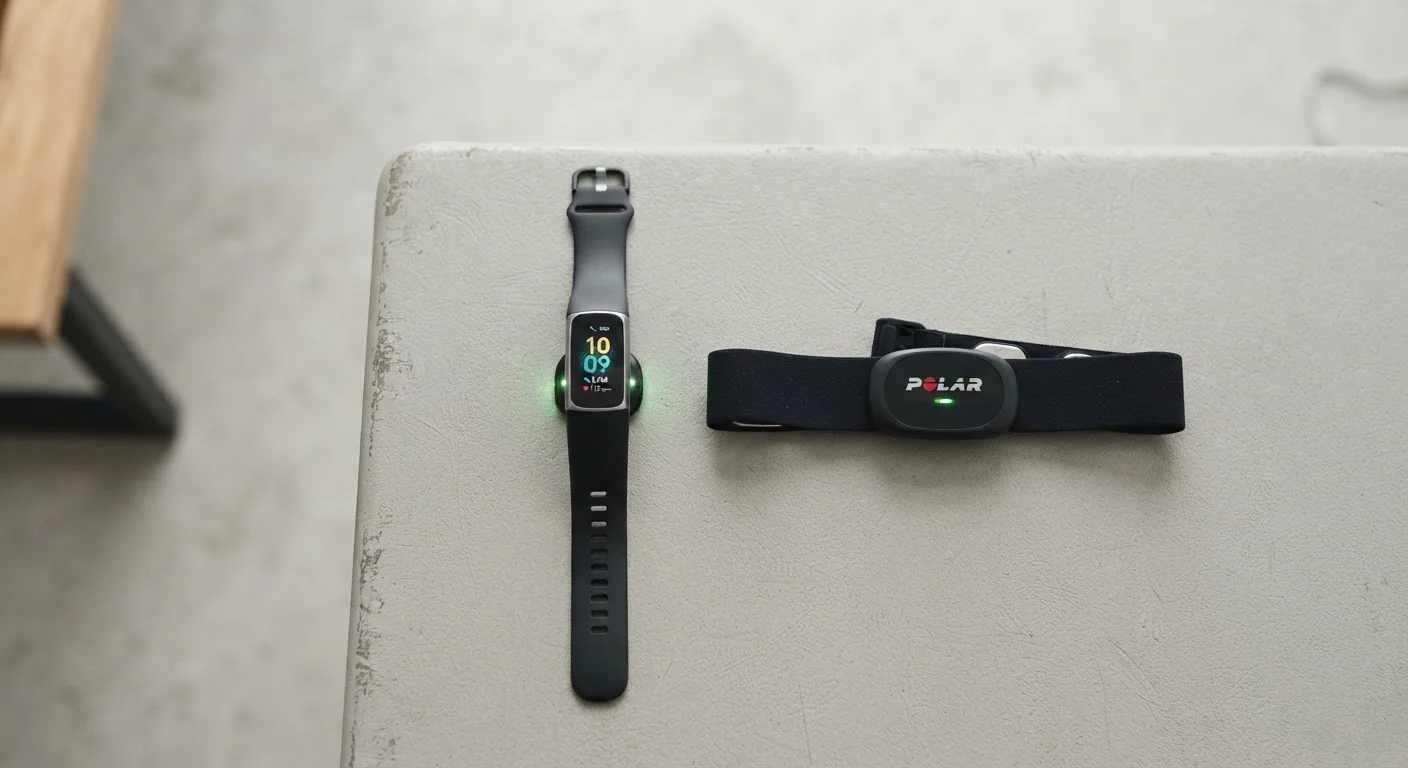
Key Takeaways
- Activity trackers use optical (PPG) sensors on the wrist, which are convenient but less precise during intense exercise.
- Chest-strap heart rate monitors measure electrical signals from the heart, offering clinical-grade accuracy during workouts.
- Activity trackers provide richer lifestyle context — steps, sleep, calories — while chest straps focus almost exclusively on heart rate.
- For casual fitness and general wellness monitoring, an activity tracker is typically sufficient.
- If you train by heart rate zones or have a cardiovascular health concern, a dedicated monitor is worth considering.
- Always consult a healthcare professional before using any device to guide decisions related to a medical condition.
Option A
Activity Tracker (Wristband)
The all-in-one lifestyle monitoring companion.
Best for: People who want a broad snapshot of daily movement, sleep, steps, and general heart rate trends in one wearable device.
Option B
Dedicated Heart Rate Monitor (Chest Strap)
The precision tool for serious cardiovascular training.
Best for: Athletes and exercisers who need highly accurate, real-time heart rate data to guide structured training intensity and zone work.
If you want an everyday health snapshot without much hassle
Activity Tracker (Wristband)
Activity trackers combine step counting, sleep tracking, and heart rate monitoring in one wearable, making them ideal for general lifestyle awareness without extra equipment.
If you follow structured training plans based on heart rate zones
Dedicated Heart Rate Monitor (Chest Strap)
Chest straps provide the electrocardiographic-level accuracy needed to reliably distinguish between training zones, which is essential for periodized endurance or interval programs.
If you're monitoring cardiovascular health under medical guidance
Dedicated Heart Rate Monitor (Chest Strap)
Their superior beat-to-beat accuracy makes them more appropriate when precise cardiac data is clinically relevant — always in coordination with your healthcare provider.
If you want to track activity, nutrition, and sleep as an integrated system
Activity Tracker (Wristband)
Wristband trackers sync with apps that combine multiple health data streams, supporting the kind of holistic monitoring described in integrated tracking guides.
How Each Device Measures Heart Rate
Understanding the technology behind each device explains most of the practical differences between them.
Activity trackers — the wristband-style devices many people wear daily — rely on PPG (photoplethysmography) sensors. These use green LED light shone into the skin to detect blood volume changes with each heartbeat. The sensor then converts those optical signals into a heart rate reading. PPG is remarkably compact and works passively throughout the day, which is why it suits a 24/7 wearable. Its limitation is sensitivity to motion: arm movement during exercise can introduce artifacts that skew readings, particularly during high-intensity intervals or activities with irregular wrist motion like rowing or cycling sprints.
Dedicated heart rate monitors — most commonly chest straps — work very differently. They detect the electrical activity of the heart directly, similar in principle to an ECG. Electrodes in the strap rest against the skin of the chest and capture the heart's actual electrical signals. This method is far less susceptible to motion artifacts and is widely considered the gold standard for accuracy during exercise. Research has consistently shown that chest-strap monitors closely match clinical ECG measurements during vigorous activity, whereas optical wrist sensors can diverge by several beats per minute under the same conditions.
What resting heart rate tells you — and what it doesn't is a useful companion read to understand how either device's resting measurements should be interpreted.
| Criterion | Activity Tracker (Wristband) | Dedicated Heart Rate Monitor (Chest Strap) |
|---|---|---|
| Heart rate sensing method | Optical (PPG) — LED light on wrist | Electrical (ECG-like) — electrodes on chest |
| Accuracy during intense exercise | Moderate — motion artifacts can skew readings | High — minimal susceptibility to motion artifacts |
| Lifestyle metrics (steps, sleep, calories) | Yes — comprehensive daily tracking | No — heart rate focused only |
| Comfort for all-day wear | High — lightweight wristband | Low — chest strap removed after workouts |
| Heart rate zone training suitability | Approximate — adequate for casual training | Precise — reliable for structured zone work |
| App ecosystem integration | Broad — pairs with nutrition, sleep, health apps | Narrower — pairs with sports and training apps |
What Else Each Device Tracks — and What That Means for You
Heart rate is only one dimension of what these devices measure, and the broader feature set often determines which suits your goals.
Activity trackers are designed as comprehensive lifestyle tools. Beyond heart rate, they log step counts, distance, active minutes, estimated calorie burn, sleep stages, and sometimes blood oxygen saturation (SpO2). Some models add stress scores derived from heart rate variability. This breadth makes them genuinely useful for the kind of integrated health monitoring covered in tracking activity, nutrition, and sleep together. You get a longitudinal picture of how your body responds to daily habits over weeks and months.
Dedicated chest-strap monitors do far less outside of heart rate. Most transmit a real-time heart rate signal via Bluetooth or ANT+ to a paired device — a GPS watch, cycling computer, or smartphone app. They typically do not track sleep, steps, or other lifestyle metrics. What they do provide is precise beat-to-beat heart rate data, which enables accurate heart rate zone calculations and supports metrics like heart rate variability when paired with compatible apps.
For a fuller picture of the metric categories modern trackers can measure, see eight types of health metrics wellness trackers can monitor.
A Note on Data Accuracy and Trust
No consumer wearable — wristband or chest strap — is a medical device unless explicitly cleared by regulatory bodies for clinical use. Even the most accurate chest strap should not be used to self-diagnose arrhythmias or other cardiac conditions. If you notice unusual readings or have cardiovascular concerns, speak with a healthcare provider. For guidance on evaluating any device's reliability, see key questions to ask about data accuracy.
This article is for informational purposes only and does not constitute medical advice. Consult a qualified healthcare professional before using any tracking device to inform decisions related to a health condition.