
Calorie Counting vs. Intuitive Eating: Two Very Different Relationships with Food

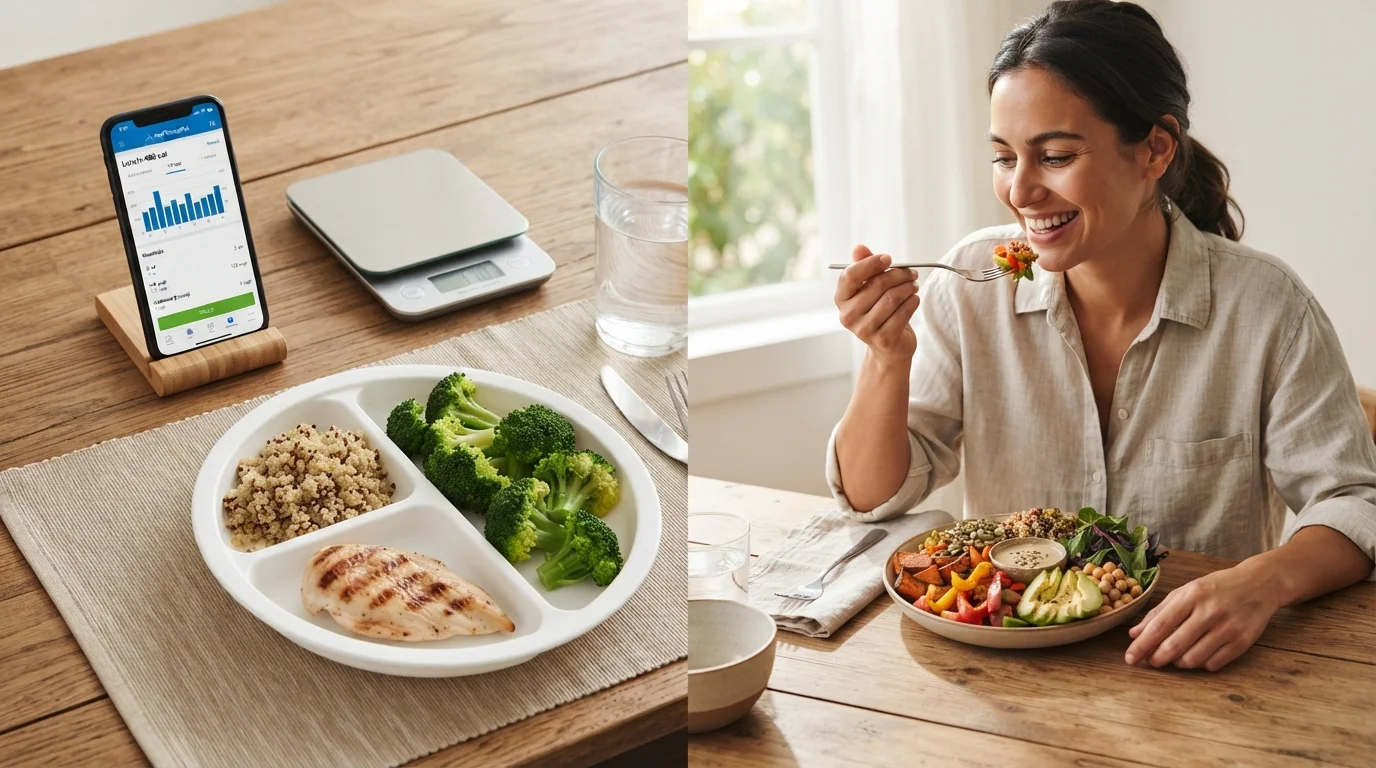
Key Takeaways
- Calorie counting uses external data to manage energy intake; intuitive eating relies on internal hunger and fullness cues.
- Research supports both approaches for different outcomes — neither is universally superior.
- Calorie tracking can provide useful awareness but may increase food-related anxiety in some individuals.
- Intuitive eating is associated with improved psychological wellbeing and reduced disordered eating patterns.
- The best approach depends on an individual's health goals, history with food, and psychological relationship with eating.
- Always consult a registered dietitian or healthcare provider before making significant changes to your eating approach.
Option A
Calorie Counting
The data-driven, structured approach to energy intake.
Best for: People who prefer measurable feedback, structured frameworks, and want explicit awareness of their energy balance.
Option B
Intuitive Eating
The body-signal-led approach to eating without external rules.
Best for: People seeking to rebuild trust with their body, break free from diet-cycle patterns, or reduce food-related stress.
If you thrive with structure and quantitative feedback
Calorie Counting
Having explicit data about energy intake can help people who feel directionless without measurable benchmarks. It works well when paired with flexible, non-punitive tracking habits.
If you have a history of disordered eating or diet-related stress
Intuitive Eating
Intuitive eating's focus on internal cues and unconditional permission to eat has shown promise in reducing food preoccupation and improving psychological wellbeing.
If you want to understand your nutritional patterns without rigidity
Calorie Counting
Short-term tracking can raise awareness of eating habits and nutrient gaps, even if you don't maintain it indefinitely. It functions well as an educational tool rather than a lifelong practice.
If you want to step away from external rules entirely
Intuitive Eating
For individuals exhausted by diet cycles, intuitive eating offers a framework grounded in body autonomy and self-trust, supported by evidence for long-term sustainable eating behavior.
If you are managing a specific clinical nutrition goal
Calorie Counting
For conditions where precise dietary monitoring is clinically indicated, structured tracking under professional supervision provides the accountability and data needed. Always work with a healthcare provider in these cases.
What Each Approach Actually Involves
Calorie counting involves logging the estimated energy content of everything consumed, typically using apps or food databases that assign numeric values to meals. The goal is to maintain awareness — and often control — of energy intake relative to expenditure. If you want to understand the terminology that underpins these tools, the Nutrition Tracking Glossary explains terms like TDEE, macros, and net carbs in plain language.
Intuitive eating, formalized by dietitians Evelyn Tribole and Elyse Resch, is a framework built on ten principles that encourage reconnecting with internal hunger, satiety, and satisfaction signals. It explicitly rejects diet mentality and the moralization of food choices — there are no "good" or "bad" foods within the framework. Rather than external rules, it asks practitioners to develop attunement to their body's physiological cues.
These are not simply different techniques; they represent fundamentally different philosophies about the source of dietary authority — external data versus internal perception.
| Criterion | Calorie Counting | Intuitive Eating |
|---|---|---|
| Primary mechanism | External data and numeric tracking | Internal hunger and satiety cues |
| Learning curve | Quick to start; time-consuming to maintain | Longer to internalize; no ongoing logging |
| Evidence for weight outcomes | Strong short-term evidence | Variable; not primary focus |
| Psychological impact | Neutral to negative for some; context-dependent | Generally positive; reduces food anxiety |
| Flexibility | Can feel rigid; depends on implementation | Highly flexible by design |
| Best evidence base | Energy balance, short-term dietary change | Psychological wellbeing, sustainable habits |
| Tools required | App, food scale, database access | No tools required |
What the Evidence Says
Calorie counting has a solid evidence base for short-term weight management. Studies consistently show that caloric awareness supports energy-balance changes when that is a stated goal. However, research also documents limitations: calorie databases carry measurement error of up to 20%, and self-reported intake is frequently underestimated. For a fuller picture of what food logging can and cannot reveal, see Calorie Logging: What It Can and Cannot Tell You.
Intuitive eating research — though a younger field — shows consistent associations with improved psychological wellbeing, lower rates of disordered eating, and better long-term eating satisfaction. A 2021 systematic review published in Nutrients found intuitive eating positively correlated with body appreciation and inversely associated with eating disorder symptoms. Long-term weight outcomes are more variable and less the primary focus of the framework.
Up to 20%
Potential error in calorie database estimates
Research on food composition databases and self-reported dietary intake consistently identifies measurement inaccuracies that can affect tracking reliability.
10 Principles
Core components of the Intuitive Eating framework
Developed by registered dietitians Evelyn Tribole and Elyse Resch, the framework addresses hunger, satiety, emotion, and body respect in a structured but non-prescriptive way.
Positive correlation
Intuitive eating and body appreciation
A 2021 systematic review in the journal Nutrients found intuitive eating consistently associated with body appreciation and inversely linked to eating disorder symptom severity.
Importantly, calorie tracking can tip from helpful to harmful. If monitoring creates obsessive thinking, guilt, or avoidance behaviors, the practice may be working against overall health. This is explored further in When Fitness Tracking Becomes Counterproductive.
Practical Considerations for Everyday Life
Calorie counting demands consistent effort: logging meals requires time, access to food data, and willingness to engage with numbers daily. It can be particularly useful as a temporary educational tool — helping people understand portion sizes, energy density, and macronutrient patterns — without necessarily becoming a permanent habit. Concepts like nutrient density vs. calorie density become more meaningful once you have baseline familiarity with how food is quantified.
Intuitive eating, by contrast, has a longer learning curve for those who have spent years following external dietary rules. Rebuilding sensitivity to hunger and fullness cues takes deliberate practice, and many find working with a registered dietitian trained in the approach accelerates the process. It is not a passive "eat whatever you want" license — it involves active, mindful engagement with food choices.
For those interested in a middle path — structuring meals around nutritional balance without numerical tracking — Building a Plate That Works offers practical, visual methods for meal composition.
This article is for general informational and educational purposes only and does not constitute medical or nutritional advice. Consult a registered dietitian or qualified healthcare professional before making significant changes to your eating approach, especially if you have an existing health condition or a history of disordered eating.