

Key Takeaways
- Calorie logging creates awareness of portion sizes and eating patterns that most people underestimate.
- Food databases in apps often contain errors, making logged totals approximate rather than exact.
- Calorie counts cannot capture food quality, nutrient density, or how your body actually absorbs nutrients.
- For some individuals, strict logging may contribute to stress or disordered eating patterns.
- Used as a short-term awareness tool rather than a permanent ledger, logging tends to be most beneficial.
Raises awareness of actual portion sizes
Many people significantly underestimate how much they eat. The act of logging — even approximately — tends to surface portion sizes that are larger than assumed, which can prompt meaningful behavioral reflection.
Reveals hidden calorie sources
Calorie-dense beverages, condiments, and snacks often go unnoticed in a person's mental model of their diet. Logging makes these contributions visible in a way that general recollection rarely does.
Tracks macronutrient distribution over time
Beyond total calories, most apps break down protein, carbohydrate, and fat intake. This helps identify whether dietary composition aligns with a person's health goals, such as meeting protein targets to support muscle maintenance.
Provides a structured starting point for behavior change
Short-term logging gives people concrete data to review and discuss with a dietitian or healthcare provider, replacing vague impressions with a documented pattern of intake.
Supports accountability without requiring external oversight
Having a personal log can reinforce consistency and deliberate food choices, functioning as a self-directed accountability mechanism that some people find more effective than subjective memory alone.
Food databases contain frequent errors
Many database entries are user-submitted and unverified. Even entries for branded or restaurant foods can differ substantially from laboratory-measured values, making calorie totals less reliable than the precise figures suggest.
Portion estimation is inherently imprecise
Without weighing food on a scale, most people misjudge serving sizes. Visual estimation of common foods has been shown to introduce consistent underestimation errors that compound across a day.
Calorie absorption varies by individual and food preparation
Cooking breaks down cell walls and increases caloric availability; raw foods generally yield fewer absorbed calories. Individual gut microbiome differences further mean that two people eating identical meals may extract different amounts of energy.
Nutrient quality is invisible in a calorie count
A 300-calorie meal of processed snack food and a 300-calorie meal of salmon and vegetables carry the same logged number but differ dramatically in micronutrient content, fiber, and satiety. Calorie logs cannot capture this distinction.
Can contribute to stress or unhealthy food relationships
For individuals with a history of disordered eating, or those prone to anxiety around food, rigid logging may reinforce harmful behaviors. Clinicians often advise caution with calorie tracking for these populations.
Logging fatigue leads to incomplete data
Research on self-monitoring consistently shows that logging frequency declines sharply within weeks. Incomplete logs produce misleading trends, particularly when the meals most likely to be skipped are also the most calorie-dense.
Our Verdict
Calorie logging is a genuinely useful tool for building dietary awareness and identifying hidden patterns in what you eat. Its outputs, however, are estimates — shaped by database inaccuracies, user error, and the biological complexity of digestion. Treating logged numbers as rough guides rather than precise measurements leads to better outcomes than pursuing perfect totals.
People who want a structured starting point for understanding their diet and are comfortable using data as a learning tool rather than a strict rule system.
What Calorie Logging Actually Measures
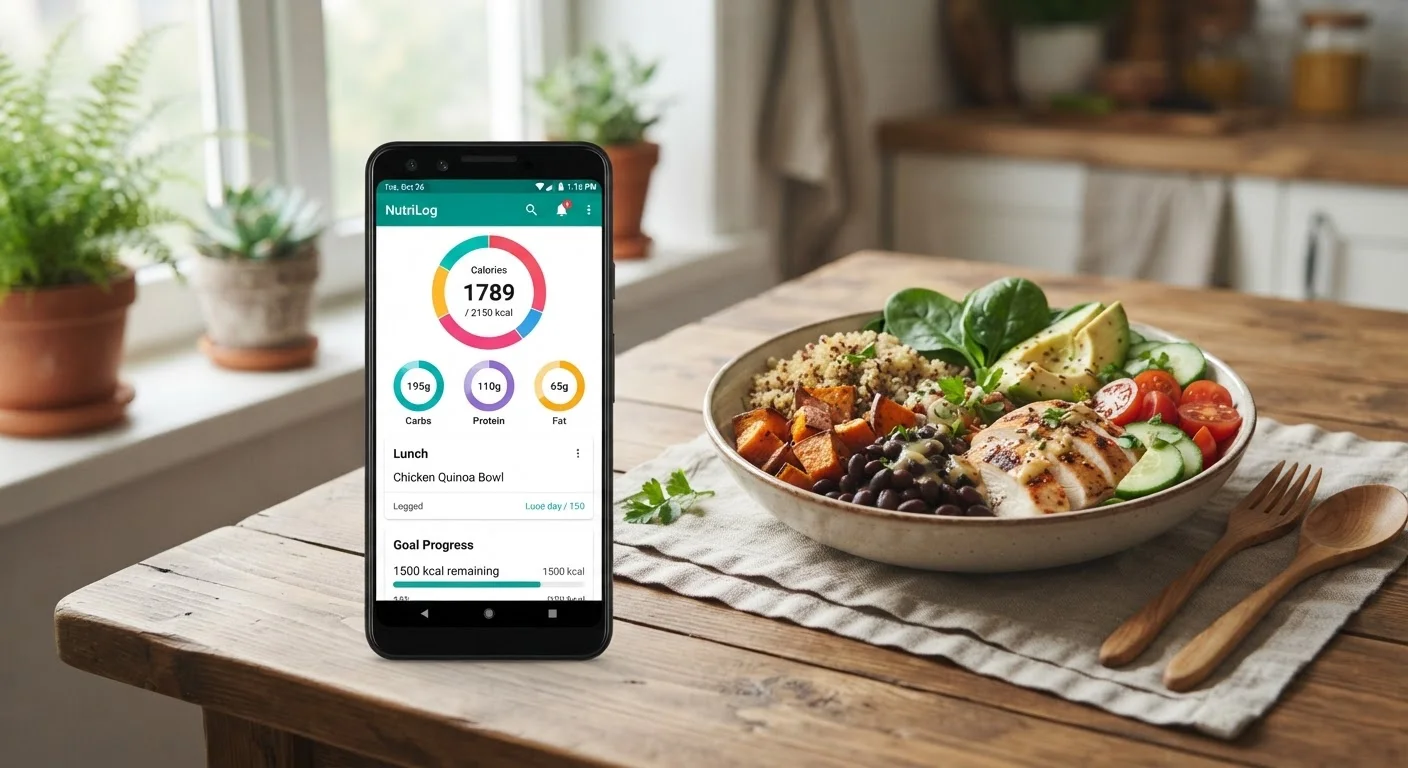
Calorie logging apps work by letting you search a food database, select what you ate, and record a portion size. The app retrieves calorie and macronutrient values — protein, carbohydrates, and fat — and adds them to a running daily total. Over time, this creates a log you can review to spot trends.
What the number represents is the estimated energy content of food, measured in kilocalories (kcal) and displayed simply as "calories." This figure comes from the Atwater system, a standard method that assigns fixed energy values per gram of each macronutrient: 4 kcal per gram of protein and carbohydrate, and 9 kcal per gram of fat. Most databases use this framework as their foundation.
For an overview of the terminology you'll encounter while logging — including macros, net carbs, and TDEE — see the Nutrition Tracking Glossary for plain-language definitions.
Raises awareness of actual portion sizes
Many people significantly underestimate how much they eat. The act of logging — even approximately — tends to surface portion sizes that are larger than assumed, which can prompt meaningful behavioral reflection.
Reveals hidden calorie sources
Calorie-dense beverages, condiments, and snacks often go unnoticed in a person's mental model of their diet. Logging makes these contributions visible in a way that general recollection rarely does.
Tracks macronutrient distribution over time
Beyond total calories, most apps break down protein, carbohydrate, and fat intake. This helps identify whether dietary composition aligns with a person's health goals, such as meeting protein targets to support muscle maintenance.
Provides a structured starting point for behavior change
Short-term logging gives people concrete data to review and discuss with a dietitian or healthcare provider, replacing vague impressions with a documented pattern of intake.
Supports accountability without requiring external oversight
Having a personal log can reinforce consistency and deliberate food choices, functioning as a self-directed accountability mechanism that some people find more effective than subjective memory alone.
Where the Data Falls Short
The limitations of calorie logging are significant and worth understanding before relying heavily on the numbers.
Database accuracy varies widely. User-submitted entries — which make up a substantial share of many food databases — frequently contain errors in serving size, portion weight, or nutrient values. Research has found meaningful inaccuracies even in professionally maintained databases for restaurant and packaged foods.
Portion estimation is imprecise. Selecting "1 medium apple" or "1 cup of pasta" rarely reflects what's actually on your plate. Studies consistently show that people, including trained dietitians, underestimate portions visually. Without a food scale, logged quantities are educated guesses.
Your body's absorption differs from the label. How many calories you actually extract from food depends on cooking method, gut microbiome composition, food structure, and individual metabolic differences. A raw almond and a roasted almond carry the same label calories but may not yield identical energy in the body.
Food databases contain frequent errors
Many database entries are user-submitted and unverified. Even entries for branded or restaurant foods can differ substantially from laboratory-measured values, making calorie totals less reliable than the precise figures suggest.
Portion estimation is inherently imprecise
Without weighing food on a scale, most people misjudge serving sizes. Visual estimation of common foods has been shown to introduce consistent underestimation errors that compound across a day.
Calorie absorption varies by individual and food preparation
Cooking breaks down cell walls and increases caloric availability; raw foods generally yield fewer absorbed calories. Individual gut microbiome differences further mean that two people eating identical meals may extract different amounts of energy.
Nutrient quality is invisible in a calorie count
A 300-calorie meal of processed snack food and a 300-calorie meal of salmon and vegetables carry the same logged number but differ dramatically in micronutrient content, fiber, and satiety. Calorie logs cannot capture this distinction.
Can contribute to stress or unhealthy food relationships
For individuals with a history of disordered eating, or those prone to anxiety around food, rigid logging may reinforce harmful behaviors. Clinicians often advise caution with calorie tracking for these populations.
Logging fatigue leads to incomplete data
Research on self-monitoring consistently shows that logging frequency declines sharply within weeks. Incomplete logs produce misleading trends, particularly when the meals most likely to be skipped are also the most calorie-dense.
For a broader discussion of how logging compares to listening to hunger cues, see Calorie Counting vs. Intuitive Eating.
Using Logging as a Practical Tool, Not a Perfect Record
The most productive use of calorie logging is as a pattern-recognition tool rather than an accounting system. A few weeks of consistent logging — even imperfect logging — can reveal habits that are genuinely hard to see otherwise: frequent high-calorie beverages, large portion drift at dinner, or protein intake that's lower than assumed.
~53%
Calorie underreporting rate in self-reported diaries
Studies published in nutrition journals have found that individuals underreport dietary intake by roughly half compared to objective doubly-labeled water measurements.
Up to 20%
Error margin in food label calorie values
FDA regulations in the US permit up to a 20% variance between the stated and actual calorie content on packaged food nutrition labels.
~2 weeks
Median time before logging frequency drops significantly
Behavioral research on digital food diary use suggests most users experience meaningful declines in logging consistency within the first two weeks of starting.
Consistency matters more than precision. Logging the same way each day, even with systematic errors, still shows relative changes and trends. If your logged intake rises by 300 kcal per day over two weeks, that directional signal is useful regardless of whether the absolute number is exact.
To build a more accurate log from the start, Setting Up a Food Diary That Actually Reflects What You Eat covers practical steps for improving entry quality and reducing the most common sources of drift.
When to Involve a Professional
Calorie logging tools are designed for general self-monitoring and are not substitutes for personalized nutritional guidance. If you have a chronic health condition, are pregnant, are trying to manage significant weight change, or notice distress around food tracking, a registered dietitian can help you set appropriate, individualized targets. Apps cannot account for your full medical history or metabolic context.
Calorie data is also just one dimension of dietary health. Tools like the Health Calculators hub can help you contextualize energy needs alongside other metrics. And like other forms of self-tracking — from sleep monitoring to resting heart rate — the value lies in sustained trends, not single data points.
This article is for general informational purposes only and does not constitute medical or nutritional advice. If you have concerns about your diet, weight, or relationship with food, please consult a qualified healthcare professional or registered dietitian.