

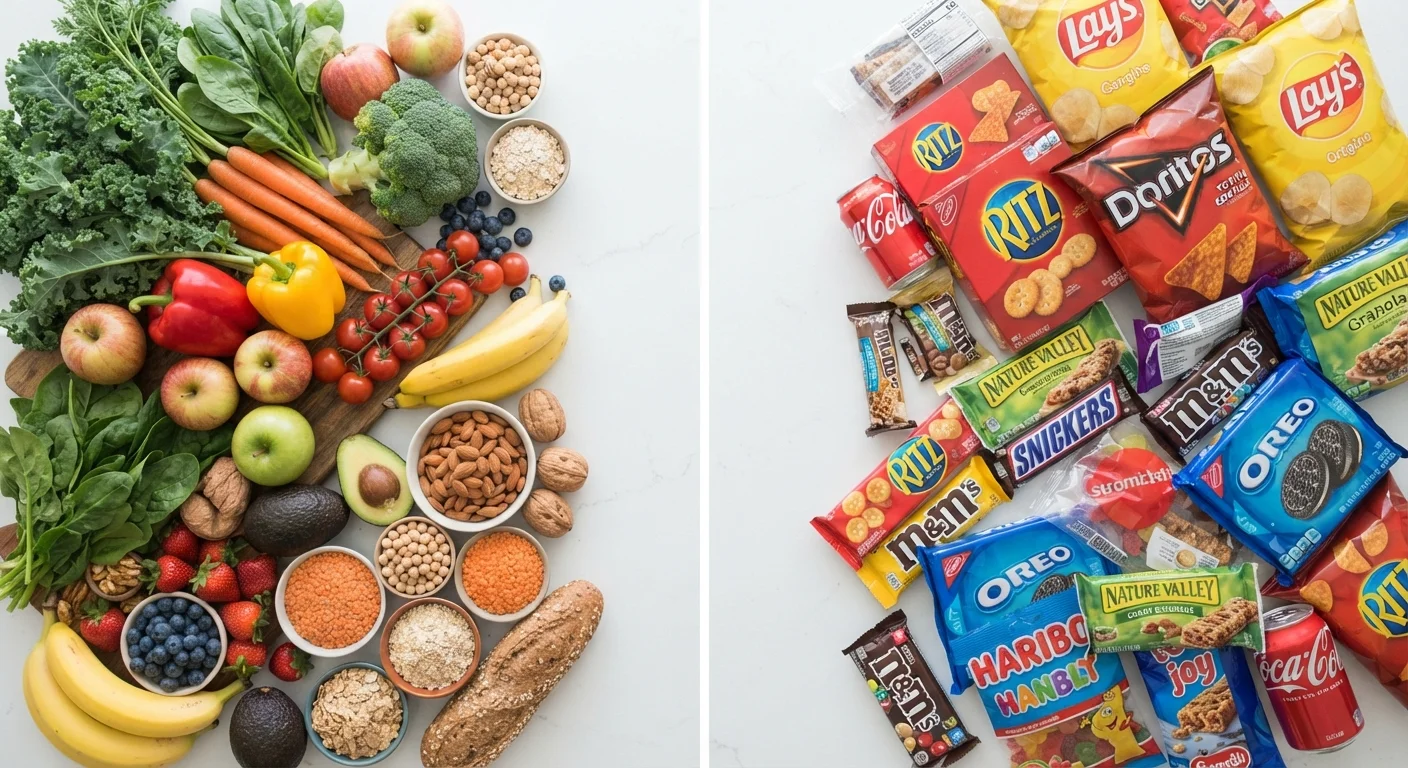
Key Takeaways
- Whole foods retain their natural matrix of fiber, micronutrients, and phytocompounds largely intact.
- Ultra-processed foods typically contain additives, refined ingredients, and fewer beneficial nutrients per calorie.
- Research consistently links higher ultra-processed food intake with poorer diet quality and chronic disease risk.
- Practical shifts toward whole foods don't require perfection — even partial substitutions meaningfully improve diet quality.
- Reading ingredient lists is one of the clearest tools for distinguishing minimally processed from ultra-processed options.
Option A
Whole Foods
The minimally altered, nutrient-dense foundation of eating.
Best for: Anyone seeking maximum nutrient retention, better satiety, and long-term dietary quality with minimal additives.
Option B
Ultra-Processed Foods
The industrially formulated, convenience-driven modern staple.
Best for: Situations requiring long shelf life and rapid preparation, though nutritional trade-offs are significant.
If your priority is maximizing nutrient density per calorie
Whole Foods
Whole foods deliver fiber, vitamins, minerals, and phytonutrients in naturally occurring ratios that support absorption and metabolic function.
If you need shelf-stable, grab-and-go options for busy schedules
Ultra-Processed Foods
Ultra-processed foods offer unmatched convenience, but choosing options with shorter ingredient lists and less added sugar or sodium can reduce trade-offs.
If you are managing chronic conditions such as type 2 diabetes or cardiovascular disease
Whole Foods
Diets emphasizing whole foods are associated with improved glycemic control and cardiovascular markers; consult a registered dietitian for personalized guidance.
If you are building sustainable long-term eating habits
Whole Foods
The fiber and water content of whole foods supports satiety and appetite regulation, making sustainable portion awareness more achievable over time.
Defining the Two Categories
The term whole foods refers to items consumed in their natural or near-natural state — think fresh vegetables, fruit, legumes, whole eggs, unprocessed meat, and nuts. Minimal processing such as washing, cutting, or cooking is generally considered compatible with the whole-food designation. What these foods share is that their original cellular structure, fiber matrix, and nutrient profile remain largely intact.
Ultra-processed foods are defined differently. The widely cited NOVA classification system, developed by nutrition researchers at the University of São Paulo, categorizes ultra-processed foods as industrial formulations made predominantly from extracted or refined food substances — such as refined starches, hydrogenated fats, and added sugars — combined with additives like emulsifiers, artificial flavors, and color stabilizers that have no culinary equivalent in a home kitchen. Common examples include packaged savory snacks, ready-to-eat frozen meals, sweetened breakfast cereals, and many flavored dairy drinks.
Importantly, not all processing is equal. Minimally processed foods (like pasteurized milk or frozen vegetables) and processed culinary ingredients (like olive oil) occupy a middle ground. The nutritional concern is specifically with ultra-processing, where the original food matrix is largely dismantled and reconstituted. For a closer look at one critical area where processing alters nutrition, see our article on what changes when grains are processed.
The Nutritional Gap: What Processing Actually Does
Processing affects nutrition at several levels. First, fiber is frequently stripped out during refining. Dietary fiber supports gut microbiome diversity, slows glucose absorption, and contributes to satiety — functions that become diminished when fiber is removed or not replaced. Second, micronutrient loss is common: milling, heat treatment, and extraction reduce concentrations of vitamins B1, B3, folate, magnesium, and potassium, among others. Fortification — adding select vitamins back — partially compensates but rarely restores the full original profile.
Third, the food matrix itself matters. Emerging nutritional science suggests that whole foods are more than the sum of their nutrients; the physical structure of the food influences how quickly it is digested and how nutrients are absorbed. An apple, for example, delivers fiber, water, and natural sugars packaged in a cell structure that slows digestion. Apple juice with equivalent sugar provides no comparable structural moderation.
| Criterion | Whole Foods | Ultra-Processed Foods |
|---|---|---|
| Fiber content | Naturally high; structure intact | Often removed or minimal |
| Micronutrient retention | Largely preserved | Often reduced; some fortified back |
| Added sugars | Naturally occurring only | Frequently added in significant amounts |
| Additives & preservatives | None or minimal | Emulsifiers, colorants, flavor agents common |
| Satiety support | High — fiber and water content help | Lower — engineered palatability may override signals |
| Shelf life | Short to moderate | Extended via processing |
| Ingredient list length | One ingredient or very few | Often 15+ ingredients |
Ultra-processed foods are also typically engineered to be hyper-palatable — calibrated combinations of fat, salt, sugar, and texture that can override normal satiety signaling. Research published in peer-reviewed journals, including a controlled trial by Hall et al. (2019) at the NIH, found that participants consuming ultra-processed diets ate significantly more calories and gained weight compared to a matched whole-food diet, even when both diets were made available ad libitum with equivalent macronutrient profiles.
Understanding how to evaluate these differences on packaging is a practical skill — our guide on reading a nutrition label without confusion explains ingredient lists and daily value percentages step by step.
Building a Practical, Sustainable Shift
Shifting dietary patterns toward whole foods doesn't require eliminating all convenience foods overnight. Research on dietary behavior change consistently shows that gradual, achievable substitutions — replacing one ultra-processed item per day, prioritizing whole-food protein sources at one meal, or adding a serving of vegetables to a convenient meal — accumulate meaningful benefits over time without triggering the resistance that comes from all-or-nothing approaches.
57%
Share of US calories from ultra-processed foods
A study published in BMJ Open (Martínez Steele et al., 2017) estimated that ultra-processed foods account for approximately 57% of total energy intake in the US diet.
500 kcal/day
Extra calories consumed on ultra-processed diet
In a controlled NIH inpatient trial (Hall et al., 2019, Cell Metabolism), participants eating an ultra-processed diet consumed roughly 500 more calories per day than on a whole-food diet.
10%
Increased chronic disease risk per serving increment
A large prospective cohort study (NutriNet-Santé, 2018) found each 10-percentage-point increase in ultra-processed food intake was associated with a roughly 10% higher risk of cardiovascular outcomes.
A useful frame is to focus on displacement rather than deprivation: adding more whole foods naturally crowds out space for ultra-processed options without relying solely on willpower. Legumes, whole grains, and produce-forward meals can be both affordable and practical. For readers interested in how specific dietary patterns apply these principles at scale, our overview of eating patterns linked to wellbeing covers evidence from large population studies.
Those following or considering plant-forward eating can also explore how food-group choices intersect — our article on plant-based, vegan, and vegetarian eating clarifies how these patterns relate to whole-food principles. Similarly, understanding nutrient density versus calorie density provides a complementary lens for evaluating food quality beyond processing level alone.
This article is for general informational and educational purposes only and does not constitute medical or dietary advice. Consult a registered dietitian or qualified healthcare professional for guidance tailored to your individual health needs.