

Key Takeaways
- Sleep tracking apps estimate sleep stages from movement and heart rate, not brain activity.
- Consumer trackers are reasonably accurate for total sleep duration but less reliable for individual sleep stages.
- Trends over multiple nights are more meaningful than any single night's readout.
- Obsessing over sleep scores can itself disrupt sleep — a pattern sometimes called orthosomnia.
- Persistent sleep concerns should be discussed with a healthcare provider, not resolved through app data alone.
Consumer Sleep Tracking
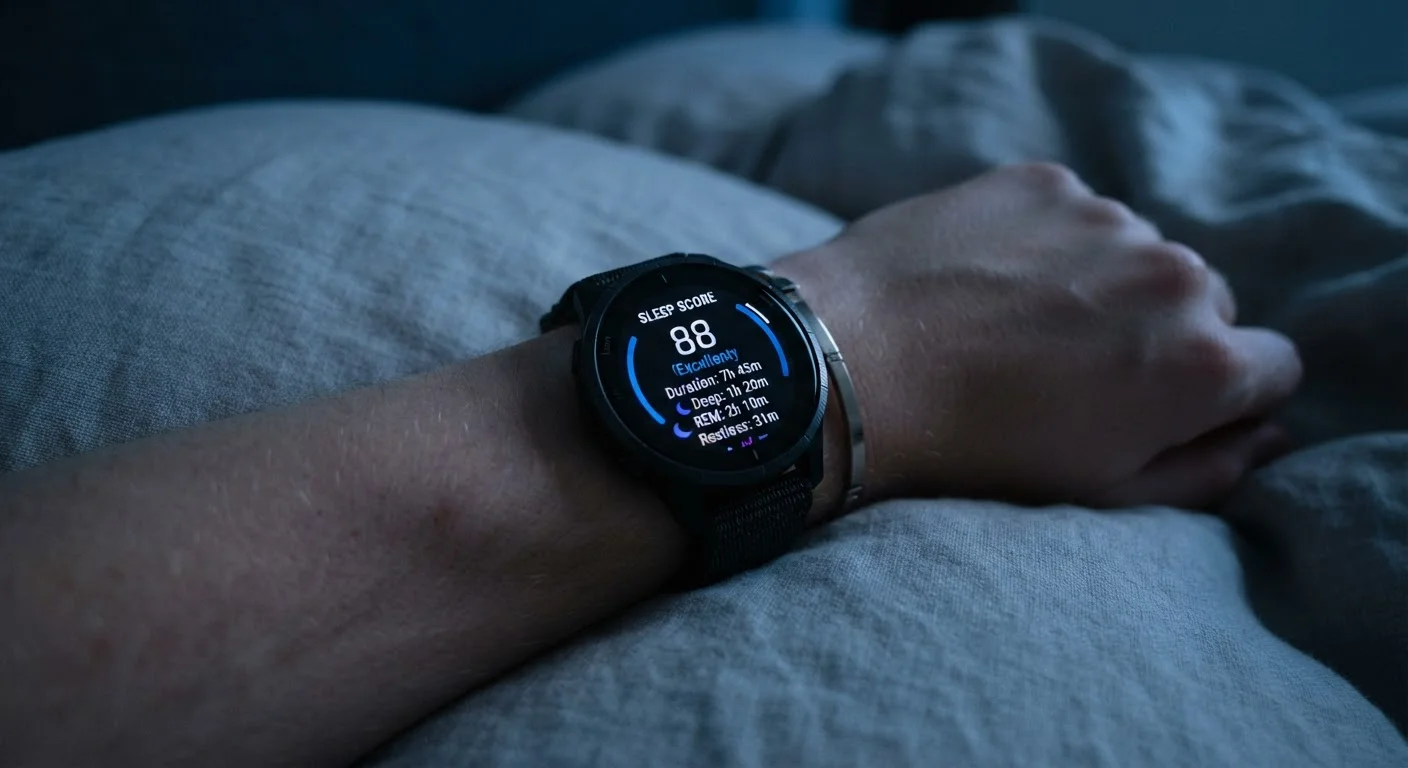
Consumer sleep tracking refers to the use of wearable devices and smartphone apps to estimate how long you sleep, how often you wake, and which sleep stages — such as light, deep, and REM — you cycle through each night. These tools use sensors like accelerometers and optical heart rate monitors to infer sleep patterns from movement and physiological signals. The resulting data is intended to help users identify trends in sleep quality over time.
Consumer trackers rely on actigraphy and photoplethysmography (PPG), which are indirect proxies for sleep architecture — not the direct neural measurements used in clinical polysomnography (PSG).
How Consumer Sleep Trackers Collect Data
Most wearable sleep trackers use two primary sensors: an accelerometer, which detects body movement, and a photoplethysmography (PPG) sensor, which shines light through the skin to measure blood volume changes and estimate heart rate. Some devices also capture heart rate variability (HRV) and blood oxygen saturation (SpO2).
From these signals, algorithms infer when you fall asleep, when you wake, and which sleep stages you pass through. This approach is called actigraphy-based sleep staging. Smartphone-only apps that don't use a wearable rely instead on microphone data or phone accelerometers placed on the mattress — a cruder method that typically yields less reliable stage data.
The clinical gold standard for measuring sleep is polysomnography (PSG), conducted in a sleep lab. PSG records brain waves, eye movements, muscle activity, and breathing simultaneously. Consumer trackers have no access to brain wave data, which is why their stage estimates are inferences, not direct measurements.
See what other health metrics modern trackers monitor for a broader view of sensor capabilities across devices.
What the Data Is — and Isn't — Telling You
Consumer trackers tend to be most reliable for total sleep duration and detecting clear wake episodes. Multiple validation studies have found that wearables generally align well with PSG on total sleep time, typically within 30 minutes. Stage-level accuracy is considerably lower: deep sleep and REM sleep detection are prone to both over- and under-estimation depending on the device and the individual.
~30 min
Typical wearable error in total sleep time vs. PSG
Multiple validation studies comparing consumer wearables to polysomnography report mean absolute differences generally within 30 minutes for total sleep duration.
~50–60%
Typical sensitivity for detecting deep sleep stages
Research reviews suggest consumer trackers frequently misclassify slow-wave (deep) sleep, with sensitivity often below 60% compared to PSG-verified measurements.
78%
US adults who report sleeping fewer than 7 hours on weeknights
Gallup polling has consistently found that a substantial share of American adults fall short of the 7–9 hour range recommended by sleep medicine organizations.
Sleep scores — the single composite number many apps display — are proprietary and not standardized. A score of 82 on one platform is not comparable to an 82 on another. What scores are genuinely useful for is tracking your own relative changes over time: a sustained drop in your typical score alongside daytime fatigue is worth noting.
HRV trends, resting heart rate during sleep, and respiratory rate are additional signals some advanced trackers report. Resting heart rate has real cardiovascular significance, but even these readings carry measurement error that compounds when aggregated into a sleep wellness estimate.
Using Sleep Data Responsibly
The most productive way to use sleep tracking data is to look for patterns over weeks, not to scrutinize individual nights. A single night flagged as poor deep sleep is rarely clinically meaningful. A consistent three-week trend of fragmented sleep correlated with afternoon energy crashes is worth discussing with a provider.
Clinicians have documented a phenomenon called orthosomnia — a preoccupation with achieving a perfect sleep score that paradoxically causes insomnia. If reviewing your nightly data creates anxiety about sleep, that's a signal to recalibrate your relationship with the tool. Learn the patterns that signal tracking may be working against your wellbeing.
Focus on Weekly Averages, Not Nightly Scores
Rather than checking your sleep score each morning, review your seven-day average at the end of each week. This smooths out night-to-night variability caused by sensor error and normal biological fluctuation. Consistent changes in your weekly average are the signal worth paying attention to.
For anyone experiencing persistent difficulty falling asleep, staying asleep, loud snoring, or excessive daytime sleepiness, tracker data is not a substitute for a clinical evaluation. Share any patterns your app has flagged with your healthcare provider as supporting context — not as a diagnosis.
To build a more complete picture, consider how sleep data fits alongside activity and nutrition signals. Tracking activity, nutrition, and sleep together can reveal interactions that no single metric captures on its own. And when you're ready to act on your data, a structured weekly data review helps translate raw numbers into actionable insights.
This article is for informational purposes only and is not a substitute for professional medical advice, diagnosis, or treatment. Always consult a qualified healthcare provider with questions about your sleep health or any medical condition.